
Ready to ace the conversation part of your Spanish oral...
 Spanish1 vizualizări·Actualizat Jun 15, 2026·6 pagini
Exploring Complex Social and Ethical Topics

1 / 6
1
of 6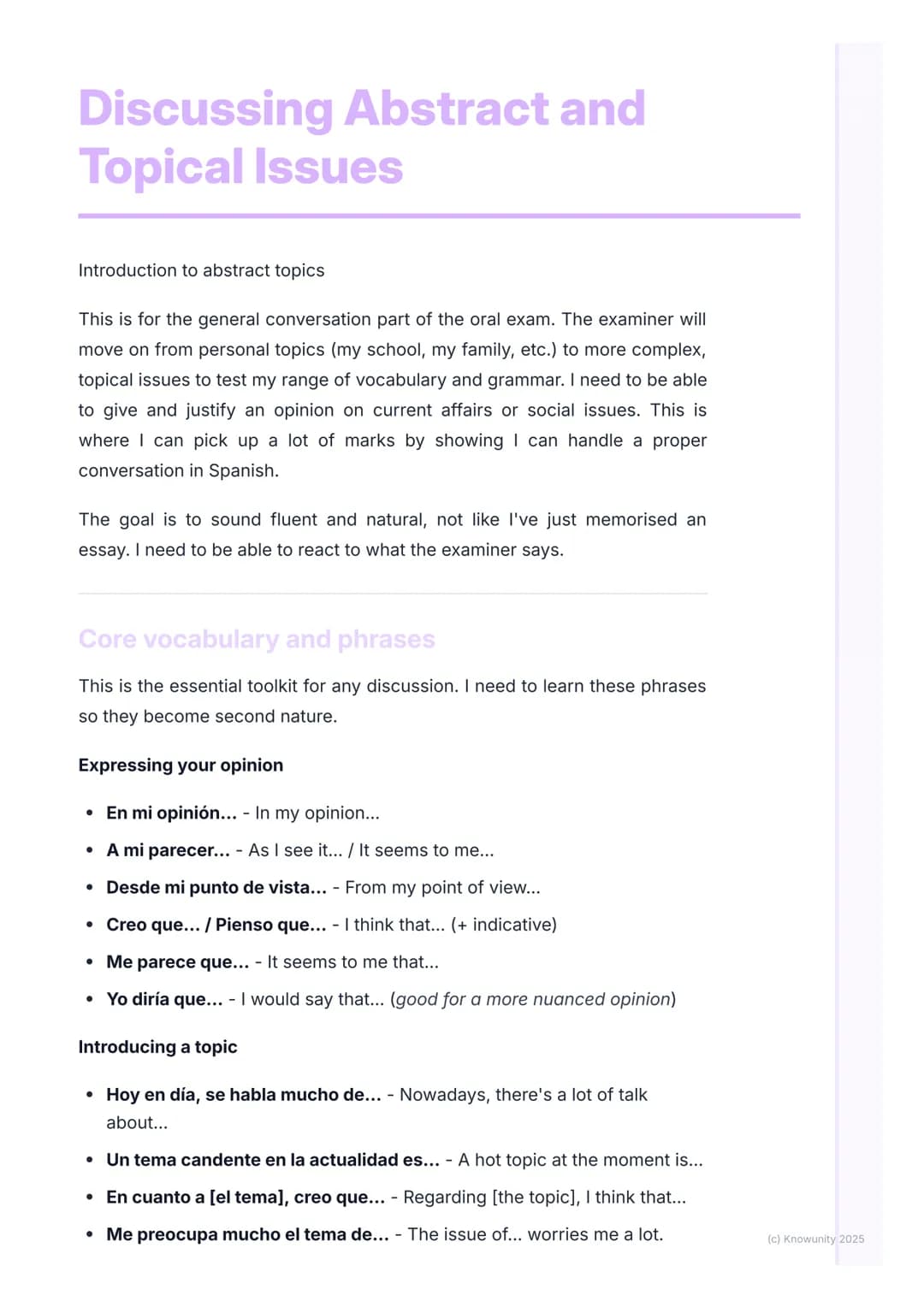
Getting Started with Abstract Topics
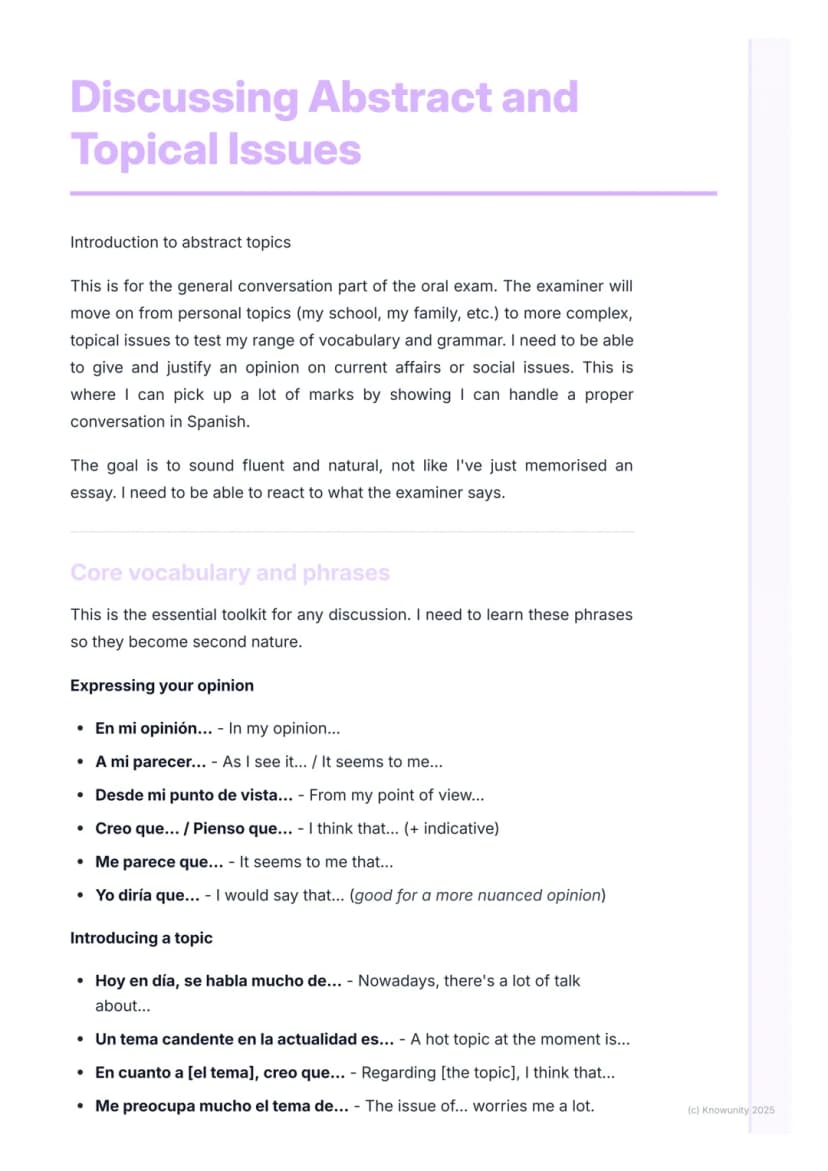
Your examiner wants to see you handle topical issues and current affairs, not just chat about your family or school. This is where you can really shine by showing your range of vocabulary and grammar. The goal isn't to sound like you've memorised an essay - you need to react naturally to what the examiner says.
Think of this as a proper conversation where you're discussing real-world problems. You'll need to give and justify opinions on things like social media, environmental issues, or problems facing Ireland today. This is your chance to pick up serious marks.
Essential opinion phrases include "En mi opinión..." (In my opinion), "Desde mi punto de vista..." (From my point of view), and "Yo diría que..." (I would say that). Learn these until they become second nature - you'll use them constantly.
Top Tip: Master phrases like "Hoy en día, se habla mucho de..." (Nowadays, there's a lot of talk about...) to introduce topics smoothly and sound sophisticated from the start.
2
of 6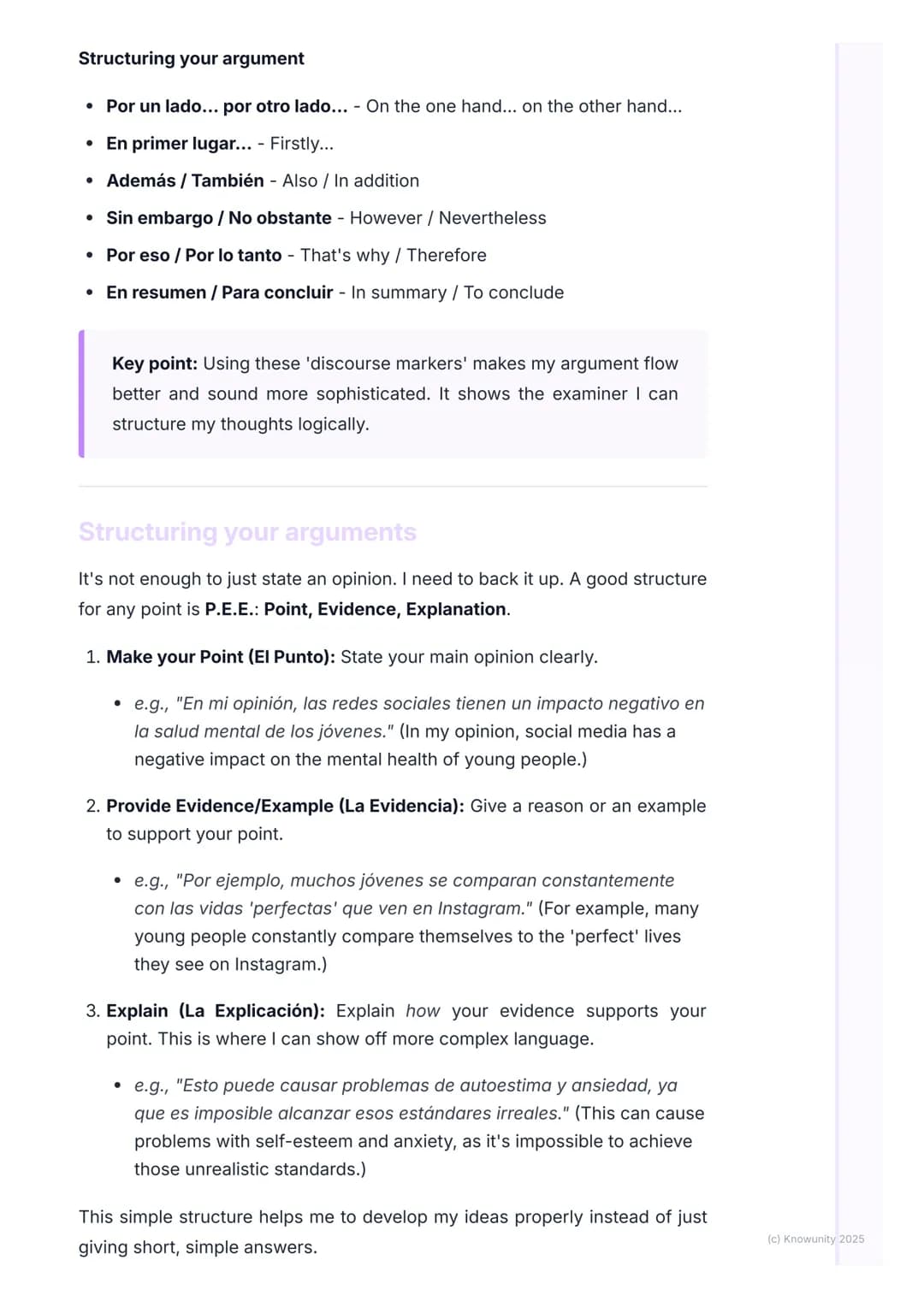
Structuring Your Arguments Like a Pro
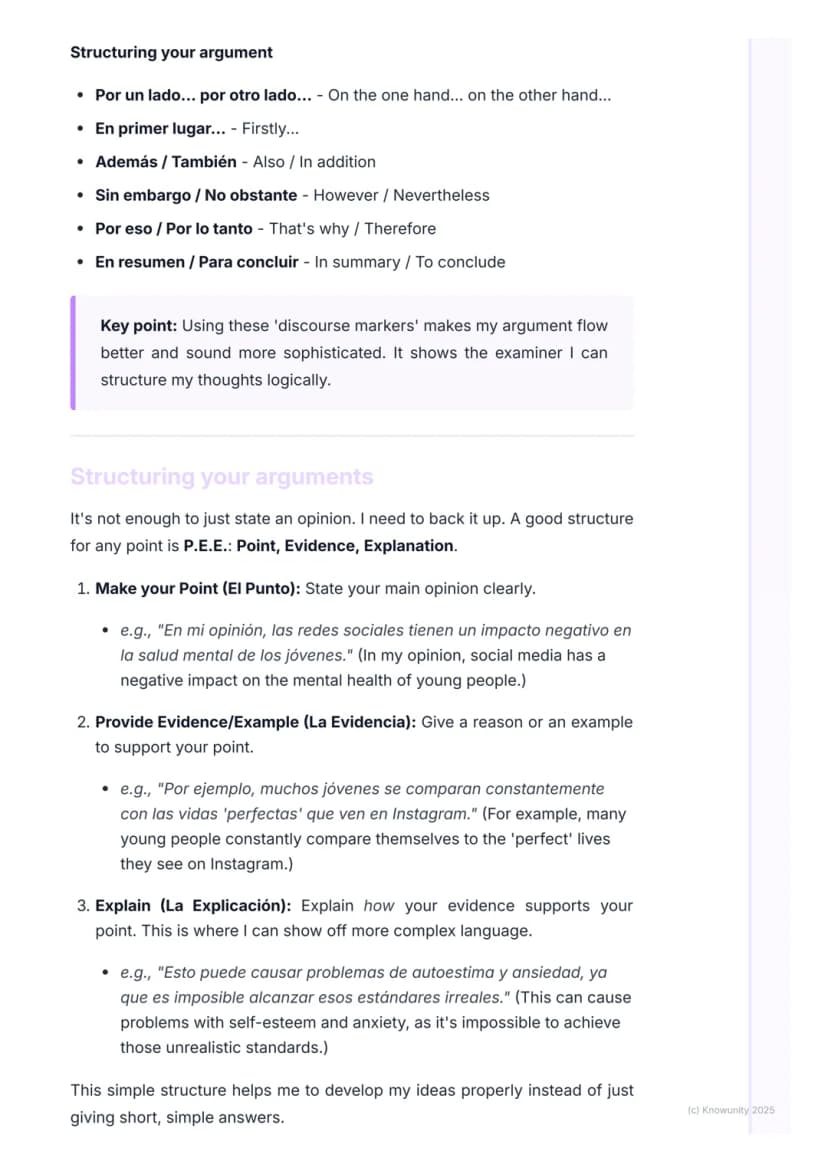
Don't just throw out random opinions - structure them properly using discourse markers. Start with "Por un lado... por otro lado..." (On the one hand... on the other hand) or "En primer lugar..." (Firstly). These phrases make your argument flow beautifully and show the examiner you can think logically.
The P.E.E. structure is your secret weapon: Point, Evidence, Explanation. First, state your opinion clearly. Then give an example or reason to back it up. Finally, explain how your evidence supports your point - this is where you can show off complex language.
For example: "Las redes sociales tienen un impacto negativo" (Point), "muchos jóvenes se comparan con vidas 'perfectas' en Instagram" (Evidence), "esto causa problemas de autoestima porque es imposible alcanzar esos estándares" (Explanation).
Grammar Gold: Use discourse markers like "Sin embargo" (However) and "Por lo tanto" (Therefore) to connect your ideas - it instantly makes you sound more sophisticated and organised.
3
of 6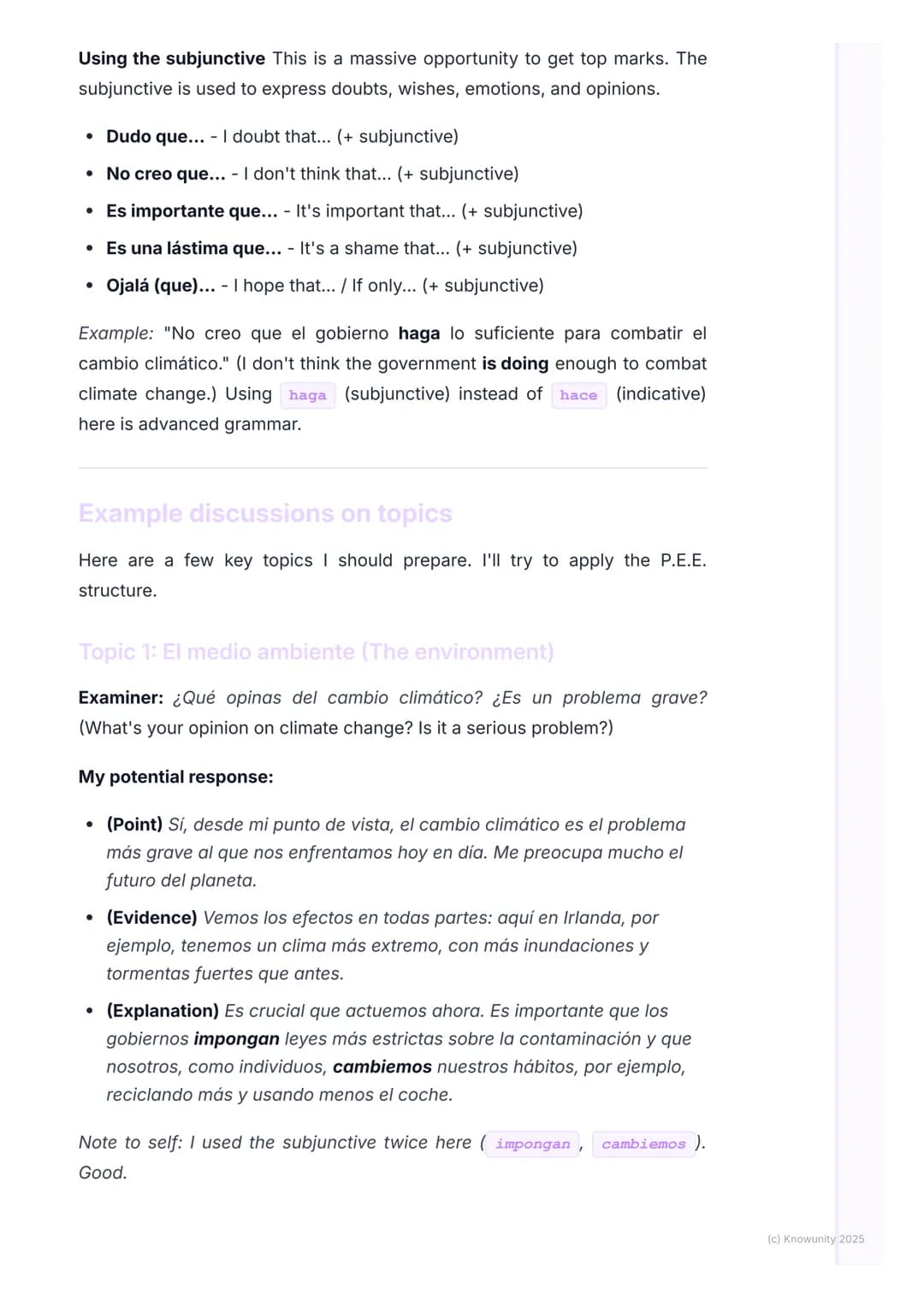
Mastering the Subjunctive for Top Marks
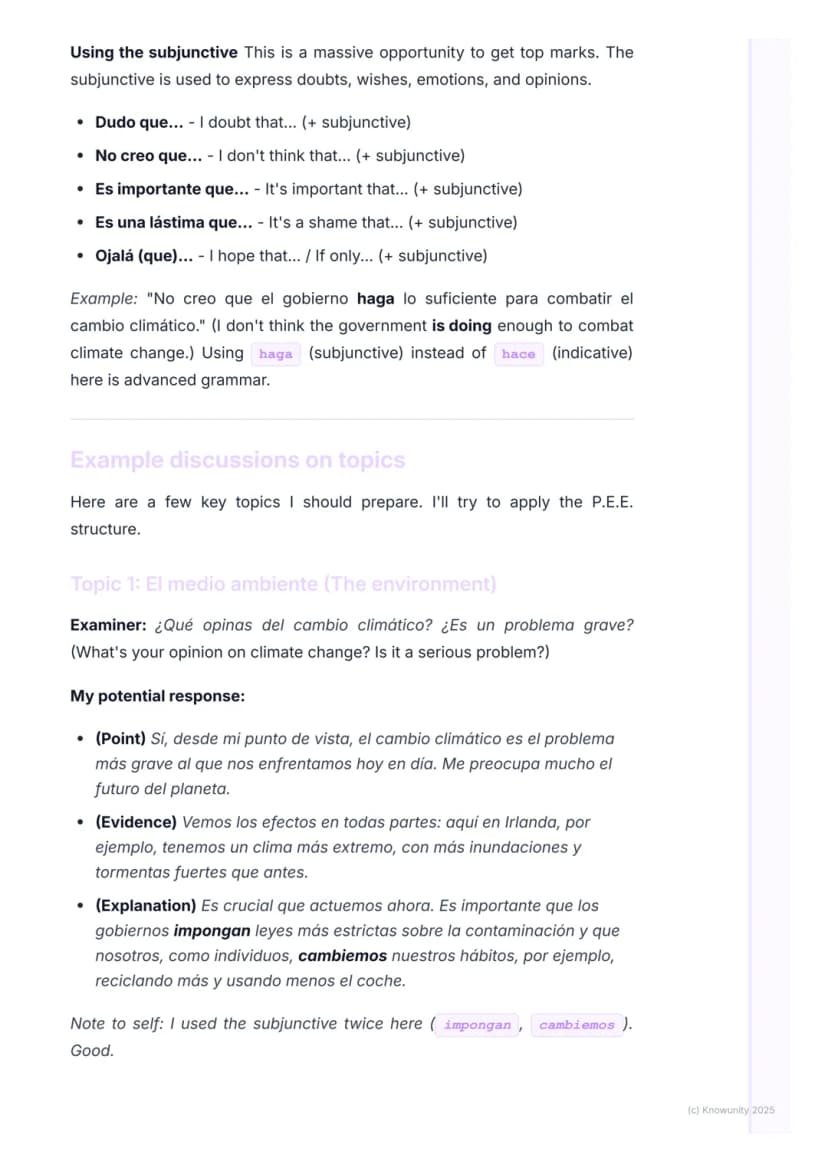
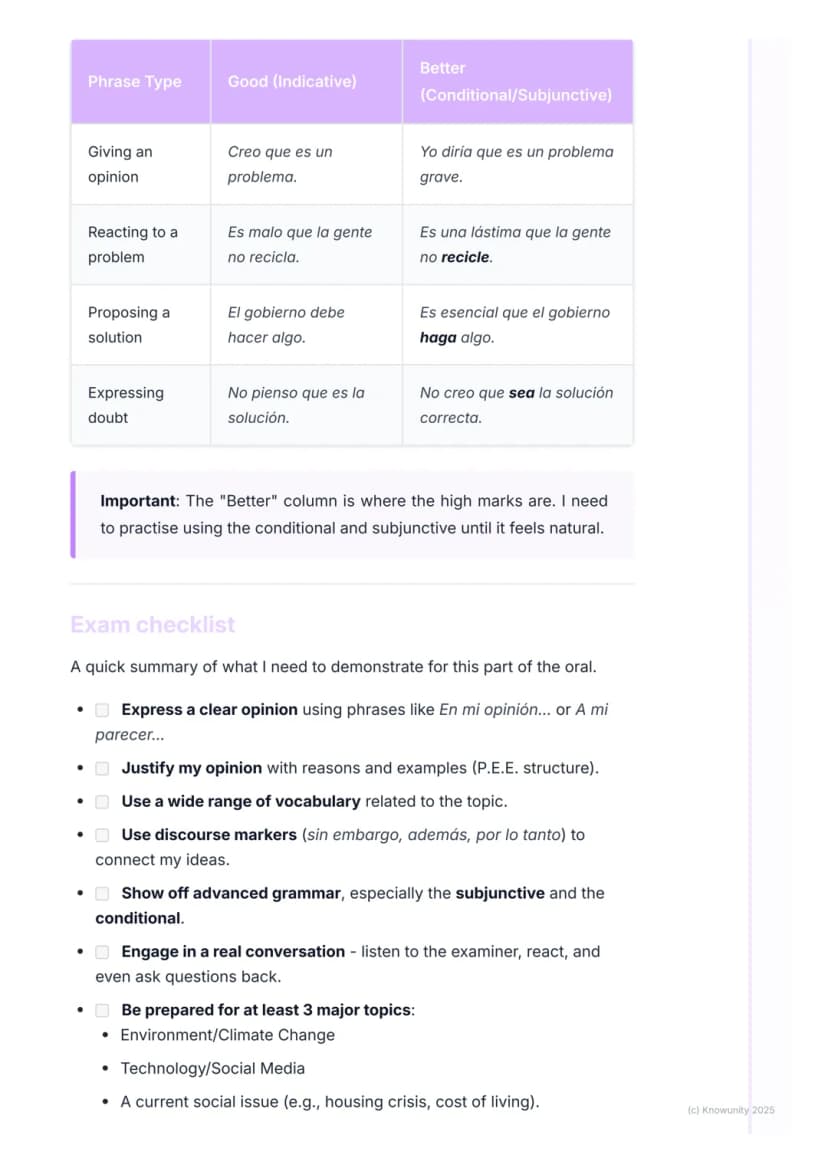
Here's your opportunity to absolutely smash the exam: using the subjunctive properly. This advanced grammar shows you're operating at a high level. Use it after phrases like "No creo que..." (I don't think that), "Es importante que..." (It's important that), and "Es una lástima que..." (It's a shame that).
Let's look at a climate change discussion. When asked about environmental problems, structure your response using P.E.E. Start with your point: "El cambio climático es el problema más grave." Add evidence from Ireland: "Tenemos más inundaciones y tormentas que antes." Then explain with subjunctive: "Es crucial que los gobiernos impongan leyes más estrictas."
Notice how "impongan" (subjunctive) sounds much more advanced than "imponen" (indicative). The examiner will definitely notice this level of grammar.
Subjunctive Success: Remember trigger phrases like "Ojalá que..." (I hope that) and "Dudo que..." automatically need the subjunctive - practise these until they're automatic.
4
of 6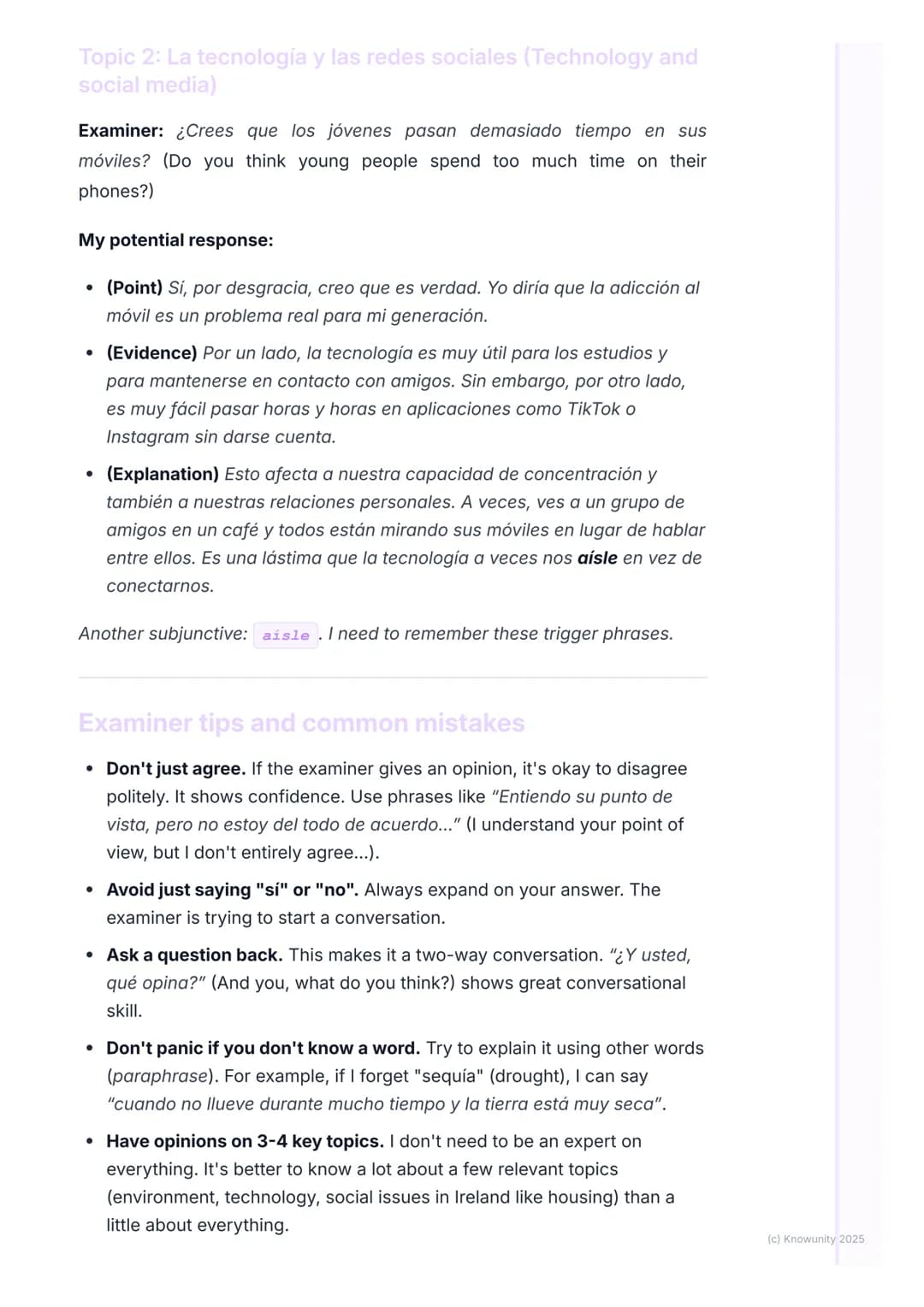
Tackling Technology and Social Media Topics
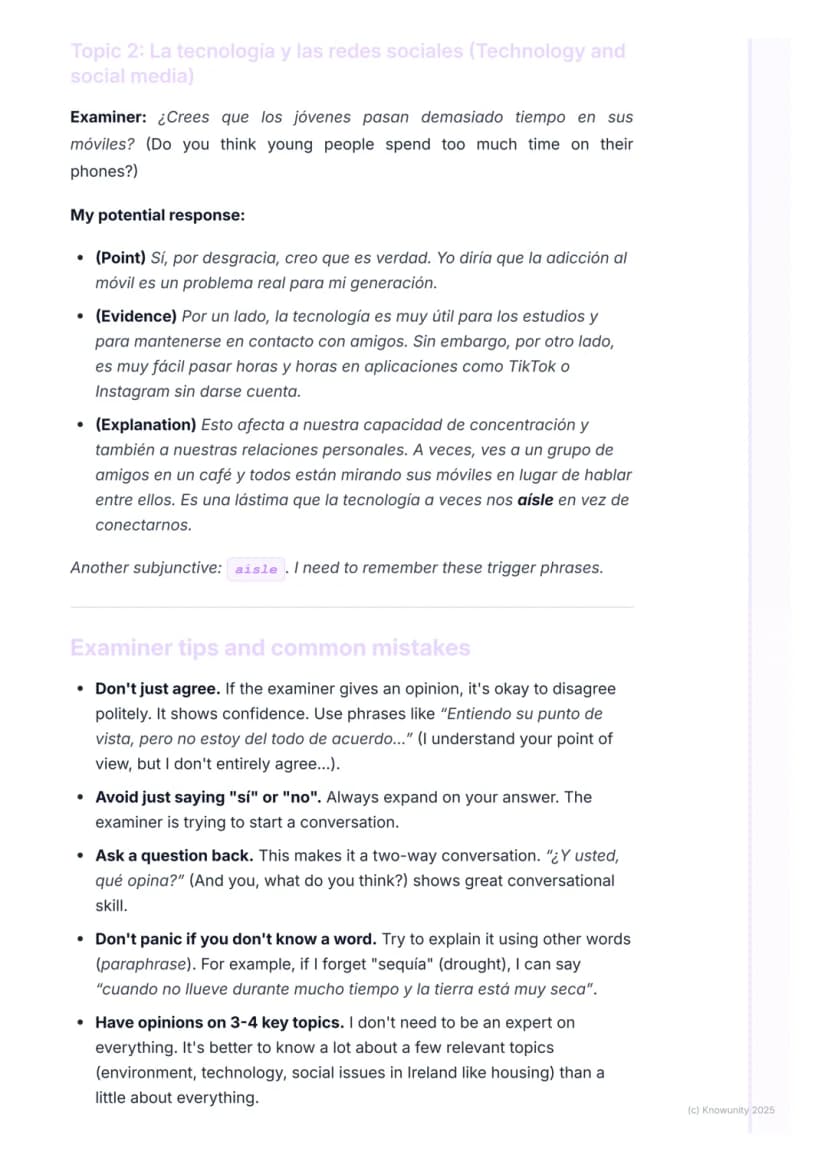
Technology discussions are exam favourites, so be ready. When asked about young people and mobile phones, don't just agree or disagree - show nuance. You might say: "Por un lado, la tecnología es útil para los estudios, sin embargo, es fácil pasar horas en TikTok sin darse cuenta."
Use personal observations to strengthen your arguments. Mention seeing groups of friends in cafés all staring at their phones instead of talking. This shows you can connect abstract issues to real-life situations.
Advanced phrases like "Yo diría que la adicción al móvil es un problema real" (I would say mobile addiction is a real problem) demonstrate sophisticated opinion-giving. The conditional "diría" is much better than simple "digo."
Conversation Hack: Don't just answer questions - ask them back! "¿Y usted, qué opina?" (And you, what do you think?) turns it into a real conversation and shows confident Spanish skills.
5
of 6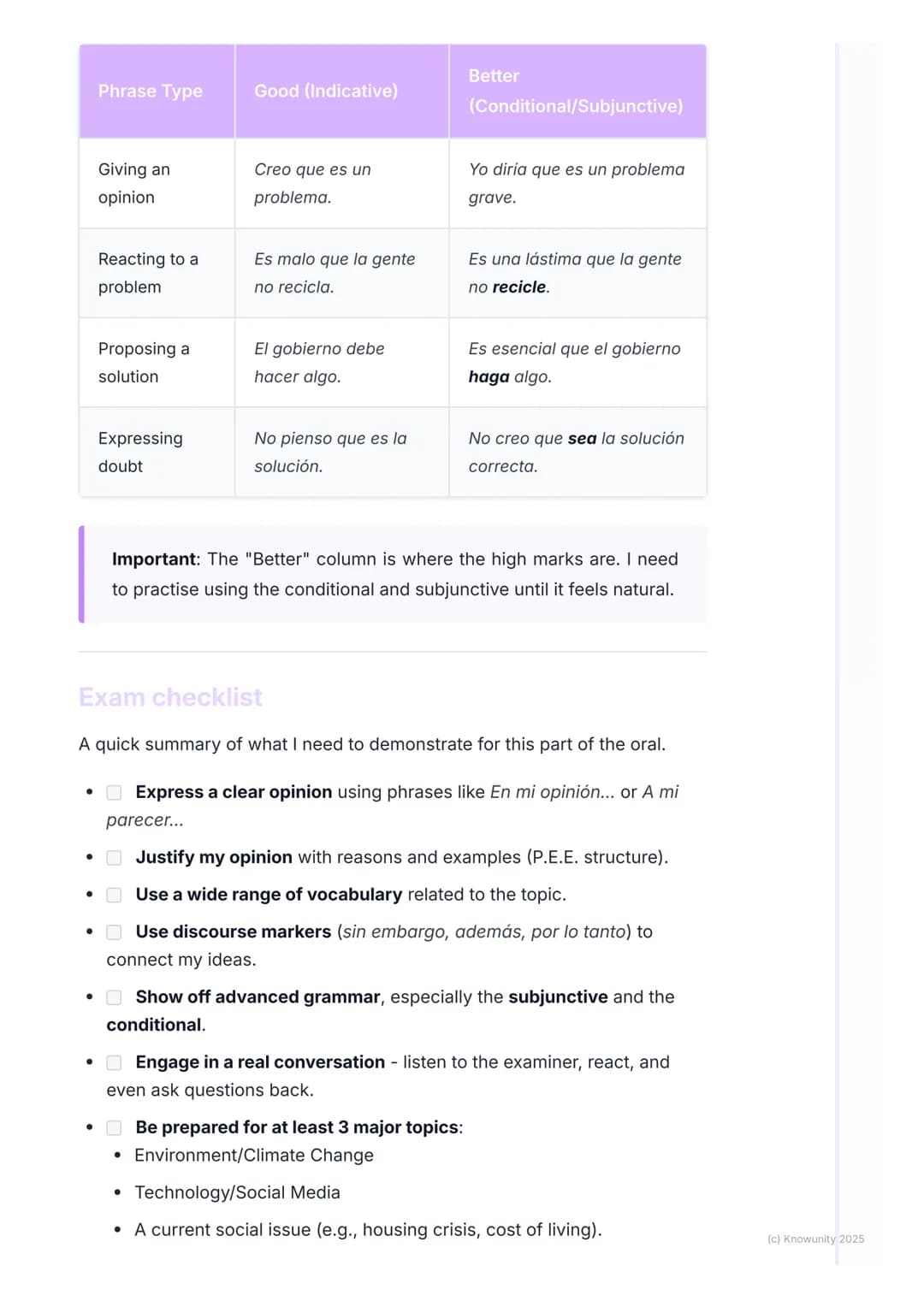
Exam Strategy and Advanced Grammar
Your grammar choices make or break this section. Compare "Creo que es un problema" (basic) with "Yo diría que es un problema grave" (advanced). The conditional and subjunctive are where high marks live, so practise using phrases like "Es esencial que el gobierno haga algo" instead of "El gobierno debe hacer algo."
Don't panic if you forget a word - paraphrase instead. Can't remember "sequía" (drought)? Say "cuando no llueve durante mucho tiempo y la tierra está muy seca." This shows real language skills.
Prepare thoroughly for three key topics: environment/climate change, technology/social media, and a current Irish issue like housing costs. It's better to know lots about a few topics than a little about everything.
Confidence Builder: Remember, it's perfectly fine to disagree with the examiner politely - "Entiendo su punto de vista, pero no estoy del todo de acuerdo..." shows real conversational confidence and language maturity.
6
of 6
Credeam că nu vei întreba niciodată...
Ce este Companionul AI Knowunity?
Companionul nostru AI este creat special pentru nevoile studenților. Bazându-ne pe milioanele de materiale de pe platformă, putem oferi răspunsuri exacte și relevante pentru studenți. Dar nu este vorba doar despre răspunsuri, companionul este mai ales despre ghidarea studenților prin provocările zilnice de învățare, cu planuri de studiu personalizate, chestionare sau conținuturi în chat și personalizare 100% bazată pe abilitățile și evoluțiile studenților.
De unde pot descărca aplicația Knowunity?
Aplicația este disponibilă în Google Play Store și Apple App Store.
Este Knowunity chiar gratuită?
Da! Bucură-te de access la materiale de studiu, conectează-te cu alți elevi, și primește ajutor instant - toate acestea la un click distanță. În plus, câștigă puncte ca să deblochezi mai multe funcționalități!
Cel mai popular conținut la Spanish
2SpanishTechnology, Social Media, and Digital Life
Learners will gain vocabulary to discuss modern technology, internet usage, social networking, and their impact on daily life.
5th Year20
SpanishComparatives and Superlatives
Students will learn how to compare people and things using comparative structures ('más... que', 'menos... que') and superlative forms ('el/la más...').
TY70
Cel mai popular conținut
9 Irish
IrishIrish oral questions and answers
Questions and answers for the leaving cert oral
5th Year4264
 English
Key Quotes : Sive
Key Quotes and explanations: Sive
6th Year2842
IrishIrish oral questions
Outline of oral questions
5th Year2055
IrishIníon- le hÁine Durkin
Aine Durkin’s poem, Iníon: Themes & summary
5th Year850
IrishIrish poetry 2027
Iníon + Dínit an Bhróin
5th Year1133
IrishLC HL notes- Iníon (poem)
Includes poem in English and Irish, theme, key words & phrases
5th Year2284
EnglishCultural Context : Shawshank Redemption : Sive : Small Things Like These
Comparative Study : Cultural Context : Shawshank Redemption, Sive and Small Things Like These
6th Year1430
IrishMo Ghrá-sa (Idir Lúibíní)
Notes on mo ghrá-sa
5th Year380
IrishAn Gaeilge Aiste
Irish Language essay
6th Year1320
Nu găsești ce cauți? Explorează alte MATERII.
Recenzii de la utilizatorii noștri. Ei iubesc să folosească Knowunity — și tu o vei face.
4.6/5App Store
4.7/5Google Play
Aplicația este foarte ușor de utilizat și bine concepută. Am găsit tot ce căutam până acum și am reușit să învăț multe din prezentări! Cu siguranță voi folosi aplicația pentru o temă la clasă! Și desigur, ajută mult ca sursă de inspirație.
Ștefan Sutilizator iOS
Această aplicație este super. Sunt atât de multe materiale de studiu și ajutor pentru elevi [...]. Materia mea mai problematică este franceza, de exemplu, și aplicația oferă foarte multe materiale ajutătoare. Mulțumită acestei aplicații, mi-am îmbunătățit franceza. Aș recomanda-o oricui.
Samantha Klichutilizator Android
Wow, sunt cu adevărat impresionat. Am încercat aplicația pentru că am văzut-o promovată de multe ori și am rămas uimit. Aceasta este AJUTORUL de care ai nevoie pentru școală și, mai presus de toate, oferă atât de multe lucruri, precum exerciții și fișe de informații, care mi-au fost FOARTE de ajutor.
Annautilizator iOS
Spanish1 vizualizări·Actualizat Jun 15, 2026·6 paginiExploring Complex Social and Ethical Topics
Ready to ace the conversation part of your Spanish oral exam? This section moves beyond personal topics to test your ability to discuss complex issues like climate change, technology, and social problems. The key is sounding natural and confident whilst...
1
of 6
Înscrie-te pentru a vedea CONȚINUTUL. E gratuit!
- Acces la toate documentele
- Îmbunătățește notele tale!
- Alătură-te milioanelor de elevi
Getting Started with Abstract Topics
Your examiner wants to see you handle topical issues and current affairs, not just chat about your family or school. This is where you can really shine by showing your range of vocabulary and grammar. The goal isn't to sound like you've memorised an essay - you need to react naturally to what the examiner says.
Think of this as a proper conversation where you're discussing real-world problems. You'll need to give and justify opinions on things like social media, environmental issues, or problems facing Ireland today. This is your chance to pick up serious marks.
Essential opinion phrases include "En mi opinión..." (In my opinion), "Desde mi punto de vista..." (From my point of view), and "Yo diría que..." (I would say that). Learn these until they become second nature - you'll use them constantly.
Top Tip: Master phrases like "Hoy en día, se habla mucho de..." (Nowadays, there's a lot of talk about...) to introduce topics smoothly and sound sophisticated from the start.
2
of 6Înscrie-te pentru a vedea CONȚINUTUL. E gratuit!
- Acces la toate documentele
- Îmbunătățește notele tale!
- Alătură-te milioanelor de elevi
Structuring Your Arguments Like a Pro
Don't just throw out random opinions - structure them properly using discourse markers. Start with "Por un lado... por otro lado..." (On the one hand... on the other hand) or "En primer lugar..." (Firstly). These phrases make your argument flow beautifully and show the examiner you can think logically.
The P.E.E. structure is your secret weapon: Point, Evidence, Explanation. First, state your opinion clearly. Then give an example or reason to back it up. Finally, explain how your evidence supports your point - this is where you can show off complex language.
For example: "Las redes sociales tienen un impacto negativo" (Point), "muchos jóvenes se comparan con vidas 'perfectas' en Instagram" (Evidence), "esto causa problemas de autoestima porque es imposible alcanzar esos estándares" (Explanation).
Grammar Gold: Use discourse markers like "Sin embargo" (However) and "Por lo tanto" (Therefore) to connect your ideas - it instantly makes you sound more sophisticated and organised.
3
of 6Înscrie-te pentru a vedea CONȚINUTUL. E gratuit!
- Acces la toate documentele
- Îmbunătățește notele tale!
- Alătură-te milioanelor de elevi
Mastering the Subjunctive for Top Marks
Here's your opportunity to absolutely smash the exam: using the subjunctive properly. This advanced grammar shows you're operating at a high level. Use it after phrases like "No creo que..." (I don't think that), "Es importante que..." (It's important that), and "Es una lástima que..." (It's a shame that).
Let's look at a climate change discussion. When asked about environmental problems, structure your response using P.E.E. Start with your point: "El cambio climático es el problema más grave." Add evidence from Ireland: "Tenemos más inundaciones y tormentas que antes." Then explain with subjunctive: "Es crucial que los gobiernos impongan leyes más estrictas."
Notice how "impongan" (subjunctive) sounds much more advanced than "imponen" (indicative). The examiner will definitely notice this level of grammar.
Subjunctive Success: Remember trigger phrases like "Ojalá que..." (I hope that) and "Dudo que..." automatically need the subjunctive - practise these until they're automatic.
4
of 6Înscrie-te pentru a vedea CONȚINUTUL. E gratuit!
- Acces la toate documentele
- Îmbunătățește notele tale!
- Alătură-te milioanelor de elevi
Tackling Technology and Social Media Topics
Technology discussions are exam favourites, so be ready. When asked about young people and mobile phones, don't just agree or disagree - show nuance. You might say: "Por un lado, la tecnología es útil para los estudios, sin embargo, es fácil pasar horas en TikTok sin darse cuenta."
Use personal observations to strengthen your arguments. Mention seeing groups of friends in cafés all staring at their phones instead of talking. This shows you can connect abstract issues to real-life situations.
Advanced phrases like "Yo diría que la adicción al móvil es un problema real" (I would say mobile addiction is a real problem) demonstrate sophisticated opinion-giving. The conditional "diría" is much better than simple "digo."
Conversation Hack: Don't just answer questions - ask them back! "¿Y usted, qué opina?" (And you, what do you think?) turns it into a real conversation and shows confident Spanish skills.
5
of 6Înscrie-te pentru a vedea CONȚINUTUL. E gratuit!
- Acces la toate documentele
- Îmbunătățește notele tale!
- Alătură-te milioanelor de elevi
Exam Strategy and Advanced Grammar
Your grammar choices make or break this section. Compare "Creo que es un problema" (basic) with "Yo diría que es un problema grave" (advanced). The conditional and subjunctive are where high marks live, so practise using phrases like "Es esencial que el gobierno haga algo" instead of "El gobierno debe hacer algo."
Don't panic if you forget a word - paraphrase instead. Can't remember "sequía" (drought)? Say "cuando no llueve durante mucho tiempo y la tierra está muy seca." This shows real language skills.
Prepare thoroughly for three key topics: environment/climate change, technology/social media, and a current Irish issue like housing costs. It's better to know lots about a few topics than a little about everything.
Confidence Builder: Remember, it's perfectly fine to disagree with the examiner politely - "Entiendo su punto de vista, pero no estoy del todo de acuerdo..." shows real conversational confidence and language maturity.
6
of 6Înscrie-te pentru a vedea CONȚINUTUL. E gratuit!
- Acces la toate documentele
- Îmbunătățește notele tale!
- Alătură-te milioanelor de elevi
Credeam că nu vei întreba niciodată...
Ce este Companionul AI Knowunity?
Companionul nostru AI este creat special pentru nevoile studenților. Bazându-ne pe milioanele de materiale de pe platformă, putem oferi răspunsuri exacte și relevante pentru studenți. Dar nu este vorba doar despre răspunsuri, companionul este mai ales despre ghidarea studenților prin provocările zilnice de învățare, cu planuri de studiu personalizate, chestionare sau conținuturi în chat și personalizare 100% bazată pe abilitățile și evoluțiile studenților.
De unde pot descărca aplicația Knowunity?
Aplicația este disponibilă în Google Play Store și Apple App Store.
Este Knowunity chiar gratuită?
Da! Bucură-te de access la materiale de studiu, conectează-te cu alți elevi, și primește ajutor instant - toate acestea la un click distanță. În plus, câștigă puncte ca să deblochezi mai multe funcționalități!
Cel mai popular conținut la Spanish
2SpanishTechnology, Social Media, and Digital Life
Learners will gain vocabulary to discuss modern technology, internet usage, social networking, and their impact on daily life.
5th Year20
SpanishComparatives and Superlatives
Students will learn how to compare people and things using comparative structures ('más... que', 'menos... que') and superlative forms ('el/la más...').
TY70
Cel mai popular conținut
9IrishIrish oral questions and answers
Questions and answers for the leaving cert oral
5th Year4264
EnglishKey Quotes : Sive
Key Quotes and explanations: Sive
6th Year2842
IrishIrish oral questions
Outline of oral questions
5th Year2055
IrishIníon- le hÁine Durkin
Aine Durkin’s poem, Iníon: Themes & summary
5th Year850
IrishIrish poetry 2027
Iníon + Dínit an Bhróin
5th Year1133
IrishLC HL notes- Iníon (poem)
Includes poem in English and Irish, theme, key words & phrases
5th Year2284
EnglishCultural Context : Shawshank Redemption : Sive : Small Things Like These
Comparative Study : Cultural Context : Shawshank Redemption, Sive and Small Things Like These
6th Year1430
IrishMo Ghrá-sa (Idir Lúibíní)
Notes on mo ghrá-sa
5th Year380
IrishAn Gaeilge Aiste
Irish Language essay
6th Year1320
Nu găsești ce cauți? Explorează alte MATERII.
Recenzii de la utilizatorii noștri. Ei iubesc să folosească Knowunity — și tu o vei face.
4.6/5App Store
4.7/5Google Play
Aplicația este foarte ușor de utilizat și bine concepută. Am găsit tot ce căutam până acum și am reușit să învăț multe din prezentări! Cu siguranță voi folosi aplicația pentru o temă la clasă! Și desigur, ajută mult ca sursă de inspirație.
Ștefan Sutilizator iOS
Această aplicație este super. Sunt atât de multe materiale de studiu și ajutor pentru elevi [...]. Materia mea mai problematică este franceza, de exemplu, și aplicația oferă foarte multe materiale ajutătoare. Mulțumită acestei aplicații, mi-am îmbunătățit franceza. Aș recomanda-o oricui.
Samantha Klichutilizator Android
Wow, sunt cu adevărat impresionat. Am încercat aplicația pentru că am văzut-o promovată de multe ori și am rămas uimit. Aceasta este AJUTORUL de care ai nevoie pentru școală și, mai presus de toate, oferă atât de multe lucruri, precum exerciții și fișe de informații, care mi-au fost FOARTE de ajutor.
Annautilizator iOS