
Irish traditional music, or "trad" music, is the heartbeat of... Afișează mai mult
 Music2 vizualizări·Actualizat May 20, 2026·5 pagini
Exploring Irish Traditional Music: Instruments, Forms, and Culture
1 / 5
1
of 5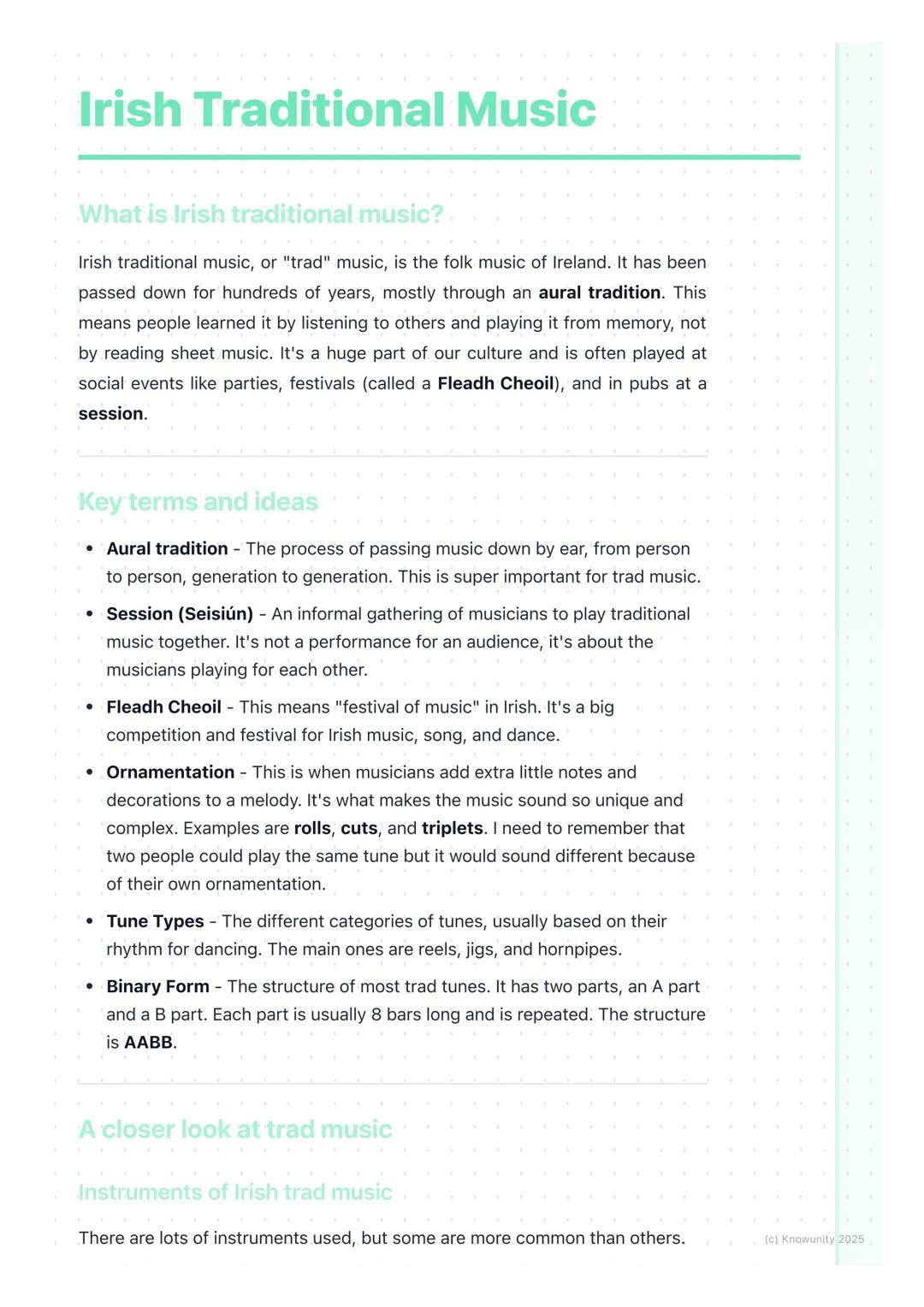
What is Irish Traditional Music?
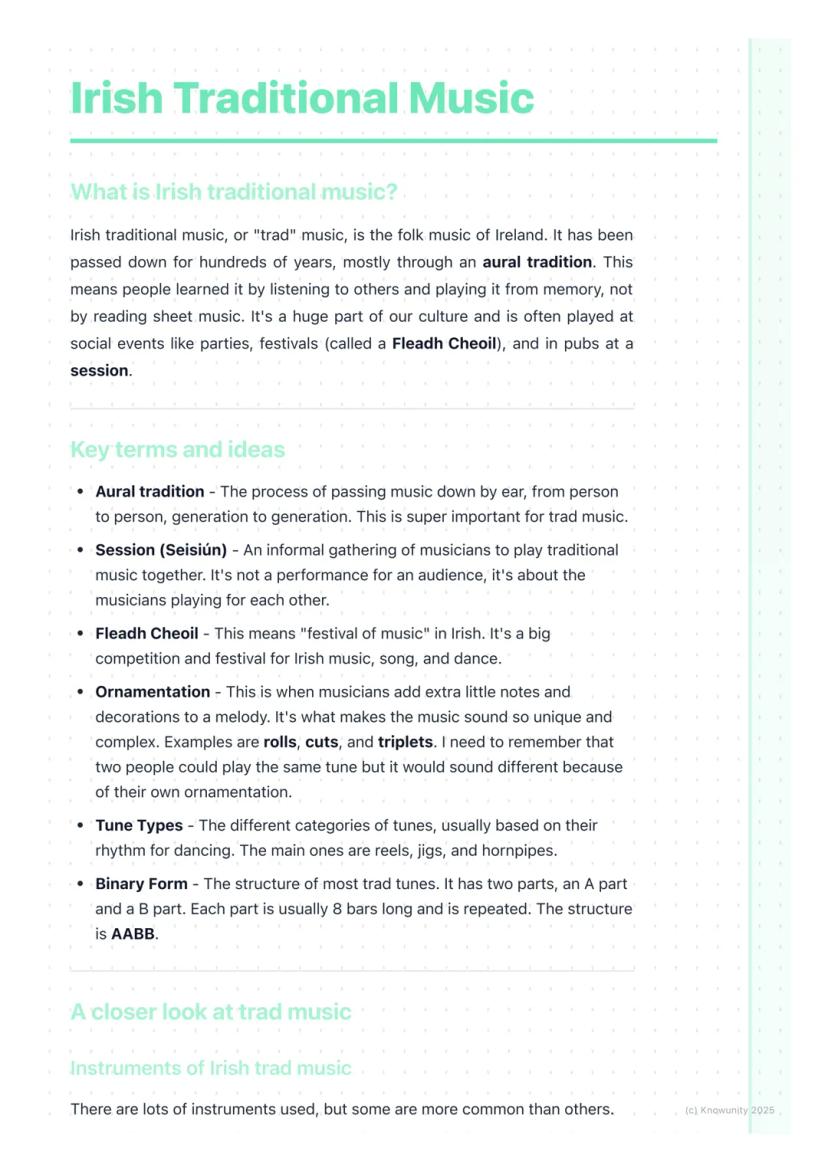
Ever wondered why Irish music sounds so distinctive and alive? Irish traditional music has survived for centuries through something called aural tradition - meaning people learned tunes by listening and playing from memory rather than reading sheet music. This creates a personal connection between musicians that you can actually hear in the music.
You'll encounter this music everywhere in Ireland, from informal sessions in pubs where musicians gather to play together, to massive Fleadh Cheoil festivals that celebrate Irish culture. These aren't performances for audiences - they're musicians playing for the pure joy of it.
The magic happens through ornamentation - those little decorative notes like rolls, cuts, and triplets that make each musician's version unique. Two people can play the same tune, but it'll sound completely different because of their personal ornamental style.
💡 Remember: Most Irish tunes follow binary form (AABB structure) - an A section and B section, each 8 bars long and repeated.
2
of 5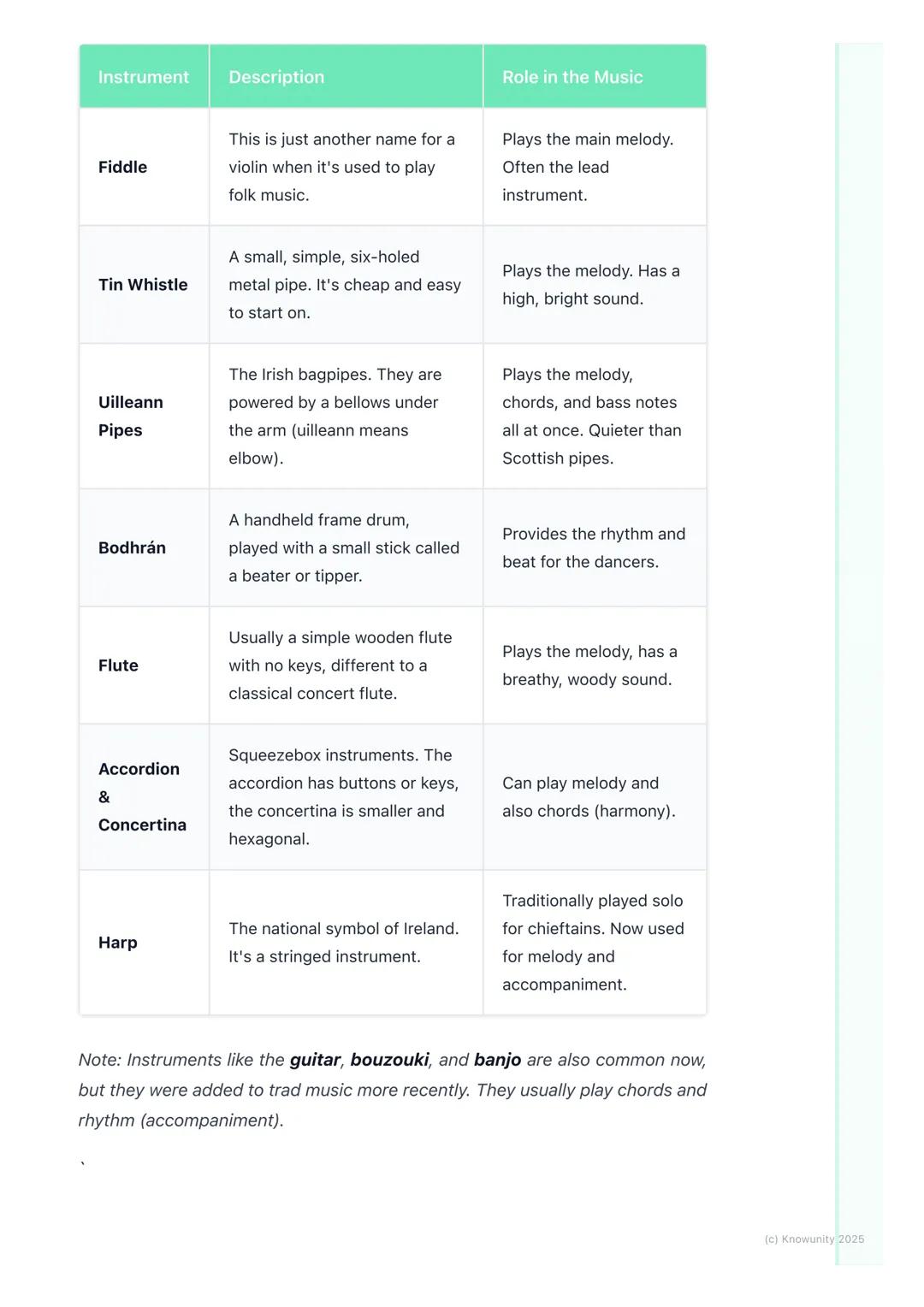
Traditional Irish Instruments
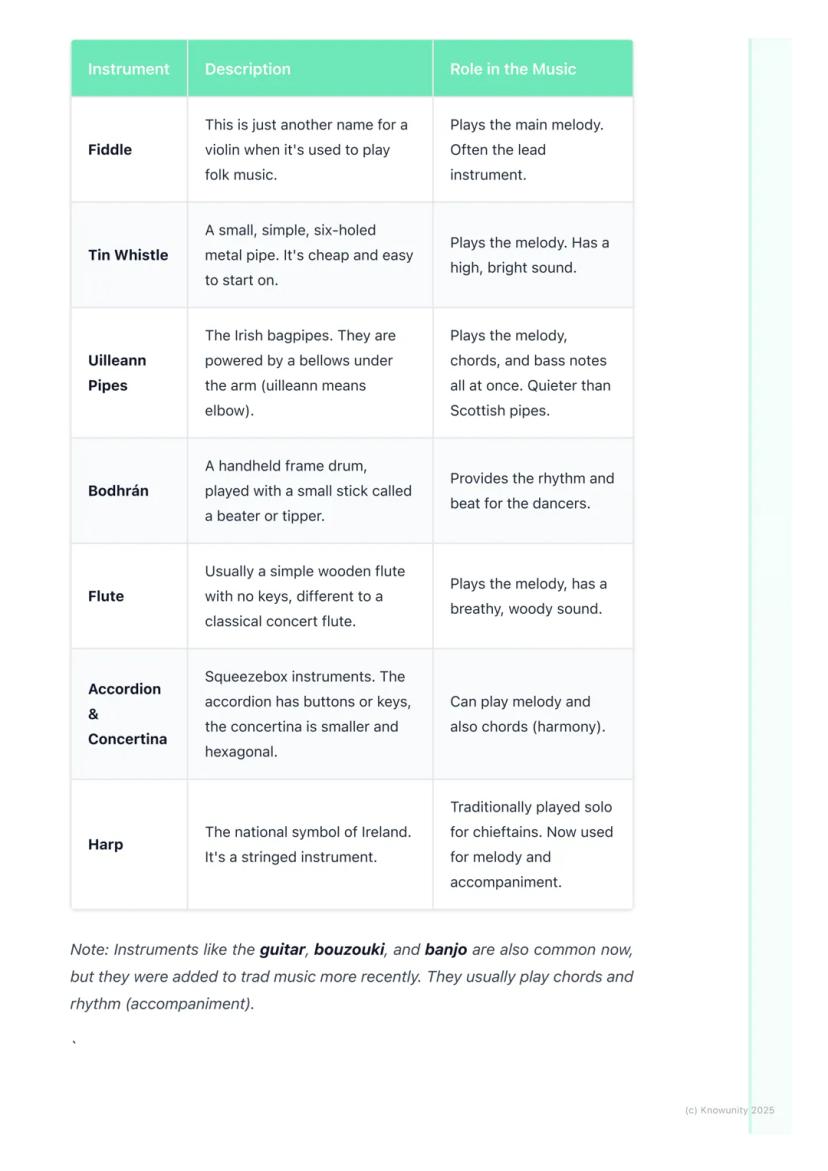
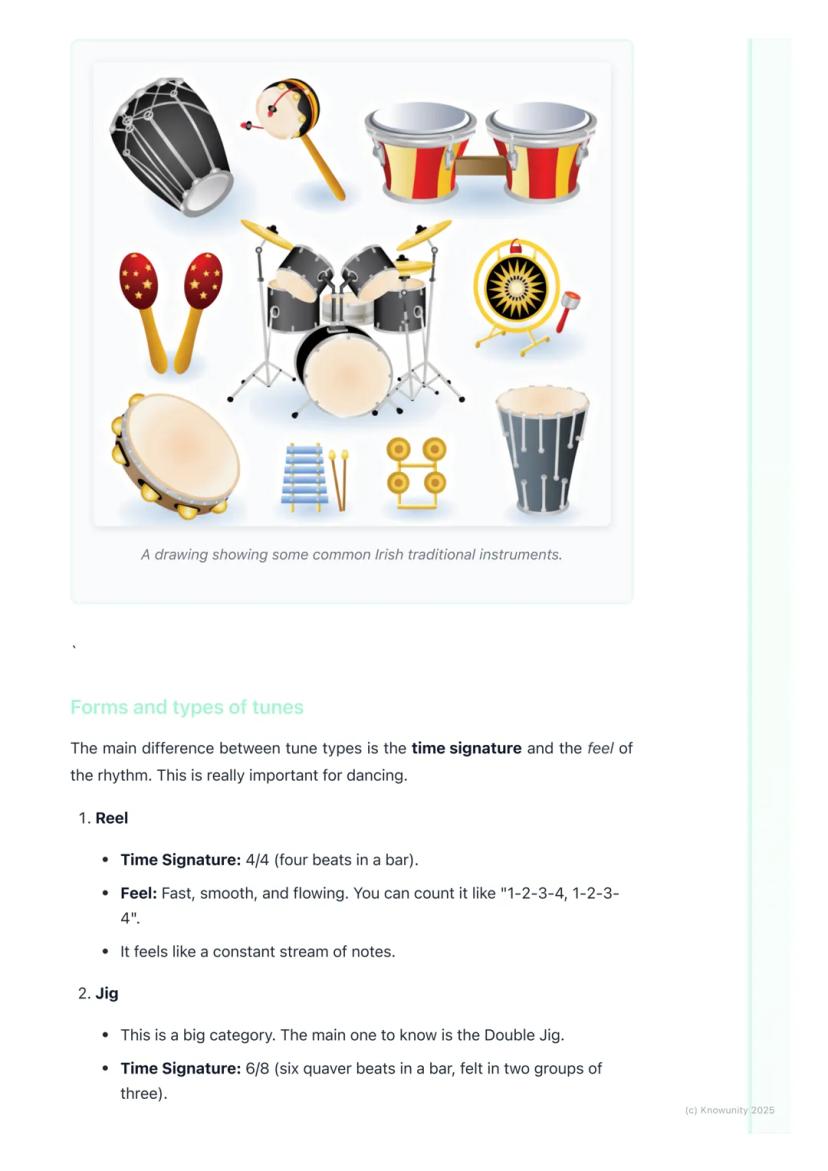
The fiddle (which is just a violin playing folk music) often leads the melody with its expressive, singing tone. For beginners, the tin whistle is brilliant - it's cheap, portable, and produces that bright, piercing sound you hear in Irish music.
Uilleann pipes are Ireland's answer to bagpipes, but they're powered by bellows under your arm (uilleann means "elbow") rather than breath. They're much quieter than Scottish pipes and can play melody, harmony, and bass all at once. The bodhrán provides the driving rhythm that gets dancers moving.
Traditional melody instruments also include wooden flutes and accordions or concertinas. The harp, Ireland's national symbol, was historically played for chieftains but now fits into modern sessions too.
💡 Quick tip: Instruments like guitar and banjo were added later for accompaniment - they're common now but aren't originally Irish.
3
of 5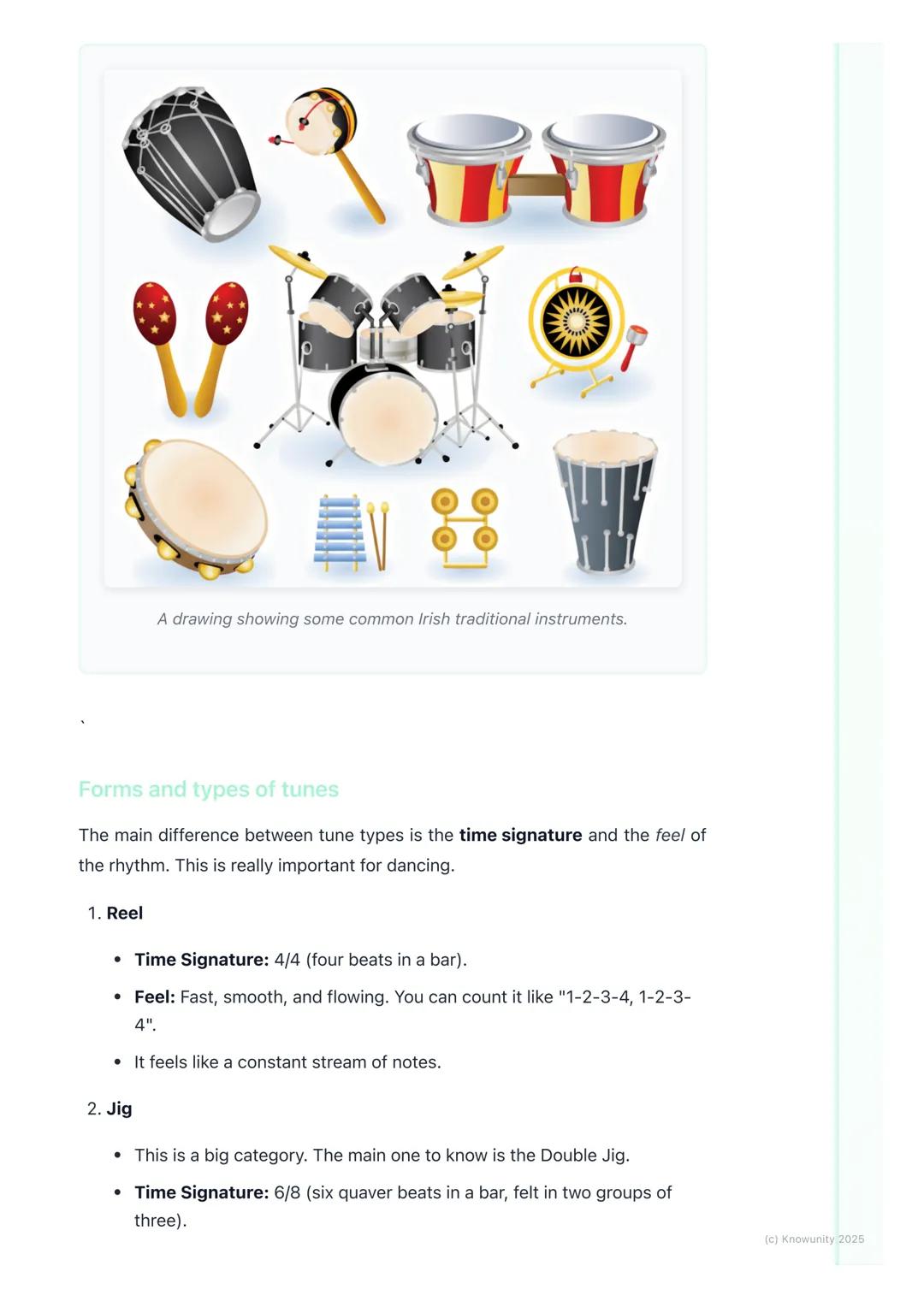
Understanding Tune Types
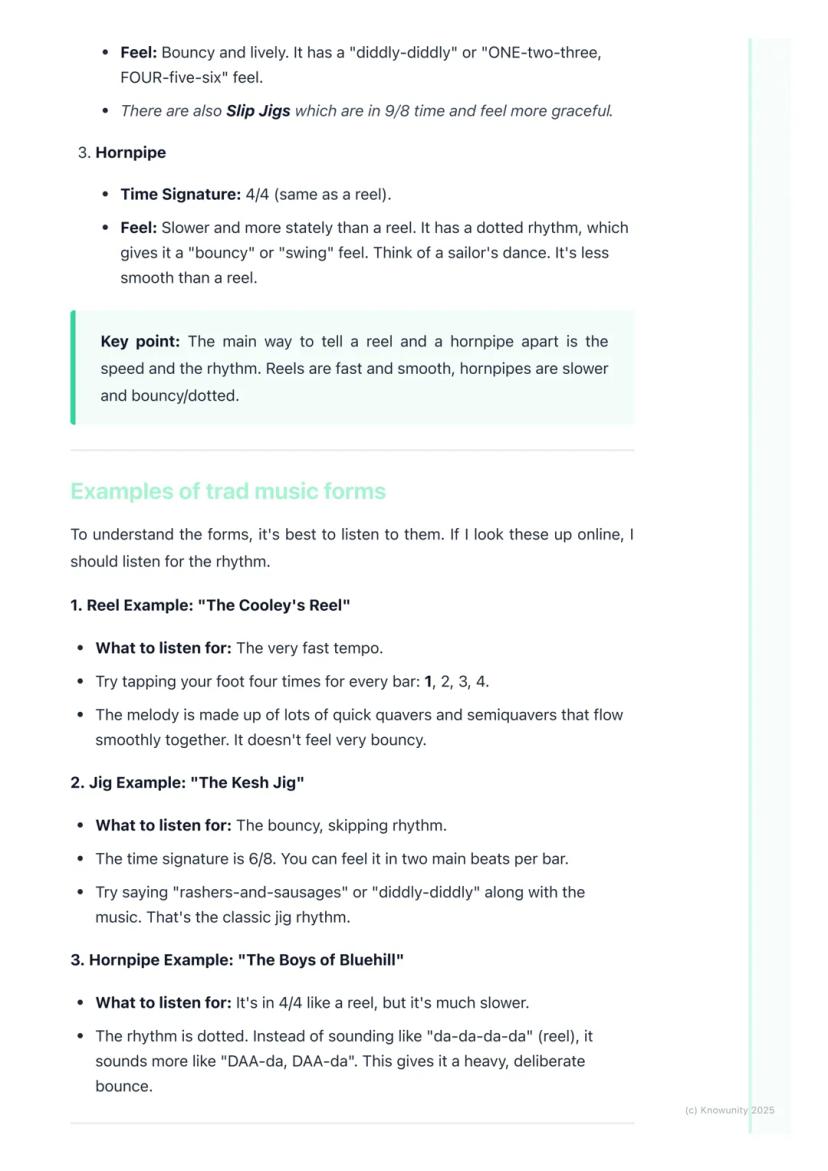
Learning to recognise different tune types is crucial because they determine how people dance. The rhythm and time signature completely change the feel of the music.
Reels are in 4/4 time and feel fast, smooth, and flowing like a constant stream of notes. Count "1-2-3-4" and tap your foot - that's a reel's steady pulse. They're probably the most common type you'll hear.
Jigs are the bouncy ones in 6/8 time that make you want to skip. The classic double jig has that "diddly-diddly" or "ONE-two-three, FOUR-five-six" feel. There are also slip jigs in 9/8 time that feel more graceful and flowing.
💡 Listen for: "The Cooley's Reel" and "The Kesh Jig" online to hear the difference - your ears will pick up the rhythmic patterns quickly.
4
of 5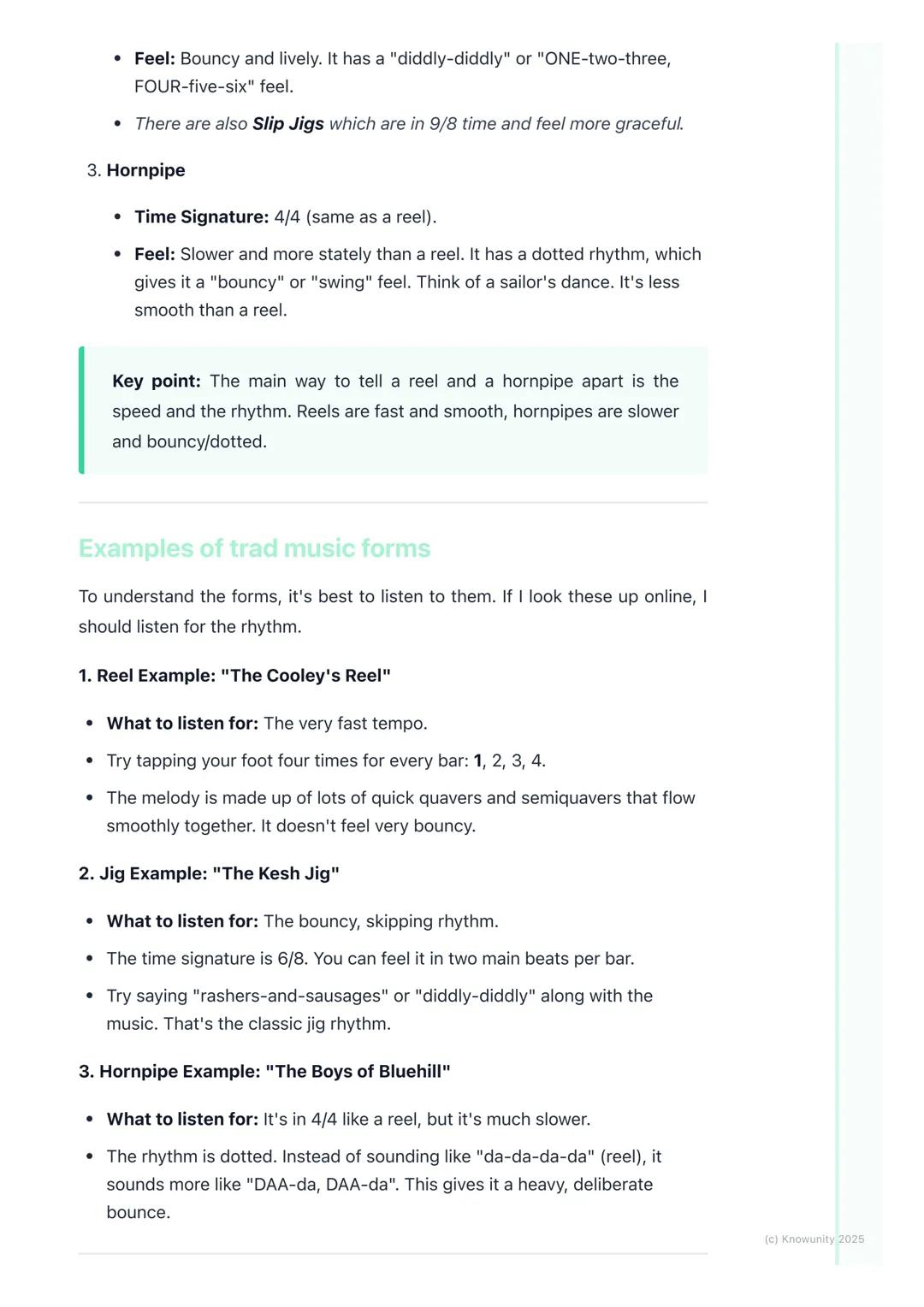
Hornpipes and Musical Examples
Hornpipes often confuse students because they're also in 4/4 like reels, but they're completely different in character. They're slower and have a dotted, bouncy rhythm that sounds like "DAA-da, DAA-da" instead of a reel's smooth "da-da-da-da". Think of a sailor's dance - deliberate and stately.
"The Boys of Bluehill" is a perfect hornpipe example. When you listen, notice how much heavier and more deliberate it sounds compared to a flowing reel. The dotted rhythms give it that characteristic swing feel.
The key difference between reels and hornpipes isn't just tempo - it's the entire rhythmic character. Reels flow like water, whilst hornpipes bounce with purpose.
💡 Exam tip: If you can distinguish between smooth flowing (reel) and bouncy dotted (hornpipe), you'll nail this topic in tests.
5
of 5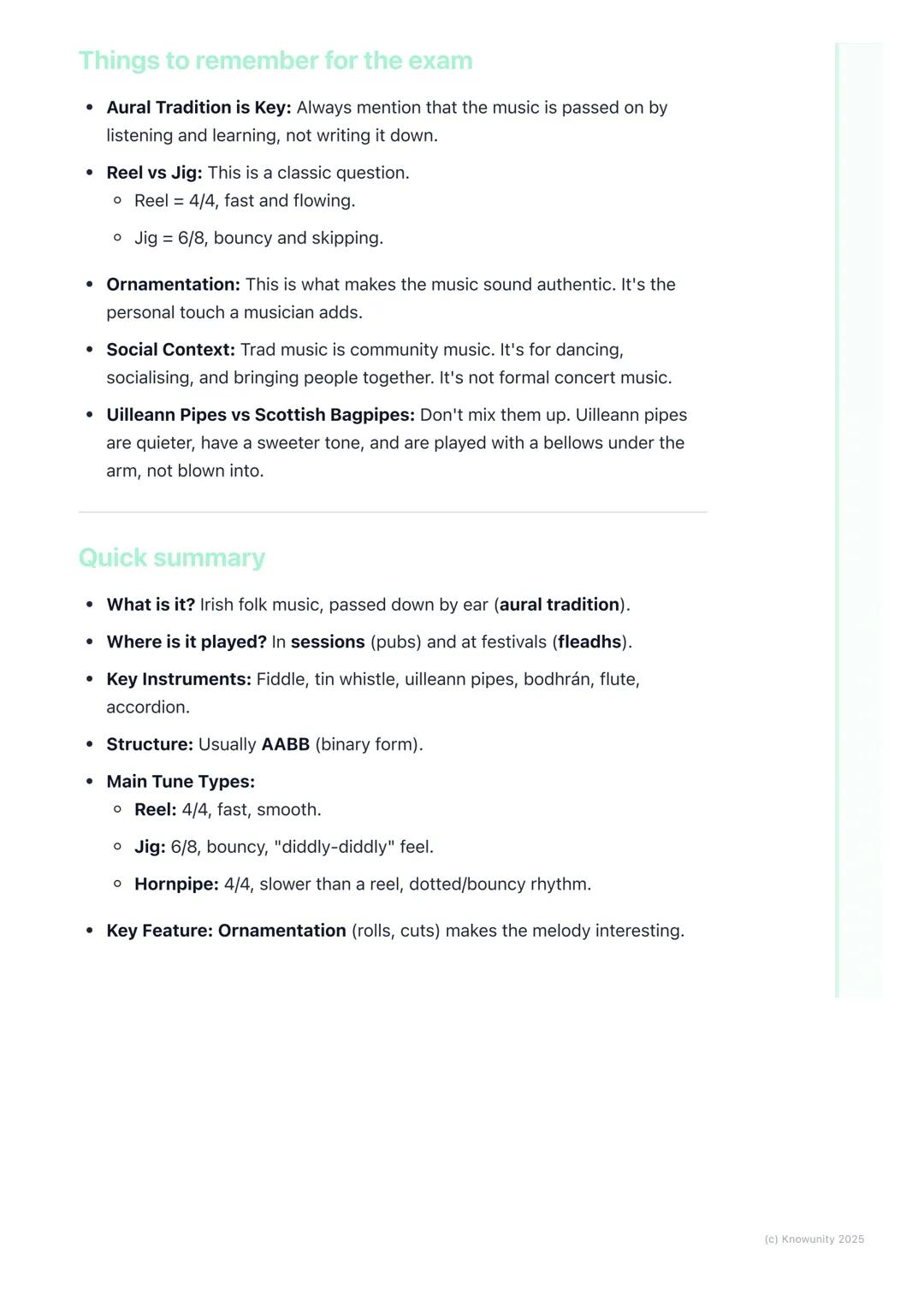
Key Points for Success
Aural tradition is the foundation of everything - always mention that this music lives through listening and learning by ear, not written notation. This creates the personal, intimate quality that makes Irish music so special.
Social context matters hugely. This isn't formal concert music - it's community music for dancing, socialising, and bringing people together. Sessions and fleadhs are where the tradition stays alive.
Ornamentation is what makes the music authentic and personal. It's how musicians add their own voice to ancient tunes, making each performance unique even when playing the same melody.
💡 Quick reference: Reel = 4/4 fast and smooth; Jig = 6/8 bouncy "diddly-diddly"; Hornpipe = 4/4 slower with dotted rhythm.
Remember that uilleann pipes are distinctly Irish - don't confuse them with Scottish bagpipes. They're quieter, sweeter, and use bellows instead of breath. Master these distinctions and you'll understand the heart of Irish traditional music.
Credeam că nu vei întreba niciodată...
Ce este Companionul AI Knowunity?
Companionul nostru AI este creat special pentru nevoile studenților. Bazându-ne pe milioanele de materiale de pe platformă, putem oferi răspunsuri exacte și relevante pentru studenți. Dar nu este vorba doar despre răspunsuri, companionul este mai ales despre ghidarea studenților prin provocările zilnice de învățare, cu planuri de studiu personalizate, chestionare sau conținuturi în chat și personalizare 100% bazată pe abilitățile și evoluțiile studenților.
De unde pot descărca aplicația Knowunity?
Aplicația este disponibilă în Google Play Store și Apple App Store.
Este Knowunity chiar gratuită?
Da! Bucură-te de access la materiale de studiu, conectează-te cu alți elevi, și primește ajutor instant - toate acestea la un click distanță. În plus, câștigă puncte ca să deblochezi mai multe funcționalități!
Cel mai popular conținut
9 Irish
IrishIrish oral questions and answers
Questions and answers for the leaving cert oral
5th Year4254
IrishIrish oral questions
Outline of oral questions
5th Year2055
IrishGaeilge Grammar Office
All the basics you need to know on Irish grammar.
6th Year883
 English
Key Quotes : Sive
Key Quotes and explanations: Sive
6th Year2191
IrishAn Gaeilge Aiste
Irish Language essay
6th Year1250
IrishIrish poetry 2027
Iníon + Dínit an Bhróin
5th Year1133
IrishMé Féin & Mo Chlann (Myself & My Family)
Students will learn vocabulary to describe themselves, their family members, and daily routines. This helps in personal introductions and discussions.
TY291
IrishLC HL notes- Iníon (poem)
Includes poem in English and Irish, theme, key words & phrases
5th Year2284
 Geography
Territory, economic activities in Paris basin
essay
6th Year80
Nu găsești ce cauți? Explorează alte MATERII.
Recenzii de la utilizatorii noștri. Ei iubesc să folosească Knowunity — și tu o vei face.
4.6/5App Store
4.7/5Google Play
Aplicația este foarte ușor de utilizat și bine concepută. Am găsit tot ce căutam până acum și am reușit să învăț multe din prezentări! Cu siguranță voi folosi aplicația pentru o temă la clasă! Și desigur, ajută mult ca sursă de inspirație.
Ștefan Sutilizator iOS
Această aplicație este super. Sunt atât de multe materiale de studiu și ajutor pentru elevi [...]. Materia mea mai problematică este franceza, de exemplu, și aplicația oferă foarte multe materiale ajutătoare. Mulțumită acestei aplicații, mi-am îmbunătățit franceza. Aș recomanda-o oricui.
Samantha Klichutilizator Android
Wow, sunt cu adevărat impresionat. Am încercat aplicația pentru că am văzut-o promovată de multe ori și am rămas uimit. Aceasta este AJUTORUL de care ai nevoie pentru școală și, mai presus de toate, oferă atât de multe lucruri, precum exerciții și fișe de informații, care mi-au fost FOARTE de ajutor.
Annautilizator iOS
Music2 vizualizări·Actualizat May 20, 2026·5 paginiExploring Irish Traditional Music: Instruments, Forms, and Culture
Irish traditional music, or "trad" music, is the heartbeat of Irish culture that's been passed down through generations by ear. This folk music isn't just entertainment - it's a living tradition that brings communities together in pubs, festivals, and social... Afișează mai mult
1
of 5Înscrie-te pentru a vedea CONȚINUTUL. E gratuit!
- Acces la toate documentele
- Îmbunătățește notele tale!
- Alătură-te milioanelor de elevi
What is Irish Traditional Music?
Ever wondered why Irish music sounds so distinctive and alive? Irish traditional music has survived for centuries through something called aural tradition - meaning people learned tunes by listening and playing from memory rather than reading sheet music. This creates a personal connection between musicians that you can actually hear in the music.
You'll encounter this music everywhere in Ireland, from informal sessions in pubs where musicians gather to play together, to massive Fleadh Cheoil festivals that celebrate Irish culture. These aren't performances for audiences - they're musicians playing for the pure joy of it.
The magic happens through ornamentation - those little decorative notes like rolls, cuts, and triplets that make each musician's version unique. Two people can play the same tune, but it'll sound completely different because of their personal ornamental style.
💡 Remember: Most Irish tunes follow binary form (AABB structure) - an A section and B section, each 8 bars long and repeated.
2
of 5Înscrie-te pentru a vedea CONȚINUTUL. E gratuit!
- Acces la toate documentele
- Îmbunătățește notele tale!
- Alătură-te milioanelor de elevi
Traditional Irish Instruments
The fiddle (which is just a violin playing folk music) often leads the melody with its expressive, singing tone. For beginners, the tin whistle is brilliant - it's cheap, portable, and produces that bright, piercing sound you hear in Irish music.
Uilleann pipes are Ireland's answer to bagpipes, but they're powered by bellows under your arm (uilleann means "elbow") rather than breath. They're much quieter than Scottish pipes and can play melody, harmony, and bass all at once. The bodhrán provides the driving rhythm that gets dancers moving.
Traditional melody instruments also include wooden flutes and accordions or concertinas. The harp, Ireland's national symbol, was historically played for chieftains but now fits into modern sessions too.
💡 Quick tip: Instruments like guitar and banjo were added later for accompaniment - they're common now but aren't originally Irish.
3
of 5Înscrie-te pentru a vedea CONȚINUTUL. E gratuit!
- Acces la toate documentele
- Îmbunătățește notele tale!
- Alătură-te milioanelor de elevi
Understanding Tune Types
Learning to recognise different tune types is crucial because they determine how people dance. The rhythm and time signature completely change the feel of the music.
Reels are in 4/4 time and feel fast, smooth, and flowing like a constant stream of notes. Count "1-2-3-4" and tap your foot - that's a reel's steady pulse. They're probably the most common type you'll hear.
Jigs are the bouncy ones in 6/8 time that make you want to skip. The classic double jig has that "diddly-diddly" or "ONE-two-three, FOUR-five-six" feel. There are also slip jigs in 9/8 time that feel more graceful and flowing.
💡 Listen for: "The Cooley's Reel" and "The Kesh Jig" online to hear the difference - your ears will pick up the rhythmic patterns quickly.
4
of 5Înscrie-te pentru a vedea CONȚINUTUL. E gratuit!
- Acces la toate documentele
- Îmbunătățește notele tale!
- Alătură-te milioanelor de elevi
Hornpipes and Musical Examples
Hornpipes often confuse students because they're also in 4/4 like reels, but they're completely different in character. They're slower and have a dotted, bouncy rhythm that sounds like "DAA-da, DAA-da" instead of a reel's smooth "da-da-da-da". Think of a sailor's dance - deliberate and stately.
"The Boys of Bluehill" is a perfect hornpipe example. When you listen, notice how much heavier and more deliberate it sounds compared to a flowing reel. The dotted rhythms give it that characteristic swing feel.
The key difference between reels and hornpipes isn't just tempo - it's the entire rhythmic character. Reels flow like water, whilst hornpipes bounce with purpose.
💡 Exam tip: If you can distinguish between smooth flowing (reel) and bouncy dotted (hornpipe), you'll nail this topic in tests.
5
of 5Înscrie-te pentru a vedea CONȚINUTUL. E gratuit!
- Acces la toate documentele
- Îmbunătățește notele tale!
- Alătură-te milioanelor de elevi
Key Points for Success
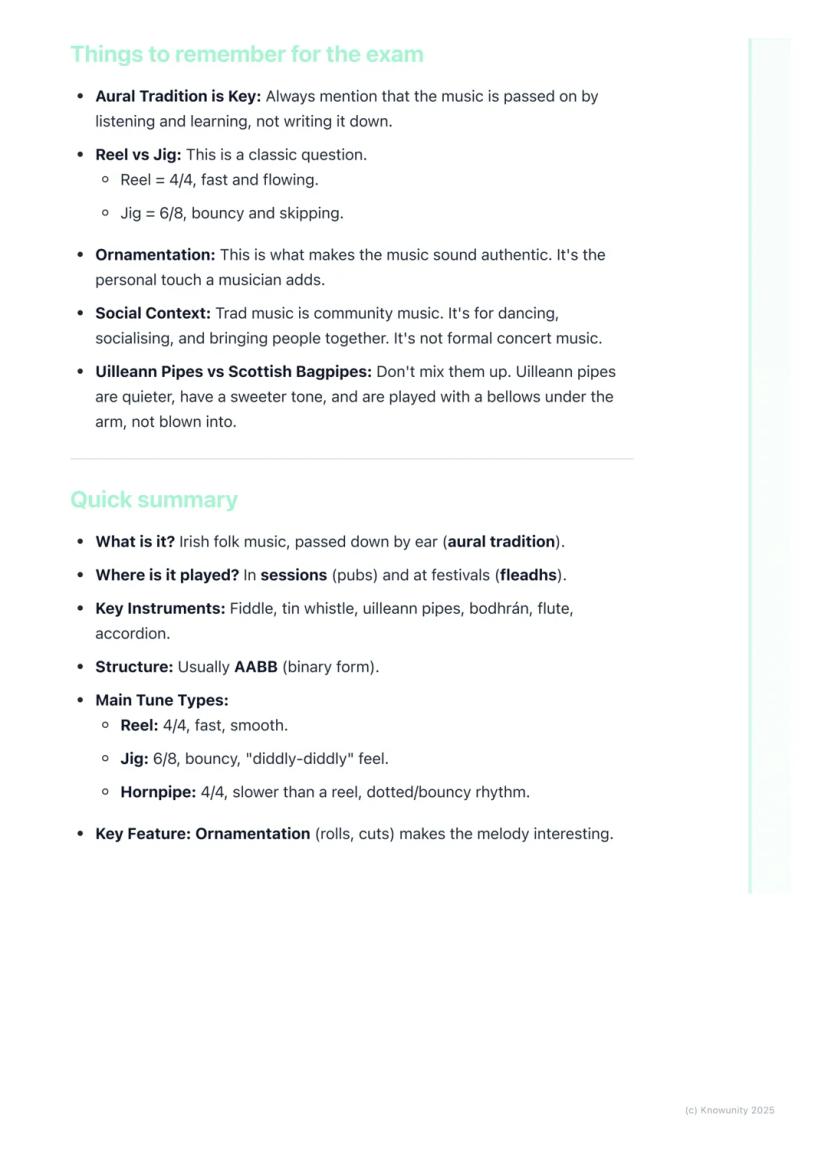
Aural tradition is the foundation of everything - always mention that this music lives through listening and learning by ear, not written notation. This creates the personal, intimate quality that makes Irish music so special.
Social context matters hugely. This isn't formal concert music - it's community music for dancing, socialising, and bringing people together. Sessions and fleadhs are where the tradition stays alive.
Ornamentation is what makes the music authentic and personal. It's how musicians add their own voice to ancient tunes, making each performance unique even when playing the same melody.
💡 Quick reference: Reel = 4/4 fast and smooth; Jig = 6/8 bouncy "diddly-diddly"; Hornpipe = 4/4 slower with dotted rhythm.
Remember that uilleann pipes are distinctly Irish - don't confuse them with Scottish bagpipes. They're quieter, sweeter, and use bellows instead of breath. Master these distinctions and you'll understand the heart of Irish traditional music.
Credeam că nu vei întreba niciodată...
Ce este Companionul AI Knowunity?
Companionul nostru AI este creat special pentru nevoile studenților. Bazându-ne pe milioanele de materiale de pe platformă, putem oferi răspunsuri exacte și relevante pentru studenți. Dar nu este vorba doar despre răspunsuri, companionul este mai ales despre ghidarea studenților prin provocările zilnice de învățare, cu planuri de studiu personalizate, chestionare sau conținuturi în chat și personalizare 100% bazată pe abilitățile și evoluțiile studenților.
De unde pot descărca aplicația Knowunity?
Aplicația este disponibilă în Google Play Store și Apple App Store.
Este Knowunity chiar gratuită?
Da! Bucură-te de access la materiale de studiu, conectează-te cu alți elevi, și primește ajutor instant - toate acestea la un click distanță. În plus, câștigă puncte ca să deblochezi mai multe funcționalități!
Cel mai popular conținut
9IrishIrish oral questions and answers
Questions and answers for the leaving cert oral
5th Year4254
IrishIrish oral questions
Outline of oral questions
5th Year2055
IrishGaeilge Grammar Office
All the basics you need to know on Irish grammar.
6th Year883
EnglishKey Quotes : Sive
Key Quotes and explanations: Sive
6th Year2191
IrishAn Gaeilge Aiste
Irish Language essay
6th Year1250
IrishIrish poetry 2027
Iníon + Dínit an Bhróin
5th Year1133
IrishMé Féin & Mo Chlann (Myself & My Family)
Students will learn vocabulary to describe themselves, their family members, and daily routines. This helps in personal introductions and discussions.
TY291
IrishLC HL notes- Iníon (poem)
Includes poem in English and Irish, theme, key words & phrases
5th Year2284
GeographyTerritory, economic activities in Paris basin
essay
6th Year80
Nu găsești ce cauți? Explorează alte MATERII.
Recenzii de la utilizatorii noștri. Ei iubesc să folosească Knowunity — și tu o vei face.
4.6/5App Store
4.7/5Google Play
Aplicația este foarte ușor de utilizat și bine concepută. Am găsit tot ce căutam până acum și am reușit să învăț multe din prezentări! Cu siguranță voi folosi aplicația pentru o temă la clasă! Și desigur, ajută mult ca sursă de inspirație.
Ștefan Sutilizator iOS
Această aplicație este super. Sunt atât de multe materiale de studiu și ajutor pentru elevi [...]. Materia mea mai problematică este franceza, de exemplu, și aplicația oferă foarte multe materiale ajutătoare. Mulțumită acestei aplicații, mi-am îmbunătățit franceza. Aș recomanda-o oricui.
Samantha Klichutilizator Android
Wow, sunt cu adevărat impresionat. Am încercat aplicația pentru că am văzut-o promovată de multe ori și am rămas uimit. Aceasta este AJUTORUL de care ai nevoie pentru școală și, mai presus de toate, oferă atât de multe lucruri, precum exerciții și fișe de informații, care mi-au fost FOARTE de ajutor.
Annautilizator iOS