
Ever wondered how companies know what flavour of crisps to... Afișează mai mult
 Mathematics
 Irish
Irish English
Înscrie-te pentru a vedea CONȚINUTULE gratuit!
Acces la toate documentele
Îmbunătățește notele tale!
Alătură-te milioanelor de elevi
Knowunity AI
Mai mult
Materii
Triangle Congruence and Similarity Theorems
Triangle Properties and Classification
Linear Equations and Graphs
Geometric Angle Relationships
Trigonometric Functions and Identities
Equation Solving Techniques
Circle Geometry Fundamentals
Division Operations and Methods
Basic Differentiation Rules
Exponent and Logarithm Properties
Afișează toate materiile
Human Organ Systems
Reproductive Cell Cycles
Biological Sciences Subdisciplines
Cellular Energy Metabolism
Autotrophic Energy Processes
Inheritance Patterns and Principles
Biomolecular Structure and Organization
Cell Cycle and Division Mechanics
Cellular Organization and Development
Biological Structural Organization
Afișează toate materiile
Chemical Sciences and Applications
Atomic Structure and Composition
Molecular Electron Structure Representation
Atomic Electron Behavior
Matter Properties and Water
Mole Concept and Calculations
Gas Laws and Behavior
Periodic Table Organization
Chemical Thermodynamics Fundamentals
Chemical Bond Types and Properties
Afișează toate materiile
European Renaissance and Enlightenment
European Cultural Movements 800-1920
American Revolution Era 1763-1797
American Civil War 1861-1865
Global Imperial Systems
Mongol and Chinese Dynasties
U.S. Presidents and World Leaders
Historical Sources and Documentation
World Wars Era and Impact
World Religious Systems
Afișează toate materiile
Classic and Contemporary Novels
Literary Character Analysis
Rhetorical Theory and Practice
Classic Literary Narratives
Reading Analysis and Interpretation
Narrative Structure and Techniques
English Language Components
Influential English-Language Authors
Basic Sentence Structure
Narrative Voice and Perspective
Afișează toate materiile
44
•
Actualizat May 6, 2026
•
Ever wondered how companies know what flavour of crisps to... Afișează mai mult
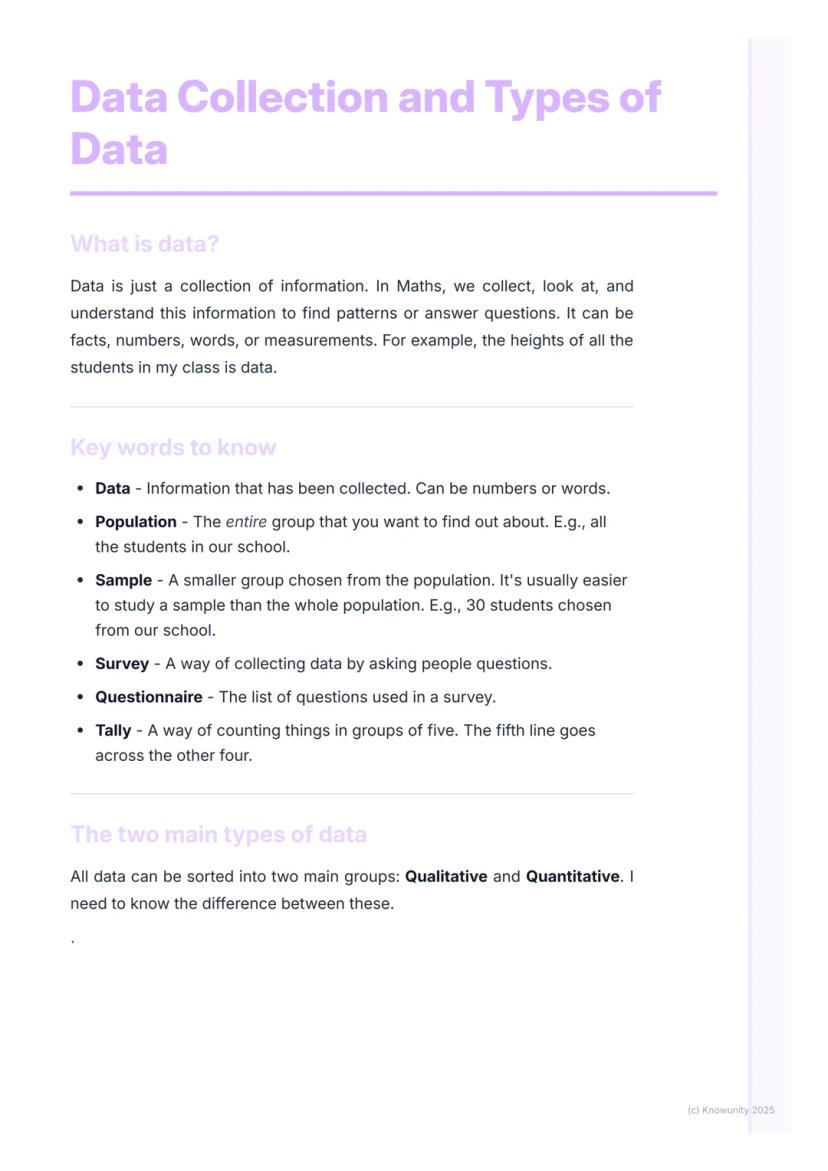
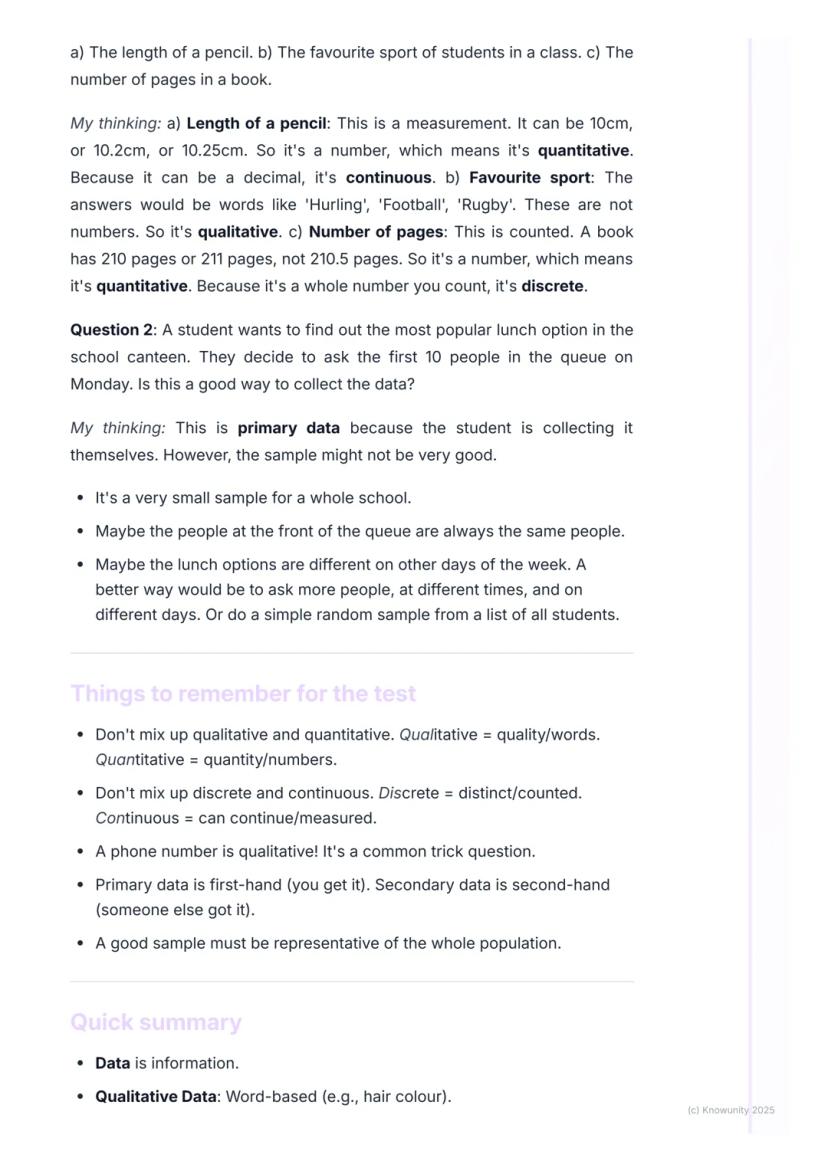
Data is simply a collection of information that helps us answer questions or spot patterns. Think of it like detective work - you're gathering clues to solve a mystery!
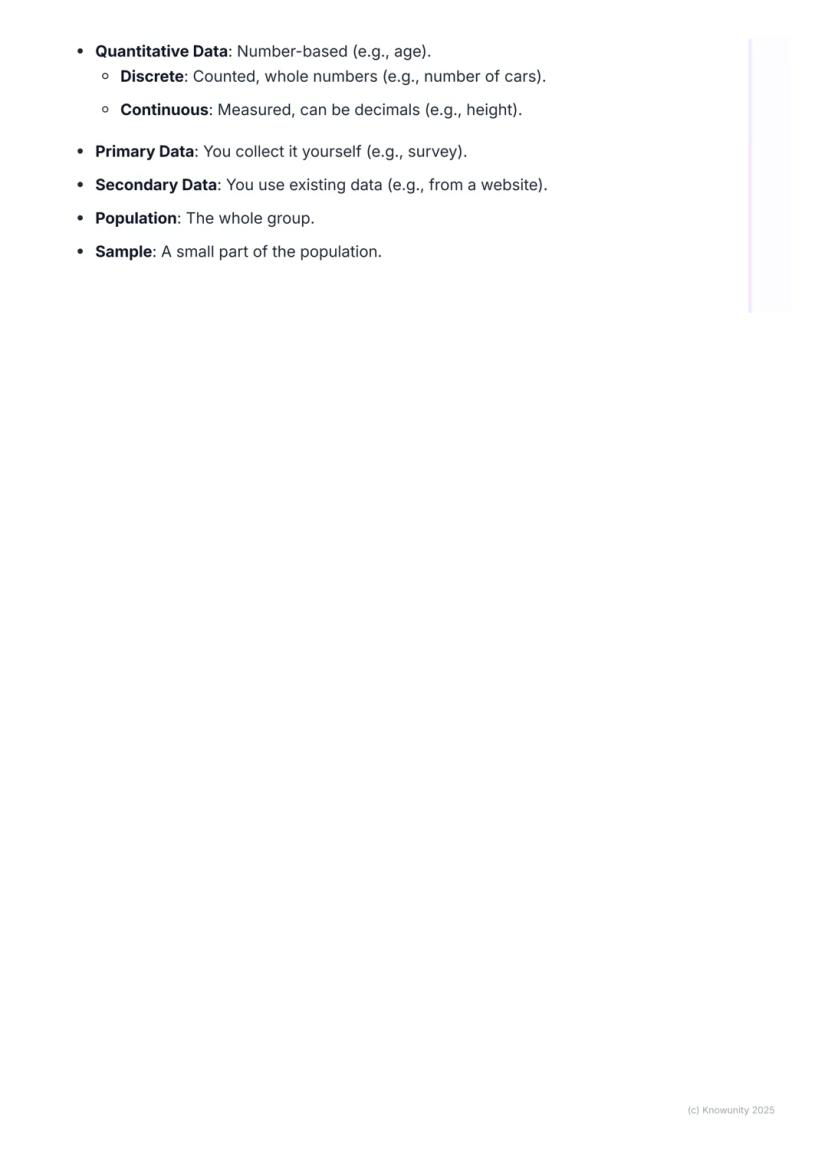
When we talk about data collection, there are some crucial terms you need to know. The population is the entire group you want to learn about (like all students in your school), whilst a sample is just a smaller chunk of that group (maybe 30 students you actually ask). It's usually much easier to study a sample than bug everyone in the whole population!
A survey is how you collect information by asking people questions, and a questionnaire is your list of questions. You'll also use tally marks to count things in groups of five - remember, the fifth line goes diagonally across the other four.
Quick Tip: Think of data like ingredients for a recipe - you need the right information to cook up the perfect answer to your question!
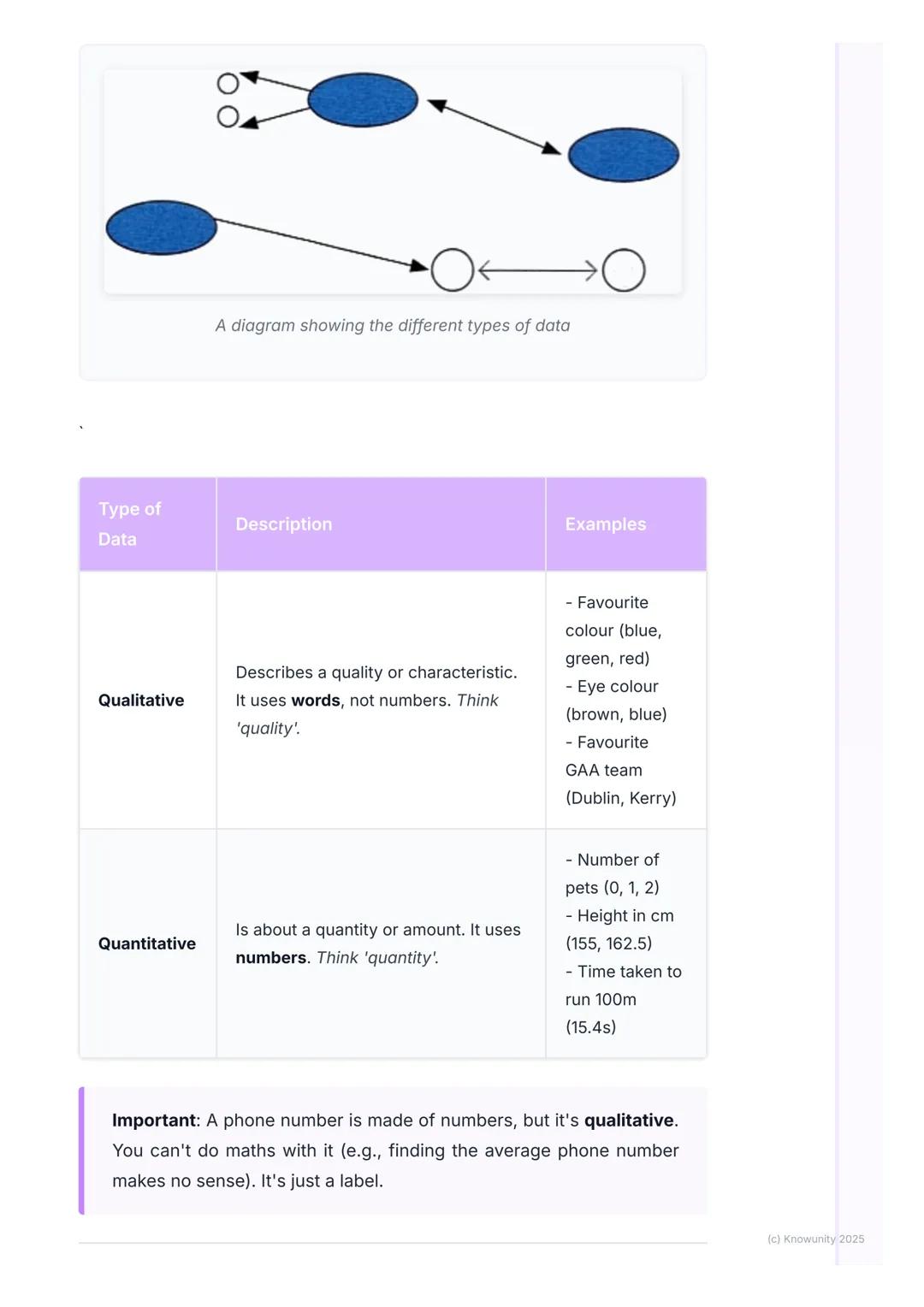
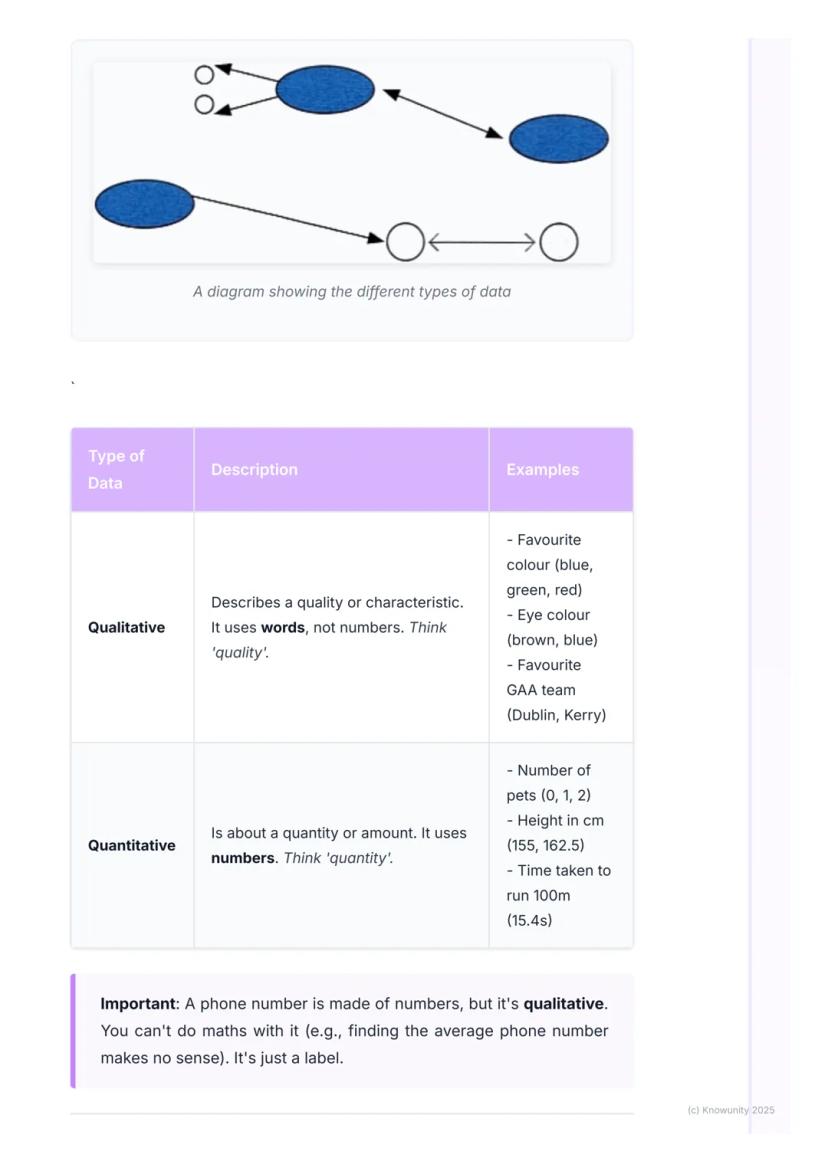
All data fits into two main categories, and knowing the difference is absolutely essential for your exams. Qualitative data describes qualities or characteristics using words - think "quality" to remember this one!
Examples of qualitative data include your favourite colour (blue, green, red), eye colour, or which GAA team you support. These answers use words, not numbers that you can do maths with.
Quantitative data is all about quantities and amounts - it uses numbers that you can actually calculate with. This includes things like the number of pets you have, your height in centimetres, or how long it takes you to run 100 metres.
Here's a sneaky exam trick: phone numbers look like numbers, but they're actually qualitative data! You can't find the average phone number or add them together - they're just labels made of digits.
Remember: Qualitative = Quality = Words, Quantitative = Quantity = Numbers you can calculate with!
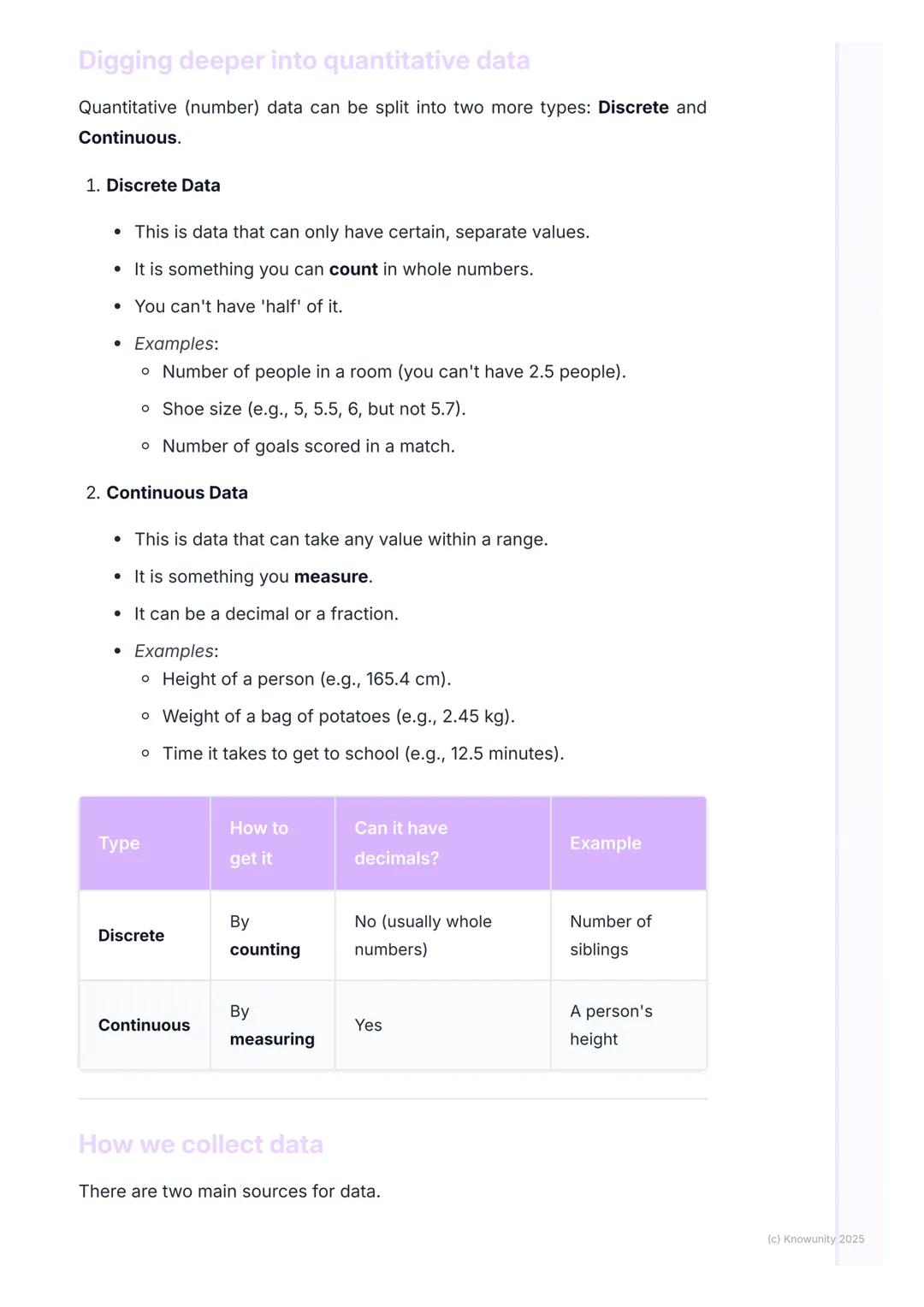
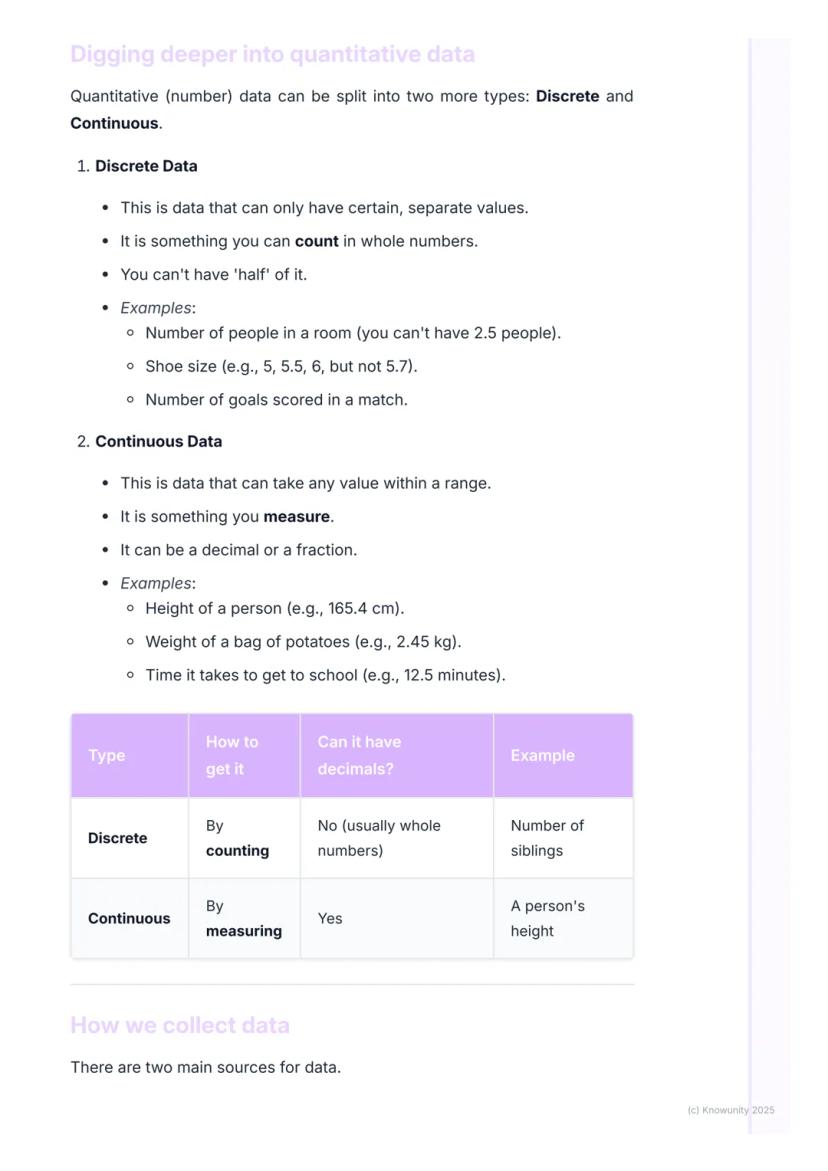
Quantitative data splits into two more types that'll definitely pop up in your tests. Discrete data can only have certain, separate values - you count it in whole numbers and can't have "half" of something.
Think about the number of people in a room (you can't have 2.5 people!) or goals scored in a match. Shoe sizes are discrete too - you might have size 5, 5.5, or 6, but never 5.7.
Continuous data can take any value within a range because you measure it rather than count it. Your height could be 165.4cm, a bag of potatoes might weigh 2.45kg, or your journey to school could take 12.5 minutes.
The easiest way to tell them apart: if you count it, it's discrete. If you measure it, it's continuous. Discrete data usually uses whole numbers, whilst continuous data often includes decimals.
Memory Trick: Discrete = Distinct separate values (count them), Continuous = Can continue with any decimal value (measure them)!
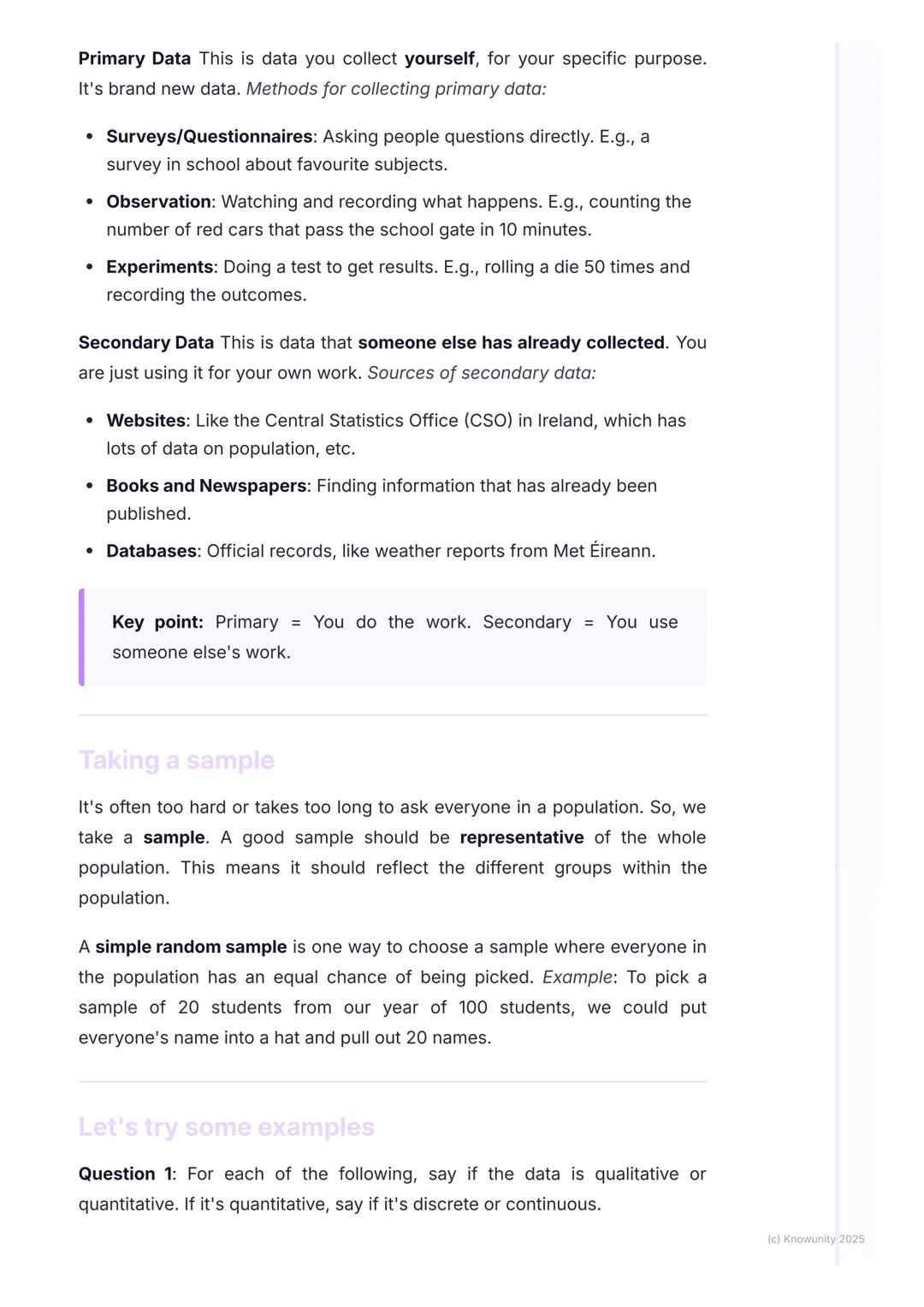
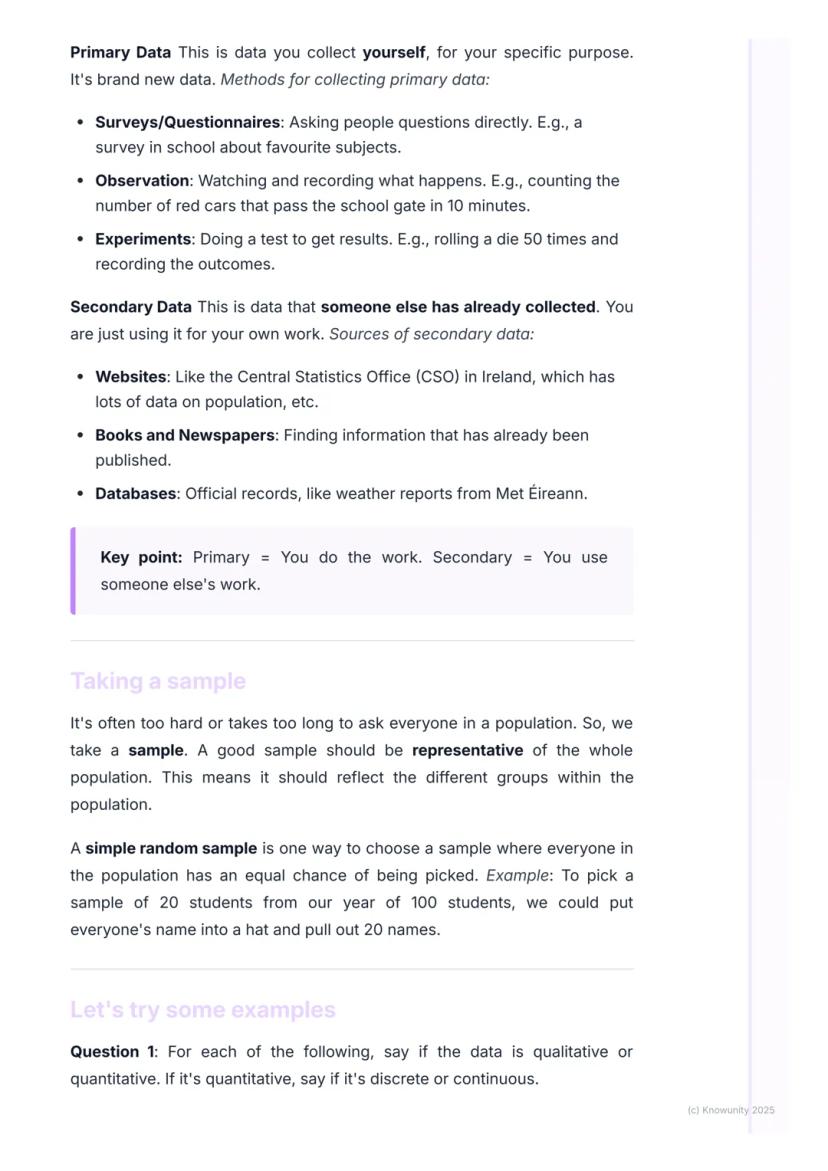
There are two main ways to get your hands on data, and you need to know both for your exams. Primary data is information you collect yourself for your specific project - it's brand new data that you've gathered first-hand.
You can collect primary data through surveys (asking people questions directly), observation (watching and recording what happens), or experiments (like rolling a dice 50 times). Think of yourself as the detective doing all the legwork!
Secondary data is information that someone else has already collected, and you're just borrowing it for your own work. You might find this on websites like the Central Statistics Office, in books and newspapers, or official databases like weather reports from Met Éireann.
Sampling is crucial because asking an entire population takes forever! A simple random sample gives everyone an equal chance of being picked - like pulling names from a hat. Your sample needs to be representative, meaning it reflects the different groups in your whole population.
Key Point: Primary = You do the detective work, Secondary = You use someone else's detective work!
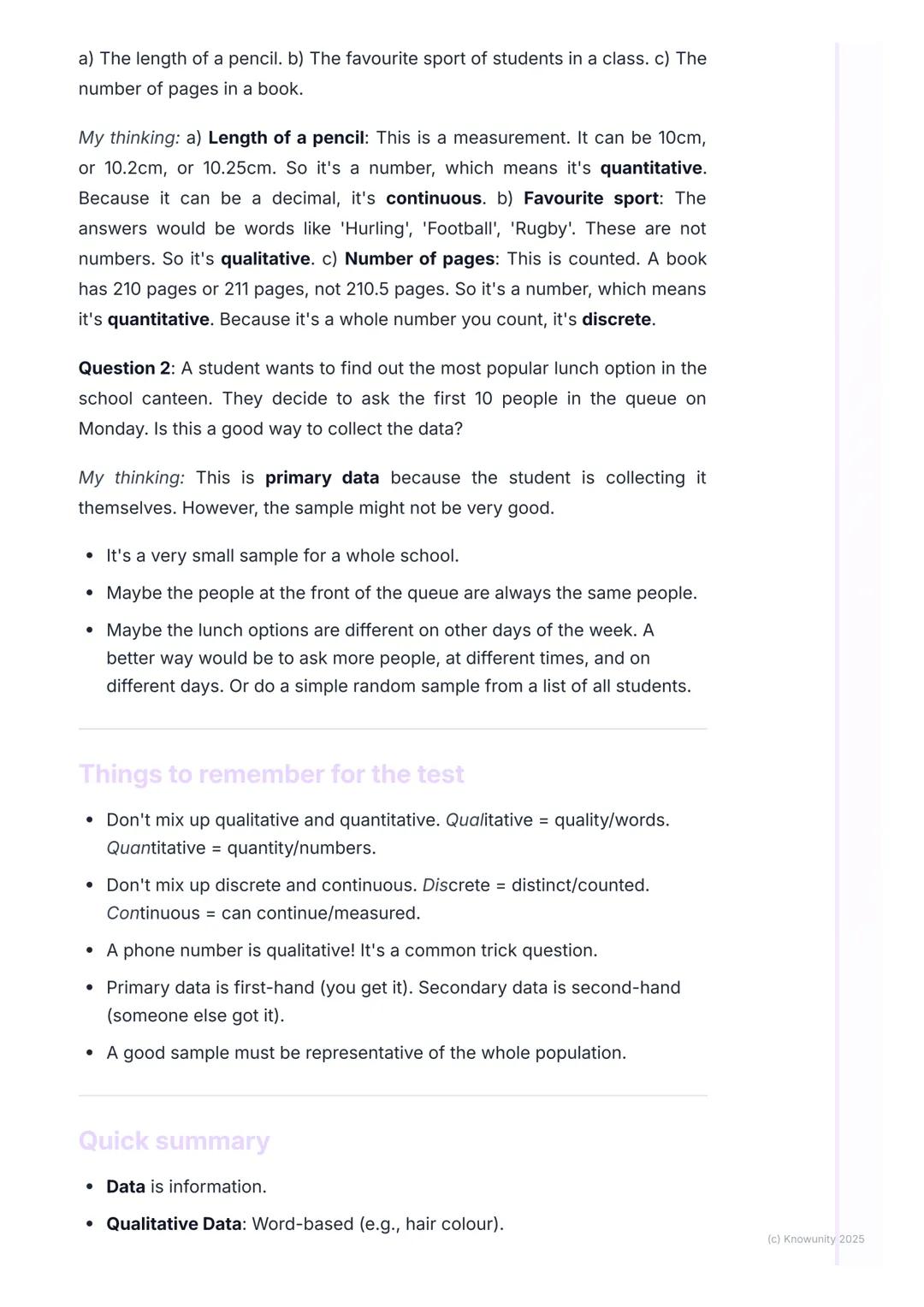
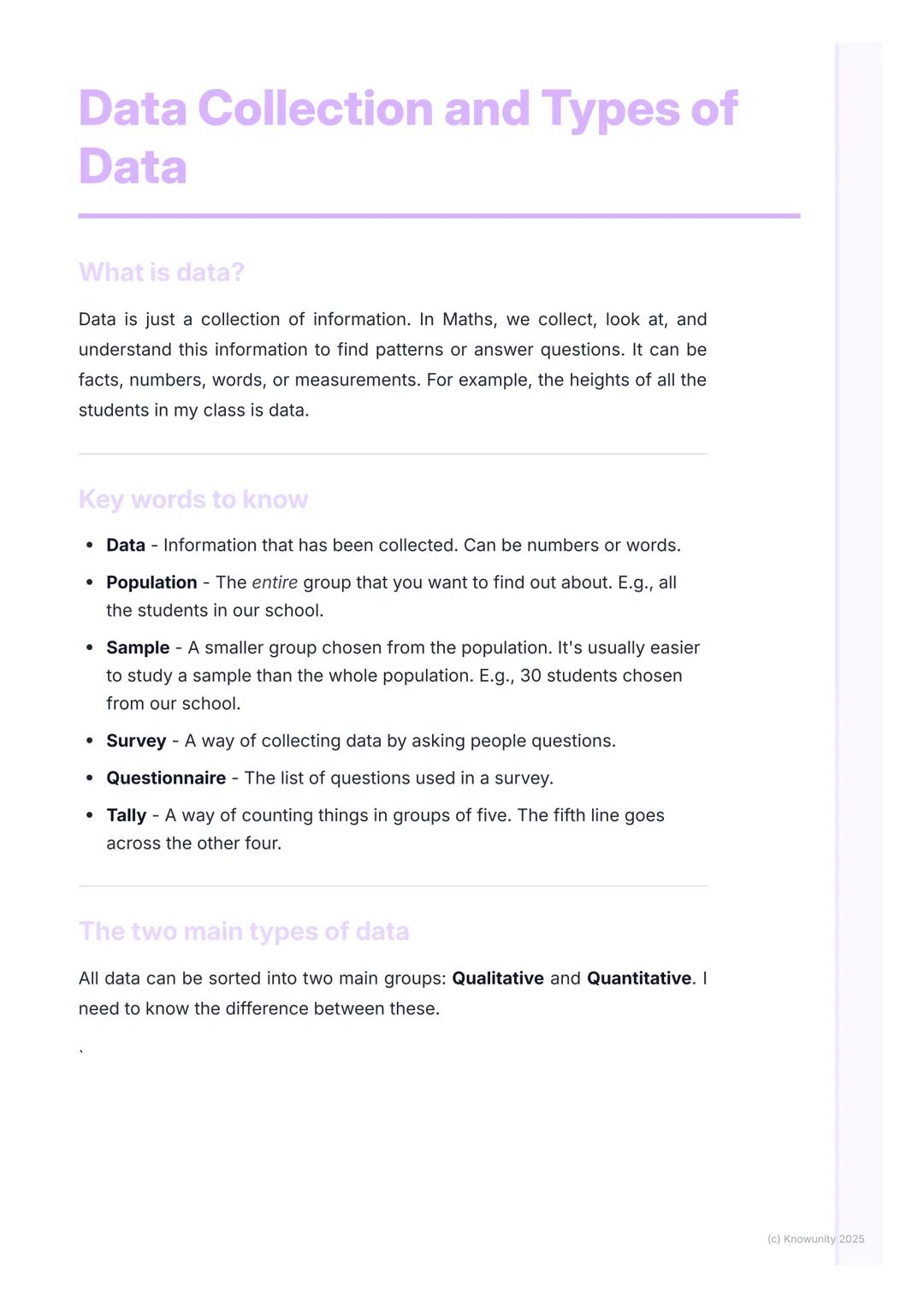
Let's practice with some typical exam questions! For "length of a pencil" - this is measured and can be 10cm, 10.2cm, or 10.25cm, so it's quantitative and continuous. "Favourite sport" gives answers like hurling or rugby (words, not numbers), making it qualitative.
"Number of pages in a book" is counted in whole numbers - a book has 210 or 211 pages, never 210.5 pages. This makes it quantitative and discrete.
Watch out for sampling problems in exam questions! If someone asks only the first 10 people in Monday's lunch queue about favourite canteen food, that's problematic. The sample is tiny, might always be the same people, and only represents Monday's options.
A better approach would involve asking more people across different days and times, or doing a proper random sample. Remember, your sample must represent the whole population fairly, not just whoever's convenient to ask!
Exam Alert: Phone numbers are qualitative data - it's the classic trick question that catches loads of students out!
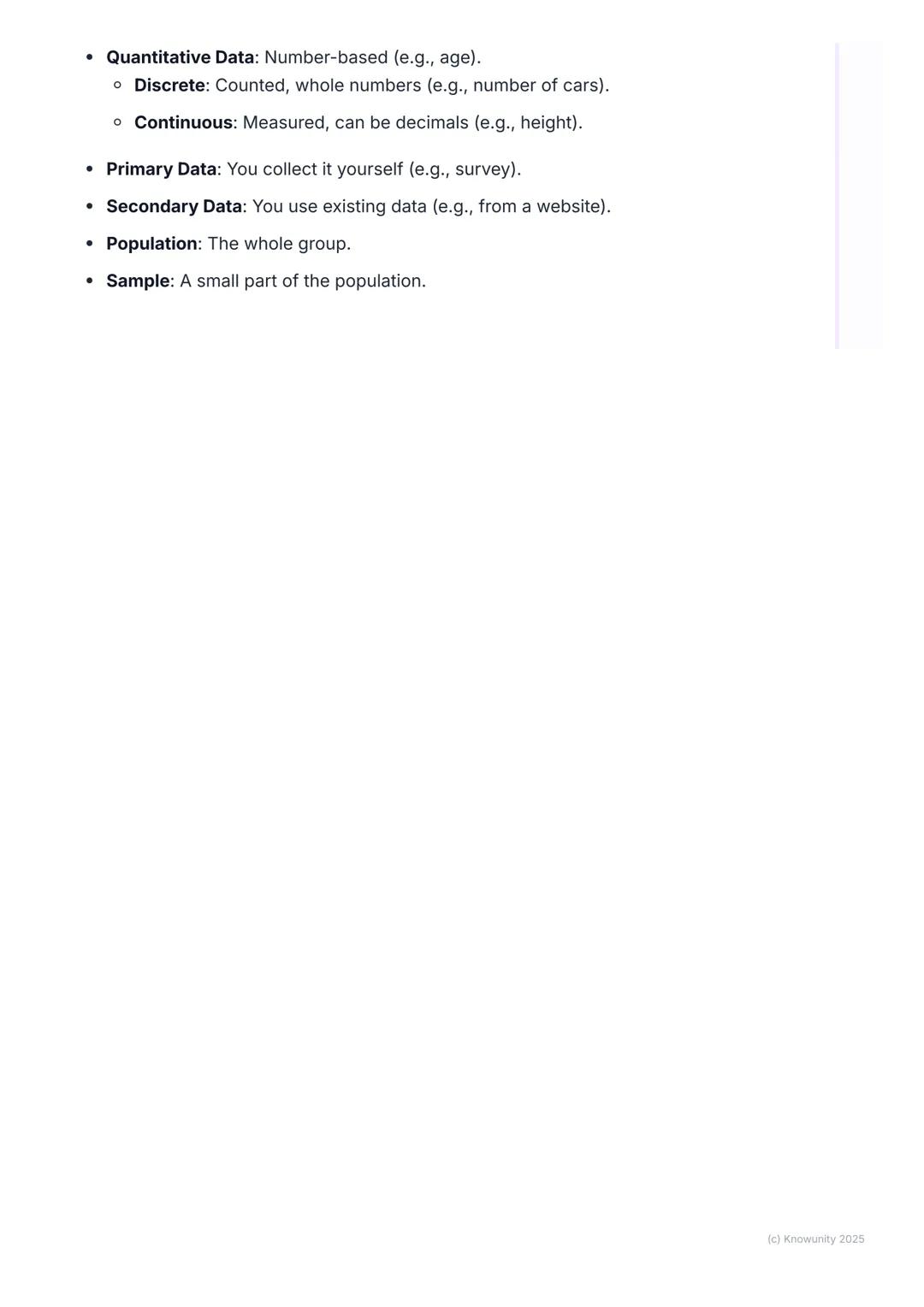
Here's everything you need to remember for your test. Qualitative data uses words to describe qualities (hair colour, favourite team), whilst quantitative data uses numbers you can calculate with (age, height).
Discrete quantitative data is counted in whole numbers (number of cars), and continuous quantitative data is measured with possible decimals (your height). Primary data means you collect it yourself through surveys or experiments, whilst secondary data comes from existing sources like websites or books.
The population is your entire group of interest, but you'll usually study a smaller sample that represents the whole group fairly. A good sample gives everyone an equal chance of being selected.
Don't forget the classic exam tricks: phone numbers are qualitative (even though they look like numbers), and always check whether quantitative data is discrete (counted) or continuous (measured). You've got this!
Success Tip: Make flashcards for qualitative vs quantitative and discrete vs continuous - these definitions are exam gold!
Companionul nostru AI este creat special pentru nevoile studenților. Bazându-ne pe milioanele de materiale de pe platformă, putem oferi răspunsuri exacte și relevante pentru studenți. Dar nu este vorba doar despre răspunsuri, companionul este mai ales despre ghidarea studenților prin provocările zilnice de învățare, cu planuri de studiu personalizate, chestionare sau conținuturi în chat și personalizare 100% bazată pe abilitățile și evoluțiile studenților.
Aplicația este disponibilă în Google Play Store și Apple App Store.
Da! Bucură-te de access la materiale de studiu, conectează-te cu alți elevi, și primește ajutor instant - toate acestea la un click distanță. În plus, câștigă puncte ca să deblochezi mai multe funcționalități!
App Store
Google Play
Aplicația este foarte ușor de utilizat și bine concepută. Am găsit tot ce căutam până acum și am reușit să învăț multe din prezentări! Cu siguranță voi folosi aplicația pentru o temă la clasă! Și desigur, ajută mult ca sursă de inspirație.
Ștefan S
utilizator iOS
Această aplicație este super. Sunt atât de multe materiale de studiu și ajutor pentru elevi [...]. Materia mea mai problematică este franceza, de exemplu, și aplicația oferă foarte multe materiale ajutătoare. Mulțumită acestei aplicații, mi-am îmbunătățit franceza. Aș recomanda-o oricui.
Samantha Klich
utilizator Android
Wow, sunt cu adevărat impresionat. Am încercat aplicația pentru că am văzut-o promovată de multe ori și am rămas uimit. Aceasta este AJUTORUL de care ai nevoie pentru școală și, mai presus de toate, oferă atât de multe lucruri, precum exerciții și fișe de informații, care mi-au fost FOARTE de ajutor.
Anna
utilizator iOS
Te ajută să înveți foarte repede și ști foarte bine ce ai dori tu să înveți, vă recomand cu drag să încercați și să învățați mai repede.!
Thomas R
utilizator iOS
Foarte bună aplicația!!!! Mă ajută să înțeleg mult mai bine lecțiile și temele le termin mult mai repede.👍❤️
Paul P
utilizator Android
Te ajută foarte bine la teme acest robot,recomand!
David K
utilizator iOS
Aplicația e grozavă! Tot ce trebuie să fac este să introduc subiectul în bara de căutare și primesc răspunsul foarte rapid. Nu mai trebuie să mă uit la 10 videoclipuri pe YouTube pentru a înțelege ceva, deci îmi economisesc timpul. Super recomandat!
Sudenaz Ocak
utilizator Android
La școală eram chiar slab la matematică, dar datorită aplicației, mă descurc mai bine acum. Sunt atât de recunoscător că ai creat aplicația.
Greenlight Bonnie
utilizator Android
Această aplicație e super interesantă și seamănă ca tiktok-ul doar că tu ai doar teorie și explicații.
Karla S
utilizator Android
Nu mai trebuie să stau cu orele să învăț după caiet când pot să citesc de 2 ori lecțiile care apar aici și iau 10 la test ! Knowunity m-a ajutat să iau nota 9,20 la română ! Voi recomanda ff tare aceasta aplicate , să nu uităm ca are și chat GPT !👍🏻
Denisa B
utilizator iOS
CHESTIONARELE ȘI FLASHCARD-URILE SUNT ATÂT DE UTILE ȘI IUBESC Knowunity AI. E LITERALMENTE CA CHATGPT DOAR CĂ MAI DEȘTEPT!! M-A AJUTAT ȘI CU PROBLEMELE MELE CU MASCARA!! PLUS CU MATERIILE MELE ADEVĂRATE! EVIDENT 😍😁😲🤑💗✨🎀😮
Sarah L
utilizator Android
Este foarte bună te ajută la teme te face să înțelegi lecțiile am înțeles o lecție în 20 de minute i singură nu reușeam să o învăț dar cu Knowunity am învățat-o foarte ușor
Alessia V
utilizator iOS
Aplicația este foarte ușor de utilizat și bine concepută. Am găsit tot ce căutam până acum și am reușit să învăț multe din prezentări! Cu siguranță voi folosi aplicația pentru o temă la clasă! Și desigur, ajută mult ca sursă de inspirație.
Ștefan S
utilizator iOS
Această aplicație este super. Sunt atât de multe materiale de studiu și ajutor pentru elevi [...]. Materia mea mai problematică este franceza, de exemplu, și aplicația oferă foarte multe materiale ajutătoare. Mulțumită acestei aplicații, mi-am îmbunătățit franceza. Aș recomanda-o oricui.
Samantha Klich
utilizator Android
Wow, sunt cu adevărat impresionat. Am încercat aplicația pentru că am văzut-o promovată de multe ori și am rămas uimit. Aceasta este AJUTORUL de care ai nevoie pentru școală și, mai presus de toate, oferă atât de multe lucruri, precum exerciții și fișe de informații, care mi-au fost FOARTE de ajutor.
Anna
utilizator iOS
Te ajută să înveți foarte repede și ști foarte bine ce ai dori tu să înveți, vă recomand cu drag să încercați și să învățați mai repede.!
Thomas R
utilizator iOS
Foarte bună aplicația!!!! Mă ajută să înțeleg mult mai bine lecțiile și temele le termin mult mai repede.👍❤️
Paul P
utilizator Android
Te ajută foarte bine la teme acest robot,recomand!
David K
utilizator iOS
Aplicația e grozavă! Tot ce trebuie să fac este să introduc subiectul în bara de căutare și primesc răspunsul foarte rapid. Nu mai trebuie să mă uit la 10 videoclipuri pe YouTube pentru a înțelege ceva, deci îmi economisesc timpul. Super recomandat!
Sudenaz Ocak
utilizator Android
La școală eram chiar slab la matematică, dar datorită aplicației, mă descurc mai bine acum. Sunt atât de recunoscător că ai creat aplicația.
Greenlight Bonnie
utilizator Android
Această aplicație e super interesantă și seamănă ca tiktok-ul doar că tu ai doar teorie și explicații.
Karla S
utilizator Android
Nu mai trebuie să stau cu orele să învăț după caiet când pot să citesc de 2 ori lecțiile care apar aici și iau 10 la test ! Knowunity m-a ajutat să iau nota 9,20 la română ! Voi recomanda ff tare aceasta aplicate , să nu uităm ca are și chat GPT !👍🏻
Denisa B
utilizator iOS
CHESTIONARELE ȘI FLASHCARD-URILE SUNT ATÂT DE UTILE ȘI IUBESC Knowunity AI. E LITERALMENTE CA CHATGPT DOAR CĂ MAI DEȘTEPT!! M-A AJUTAT ȘI CU PROBLEMELE MELE CU MASCARA!! PLUS CU MATERIILE MELE ADEVĂRATE! EVIDENT 😍😁😲🤑💗✨🎀😮
Sarah L
utilizator Android
Este foarte bună te ajută la teme te face să înțelegi lecțiile am înțeles o lecție în 20 de minute i singură nu reușeam să o învăț dar cu Knowunity am învățat-o foarte ușor
Alessia V
utilizator iOS
Ever wondered how companies know what flavour of crisps to make next, or how scientists discover new things? It all starts with data- basically just collecting information to answer questions. Learning about data types and collection methods will help... Afișează mai mult
Acces la toate documentele
Îmbunătățește notele tale!
Alătură-te milioanelor de elevi
Data is simply a collection of information that helps us answer questions or spot patterns. Think of it like detective work - you're gathering clues to solve a mystery!
When we talk about data collection, there are some crucial terms you need to know. The population is the entire group you want to learn about (like all students in your school), whilst a sample is just a smaller chunk of that group (maybe 30 students you actually ask). It's usually much easier to study a sample than bug everyone in the whole population!
A survey is how you collect information by asking people questions, and a questionnaire is your list of questions. You'll also use tally marks to count things in groups of five - remember, the fifth line goes diagonally across the other four.
Quick Tip: Think of data like ingredients for a recipe - you need the right information to cook up the perfect answer to your question!
Acces la toate documentele
Îmbunătățește notele tale!
Alătură-te milioanelor de elevi
All data fits into two main categories, and knowing the difference is absolutely essential for your exams. Qualitative data describes qualities or characteristics using words - think "quality" to remember this one!
Examples of qualitative data include your favourite colour (blue, green, red), eye colour, or which GAA team you support. These answers use words, not numbers that you can do maths with.
Quantitative data is all about quantities and amounts - it uses numbers that you can actually calculate with. This includes things like the number of pets you have, your height in centimetres, or how long it takes you to run 100 metres.
Here's a sneaky exam trick: phone numbers look like numbers, but they're actually qualitative data! You can't find the average phone number or add them together - they're just labels made of digits.
Remember: Qualitative = Quality = Words, Quantitative = Quantity = Numbers you can calculate with!
Acces la toate documentele
Îmbunătățește notele tale!
Alătură-te milioanelor de elevi
Quantitative data splits into two more types that'll definitely pop up in your tests. Discrete data can only have certain, separate values - you count it in whole numbers and can't have "half" of something.
Think about the number of people in a room (you can't have 2.5 people!) or goals scored in a match. Shoe sizes are discrete too - you might have size 5, 5.5, or 6, but never 5.7.
Continuous data can take any value within a range because you measure it rather than count it. Your height could be 165.4cm, a bag of potatoes might weigh 2.45kg, or your journey to school could take 12.5 minutes.
The easiest way to tell them apart: if you count it, it's discrete. If you measure it, it's continuous. Discrete data usually uses whole numbers, whilst continuous data often includes decimals.
Memory Trick: Discrete = Distinct separate values (count them), Continuous = Can continue with any decimal value (measure them)!
Acces la toate documentele
Îmbunătățește notele tale!
Alătură-te milioanelor de elevi
There are two main ways to get your hands on data, and you need to know both for your exams. Primary data is information you collect yourself for your specific project - it's brand new data that you've gathered first-hand.
You can collect primary data through surveys (asking people questions directly), observation (watching and recording what happens), or experiments (like rolling a dice 50 times). Think of yourself as the detective doing all the legwork!
Secondary data is information that someone else has already collected, and you're just borrowing it for your own work. You might find this on websites like the Central Statistics Office, in books and newspapers, or official databases like weather reports from Met Éireann.
Sampling is crucial because asking an entire population takes forever! A simple random sample gives everyone an equal chance of being picked - like pulling names from a hat. Your sample needs to be representative, meaning it reflects the different groups in your whole population.
Key Point: Primary = You do the detective work, Secondary = You use someone else's detective work!
Acces la toate documentele
Îmbunătățește notele tale!
Alătură-te milioanelor de elevi
Let's practice with some typical exam questions! For "length of a pencil" - this is measured and can be 10cm, 10.2cm, or 10.25cm, so it's quantitative and continuous. "Favourite sport" gives answers like hurling or rugby (words, not numbers), making it qualitative.
"Number of pages in a book" is counted in whole numbers - a book has 210 or 211 pages, never 210.5 pages. This makes it quantitative and discrete.
Watch out for sampling problems in exam questions! If someone asks only the first 10 people in Monday's lunch queue about favourite canteen food, that's problematic. The sample is tiny, might always be the same people, and only represents Monday's options.
A better approach would involve asking more people across different days and times, or doing a proper random sample. Remember, your sample must represent the whole population fairly, not just whoever's convenient to ask!
Exam Alert: Phone numbers are qualitative data - it's the classic trick question that catches loads of students out!
Acces la toate documentele
Îmbunătățește notele tale!
Alătură-te milioanelor de elevi
Here's everything you need to remember for your test. Qualitative data uses words to describe qualities (hair colour, favourite team), whilst quantitative data uses numbers you can calculate with (age, height).
Discrete quantitative data is counted in whole numbers (number of cars), and continuous quantitative data is measured with possible decimals (your height). Primary data means you collect it yourself through surveys or experiments, whilst secondary data comes from existing sources like websites or books.
The population is your entire group of interest, but you'll usually study a smaller sample that represents the whole group fairly. A good sample gives everyone an equal chance of being selected.
Don't forget the classic exam tricks: phone numbers are qualitative (even though they look like numbers), and always check whether quantitative data is discrete (counted) or continuous (measured). You've got this!
Success Tip: Make flashcards for qualitative vs quantitative and discrete vs continuous - these definitions are exam gold!
Companionul nostru AI este creat special pentru nevoile studenților. Bazându-ne pe milioanele de materiale de pe platformă, putem oferi răspunsuri exacte și relevante pentru studenți. Dar nu este vorba doar despre răspunsuri, companionul este mai ales despre ghidarea studenților prin provocările zilnice de învățare, cu planuri de studiu personalizate, chestionare sau conținuturi în chat și personalizare 100% bazată pe abilitățile și evoluțiile studenților.
Aplicația este disponibilă în Google Play Store și Apple App Store.
Da! Bucură-te de access la materiale de studiu, conectează-te cu alți elevi, și primește ajutor instant - toate acestea la un click distanță. În plus, câștigă puncte ca să deblochezi mai multe funcționalități!
3
Instrumente inteligente NOU
Transformă această notiță în: ✓ 50+ întrebări de exersare ✓ Flashcard-uri interactive ✓ Examen de practică complet ✓ Planuri de eseu
App Store
Google Play
Aplicația este foarte ușor de utilizat și bine concepută. Am găsit tot ce căutam până acum și am reușit să învăț multe din prezentări! Cu siguranță voi folosi aplicația pentru o temă la clasă! Și desigur, ajută mult ca sursă de inspirație.
Ștefan S
utilizator iOS
Această aplicație este super. Sunt atât de multe materiale de studiu și ajutor pentru elevi [...]. Materia mea mai problematică este franceza, de exemplu, și aplicația oferă foarte multe materiale ajutătoare. Mulțumită acestei aplicații, mi-am îmbunătățit franceza. Aș recomanda-o oricui.
Samantha Klich
utilizator Android
Wow, sunt cu adevărat impresionat. Am încercat aplicația pentru că am văzut-o promovată de multe ori și am rămas uimit. Aceasta este AJUTORUL de care ai nevoie pentru școală și, mai presus de toate, oferă atât de multe lucruri, precum exerciții și fișe de informații, care mi-au fost FOARTE de ajutor.
Anna
utilizator iOS
Te ajută să înveți foarte repede și ști foarte bine ce ai dori tu să înveți, vă recomand cu drag să încercați și să învățați mai repede.!
Thomas R
utilizator iOS
Foarte bună aplicația!!!! Mă ajută să înțeleg mult mai bine lecțiile și temele le termin mult mai repede.👍❤️
Paul P
utilizator Android
Te ajută foarte bine la teme acest robot,recomand!
David K
utilizator iOS
Aplicația e grozavă! Tot ce trebuie să fac este să introduc subiectul în bara de căutare și primesc răspunsul foarte rapid. Nu mai trebuie să mă uit la 10 videoclipuri pe YouTube pentru a înțelege ceva, deci îmi economisesc timpul. Super recomandat!
Sudenaz Ocak
utilizator Android
La școală eram chiar slab la matematică, dar datorită aplicației, mă descurc mai bine acum. Sunt atât de recunoscător că ai creat aplicația.
Greenlight Bonnie
utilizator Android
Această aplicație e super interesantă și seamănă ca tiktok-ul doar că tu ai doar teorie și explicații.
Karla S
utilizator Android
Nu mai trebuie să stau cu orele să învăț după caiet când pot să citesc de 2 ori lecțiile care apar aici și iau 10 la test ! Knowunity m-a ajutat să iau nota 9,20 la română ! Voi recomanda ff tare aceasta aplicate , să nu uităm ca are și chat GPT !👍🏻
Denisa B
utilizator iOS
CHESTIONARELE ȘI FLASHCARD-URILE SUNT ATÂT DE UTILE ȘI IUBESC Knowunity AI. E LITERALMENTE CA CHATGPT DOAR CĂ MAI DEȘTEPT!! M-A AJUTAT ȘI CU PROBLEMELE MELE CU MASCARA!! PLUS CU MATERIILE MELE ADEVĂRATE! EVIDENT 😍😁😲🤑💗✨🎀😮
Sarah L
utilizator Android
Este foarte bună te ajută la teme te face să înțelegi lecțiile am înțeles o lecție în 20 de minute i singură nu reușeam să o învăț dar cu Knowunity am învățat-o foarte ușor
Alessia V
utilizator iOS
Aplicația este foarte ușor de utilizat și bine concepută. Am găsit tot ce căutam până acum și am reușit să învăț multe din prezentări! Cu siguranță voi folosi aplicația pentru o temă la clasă! Și desigur, ajută mult ca sursă de inspirație.
Ștefan S
utilizator iOS
Această aplicație este super. Sunt atât de multe materiale de studiu și ajutor pentru elevi [...]. Materia mea mai problematică este franceza, de exemplu, și aplicația oferă foarte multe materiale ajutătoare. Mulțumită acestei aplicații, mi-am îmbunătățit franceza. Aș recomanda-o oricui.
Samantha Klich
utilizator Android
Wow, sunt cu adevărat impresionat. Am încercat aplicația pentru că am văzut-o promovată de multe ori și am rămas uimit. Aceasta este AJUTORUL de care ai nevoie pentru școală și, mai presus de toate, oferă atât de multe lucruri, precum exerciții și fișe de informații, care mi-au fost FOARTE de ajutor.
Anna
utilizator iOS
Te ajută să înveți foarte repede și ști foarte bine ce ai dori tu să înveți, vă recomand cu drag să încercați și să învățați mai repede.!
Thomas R
utilizator iOS
Foarte bună aplicația!!!! Mă ajută să înțeleg mult mai bine lecțiile și temele le termin mult mai repede.👍❤️
Paul P
utilizator Android
Te ajută foarte bine la teme acest robot,recomand!
David K
utilizator iOS
Aplicația e grozavă! Tot ce trebuie să fac este să introduc subiectul în bara de căutare și primesc răspunsul foarte rapid. Nu mai trebuie să mă uit la 10 videoclipuri pe YouTube pentru a înțelege ceva, deci îmi economisesc timpul. Super recomandat!
Sudenaz Ocak
utilizator Android
La școală eram chiar slab la matematică, dar datorită aplicației, mă descurc mai bine acum. Sunt atât de recunoscător că ai creat aplicația.
Greenlight Bonnie
utilizator Android
Această aplicație e super interesantă și seamănă ca tiktok-ul doar că tu ai doar teorie și explicații.
Karla S
utilizator Android
Nu mai trebuie să stau cu orele să învăț după caiet când pot să citesc de 2 ori lecțiile care apar aici și iau 10 la test ! Knowunity m-a ajutat să iau nota 9,20 la română ! Voi recomanda ff tare aceasta aplicate , să nu uităm ca are și chat GPT !👍🏻
Denisa B
utilizator iOS
CHESTIONARELE ȘI FLASHCARD-URILE SUNT ATÂT DE UTILE ȘI IUBESC Knowunity AI. E LITERALMENTE CA CHATGPT DOAR CĂ MAI DEȘTEPT!! M-A AJUTAT ȘI CU PROBLEMELE MELE CU MASCARA!! PLUS CU MATERIILE MELE ADEVĂRATE! EVIDENT 😍😁😲🤑💗✨🎀😮
Sarah L
utilizator Android
Este foarte bună te ajută la teme te face să înțelegi lecțiile am înțeles o lecție în 20 de minute i singură nu reușeam să o învăț dar cu Knowunity am învățat-o foarte ușor
Alessia V
utilizator iOS