
Ever wondered why we use letters in maths? Algebraic expressions...
 Mathematics13 vizualizări·Actualizat Jun 7, 2026·5 pagini
Understanding and Simplifying Algebraic Expressions
1 / 5
1
of 5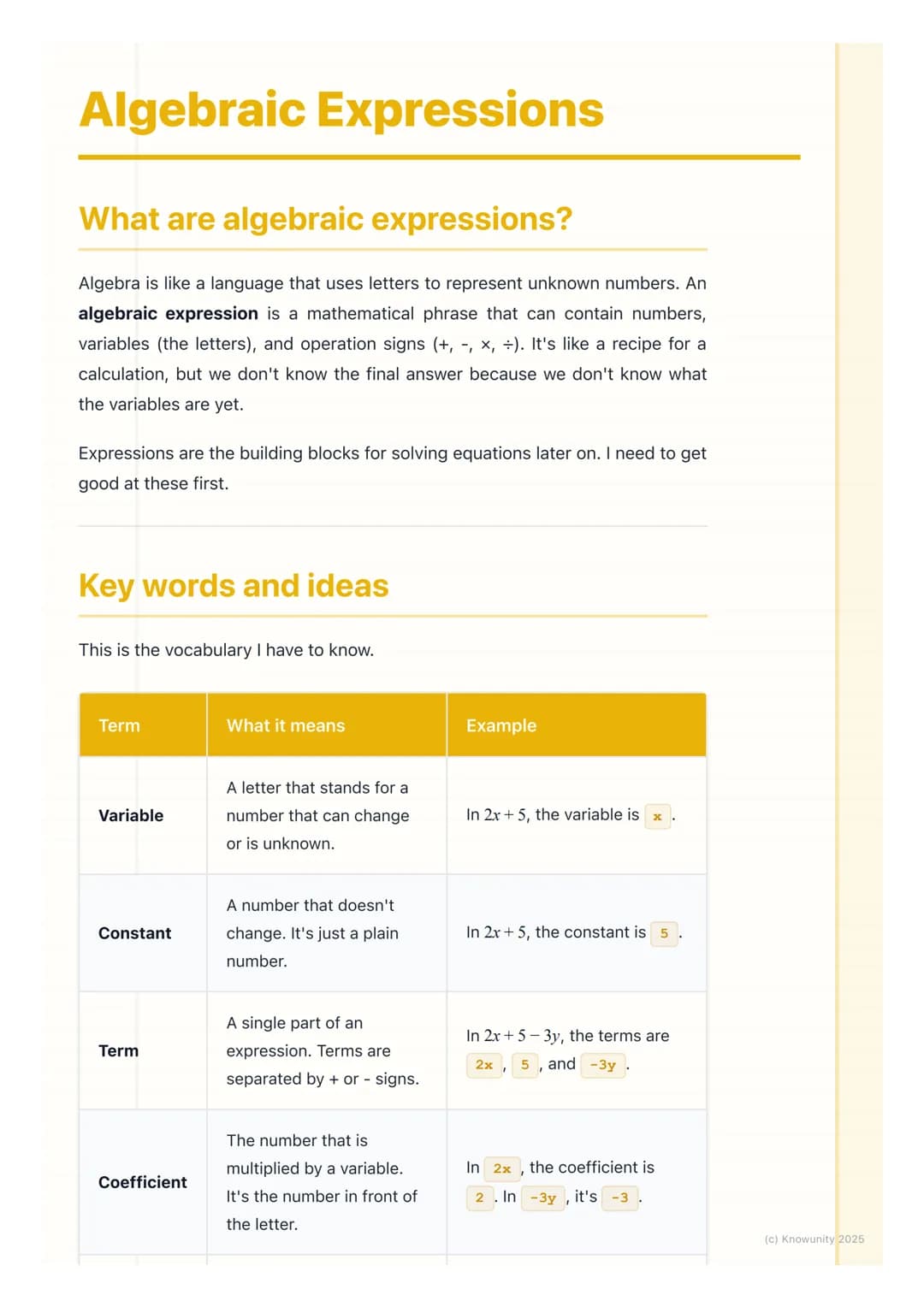
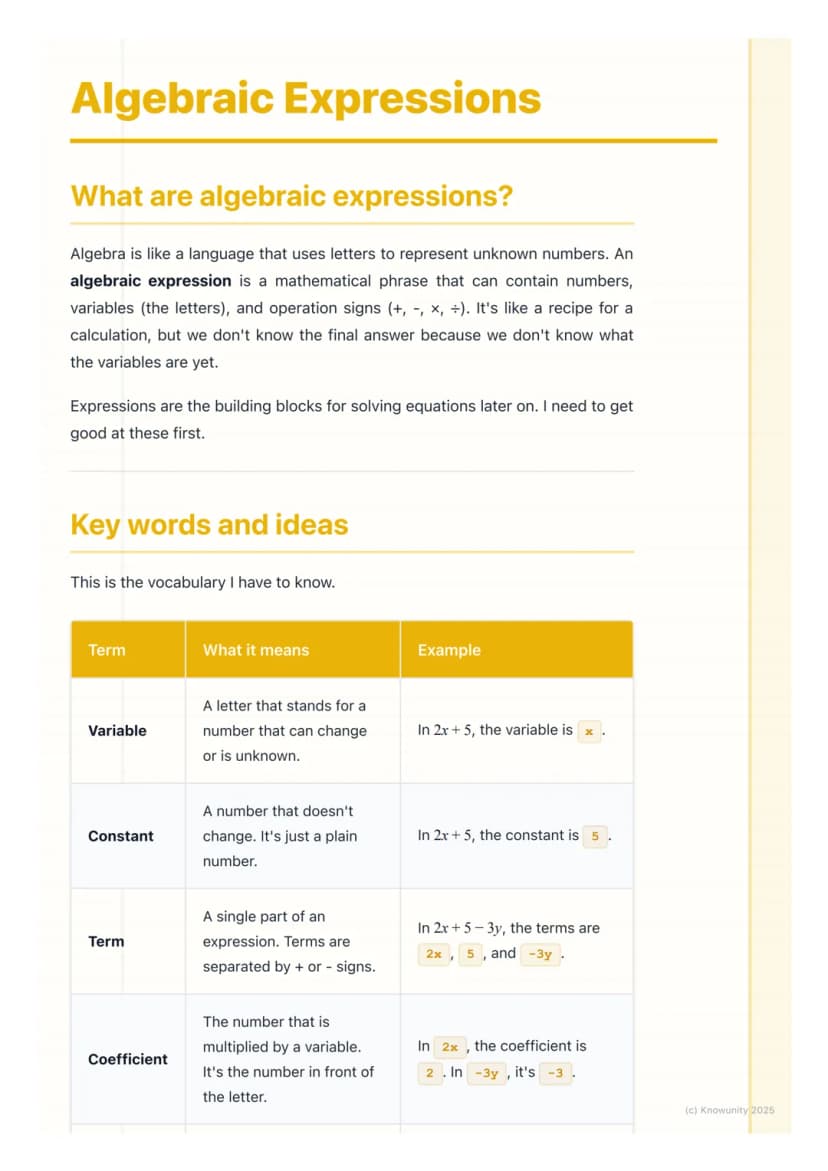
What are Algebraic Expressions?
Think of algebraic expressions as mathematical phrases that mix numbers, letters, and operation signs (+, -, ×, ÷). Unlike equations, expressions don't have an equals sign - they're just a collection of mathematical terms waiting to be worked with.
The letters in expressions are called variables, and they represent unknown numbers. A term is each separate part of an expression, like 4x, -5y, or just 8 on its own.
Like terms are terms that have exactly the same variable part, including any powers. For example, 3x and -5x are like terms because they both have just 'x'. However, 3x and 3x² are NOT like terms because one has x and the other has x².
Remember: Expressions are the foundation for solving equations later, so getting comfortable with these basics now will make your life much easier!
2
of 5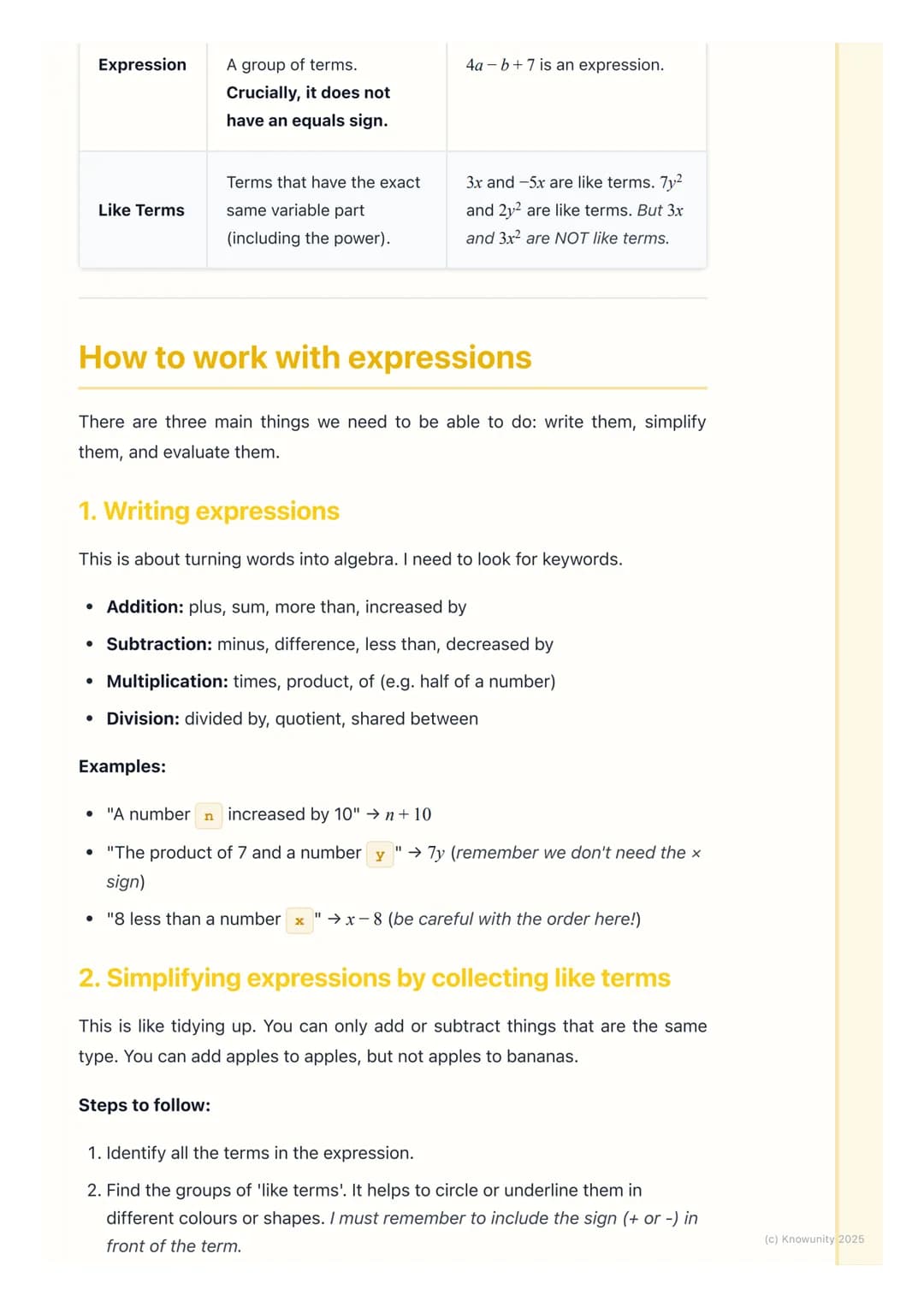
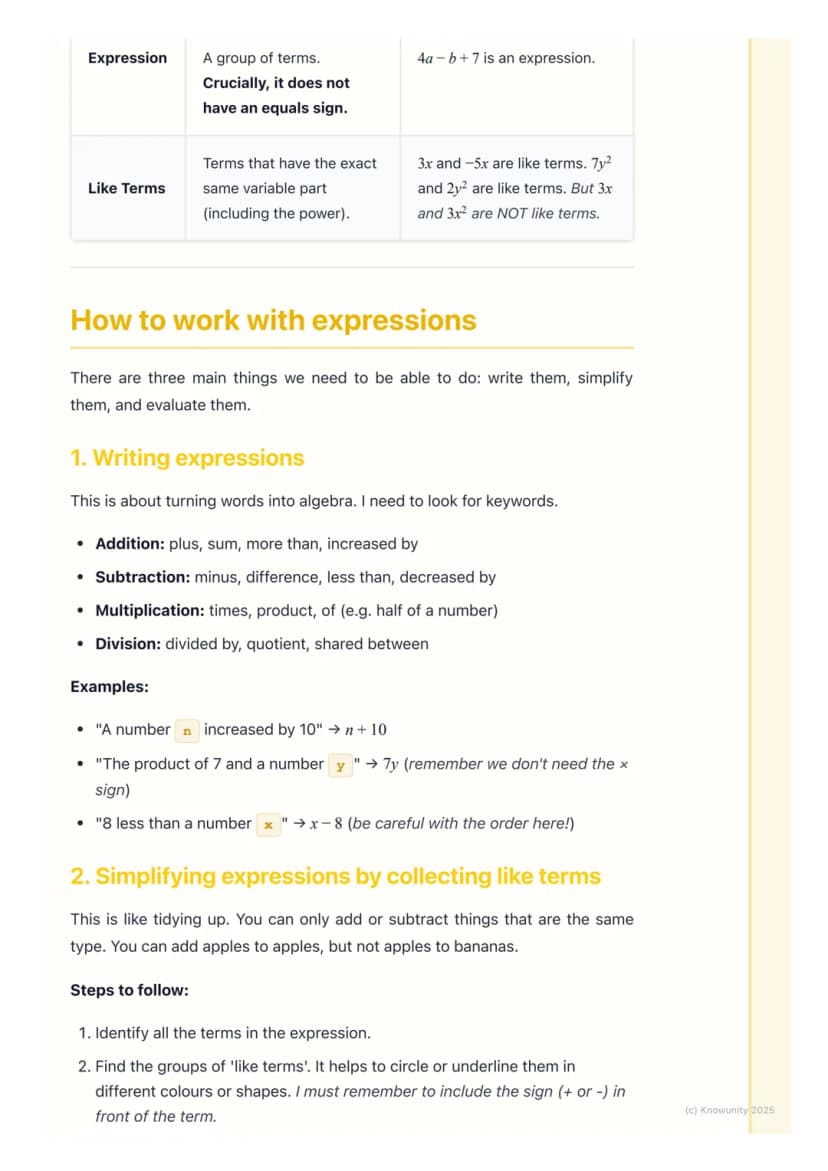
Writing Expressions from Words
Converting word problems into algebraic expressions is all about spotting the right keywords. Once you know what to look for, it becomes like translating from English to maths.
Addition keywords: plus, sum, more than, increased by
Subtraction keywords: minus, difference, less than, decreased by
Multiplication keywords: times, product, of (like "half of a number")
Division keywords: divided by, quotient, shared between
Watch out for tricky phrases like "8 less than a number x" - this becomes x - 8, not 8 - x. The order matters! "A number n increased by 10" simply becomes n + 10, while "the product of 7 and a number y" becomes 7y (no multiplication sign needed).
Top tip: Always double-check the order, especially with subtraction. "Less than" flips the order around!
3
of 5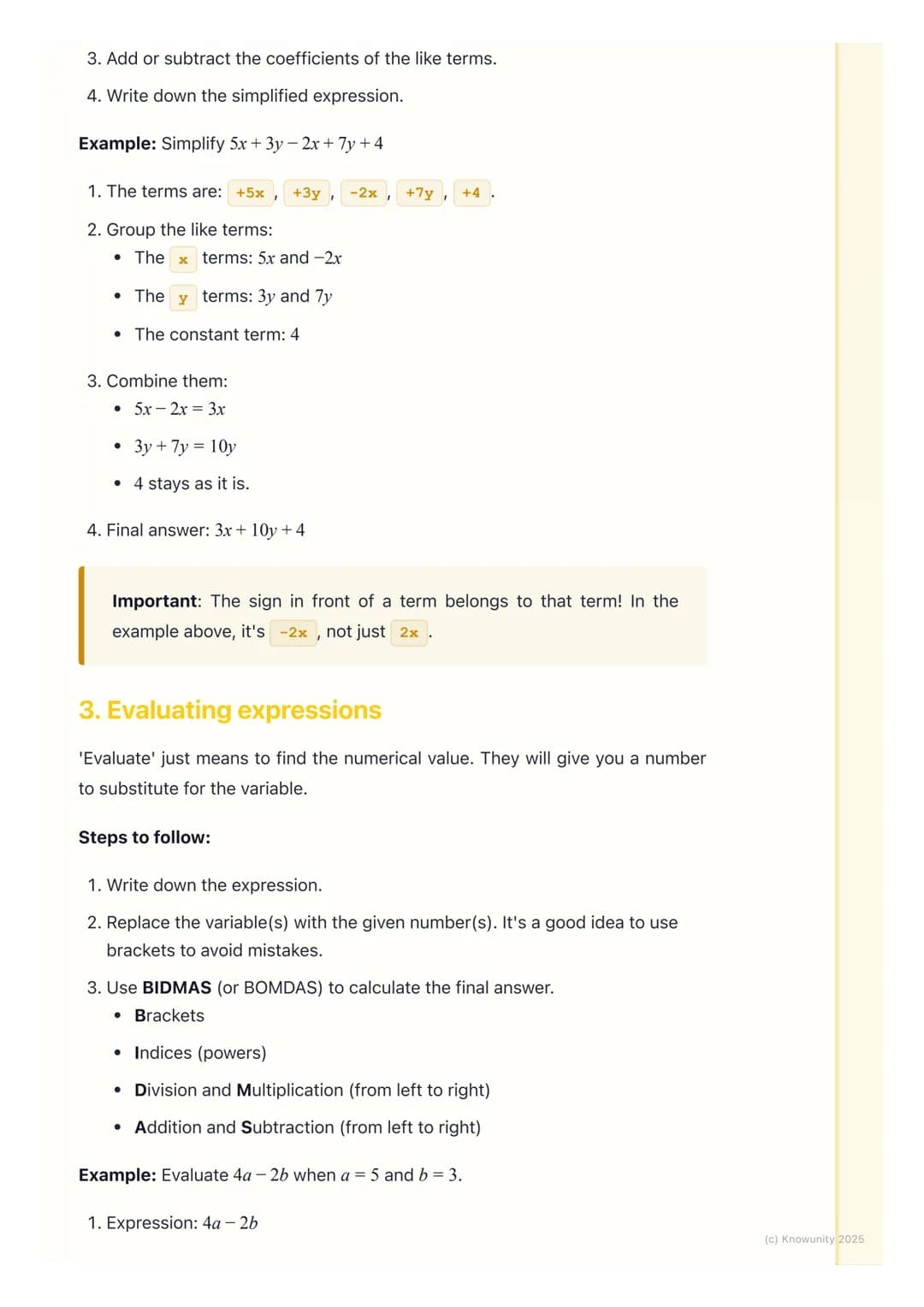
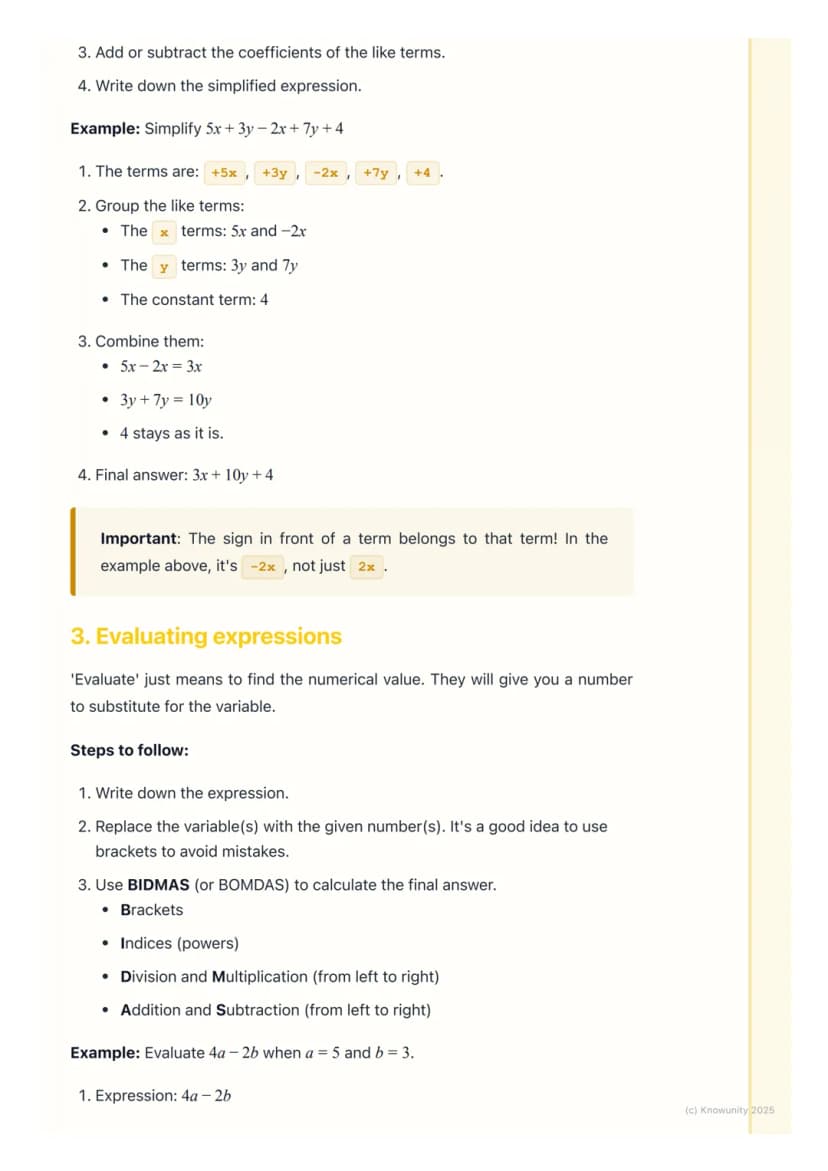
Simplifying by Collecting Like Terms
Simplifying expressions is like tidying your room - you group similar things together. You can only combine terms that are exactly the same type, just like you can add apples to apples but not apples to oranges.
Here's your step-by-step process: First, identify all the terms in the expression. Next, find groups of like terms - it helps to circle them in different colours. Remember to include the + or - sign with each term!
Then add or subtract the coefficients (the numbers in front) of like terms. Finally, write your simplified expression.
Let's try: 5x + 3y - 2x + 7y + 4. Group the x terms , the y terms (3y and 7y), and the constant (4). Combine: 5x - 2x = 3x, 3y + 7y = 10y, and 4 stays as is. Your answer: 3x + 10y + 4.
Watch out: The sign in front of a term belongs to that term! So -2x means negative 2x, not positive 2x that you subtract later.
4
of 5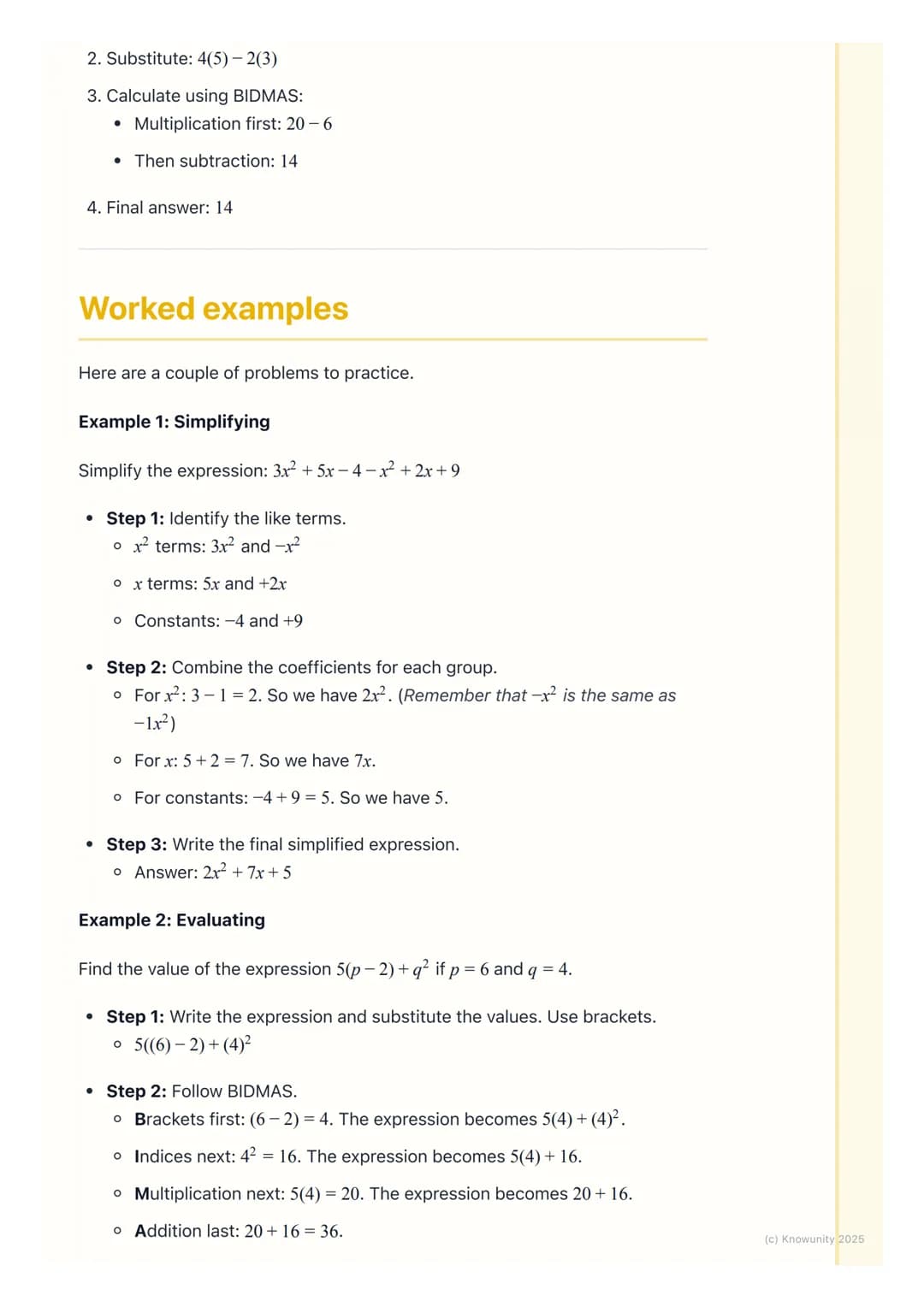
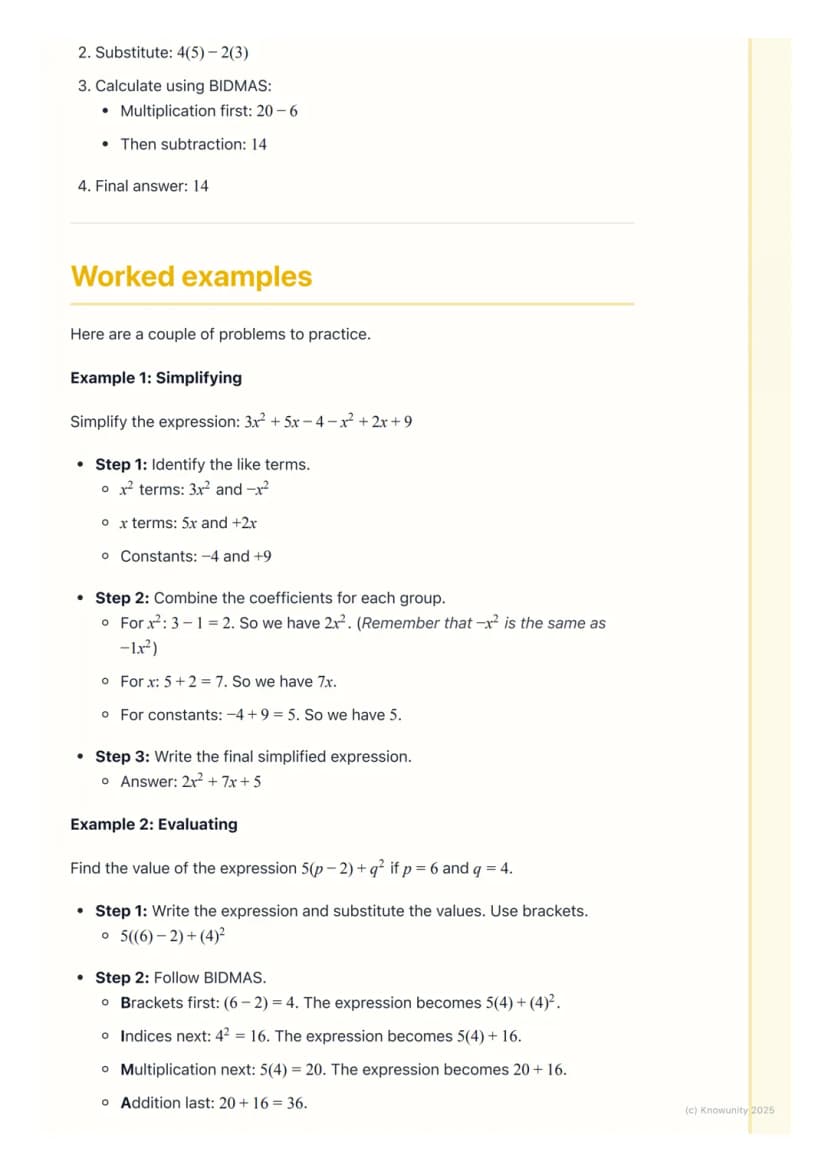
Evaluating Expressions
Evaluating expressions means finding the actual number value when you're given specific values for the variables. It's like following a recipe when you finally know all the ingredients.
Your method is simple: write the expression, replace each variable with its given number (use brackets to avoid mistakes!), then use BIDMAS to calculate your final answer.
BIDMAS stands for: Brackets, Indices (powers), Division and Multiplication (left to right), Addition and Subtraction (left to right).
Example: Evaluate 4a - 2b when a = 5 and b = 3. Substitute: 4(5) - 2(3). Calculate: 20 - 6 = 14.
Pro tip: Always use brackets when substituting, especially with negative numbers. If x = -3, then x² = (-3)² = 9, not -3² = -9!
5
of 5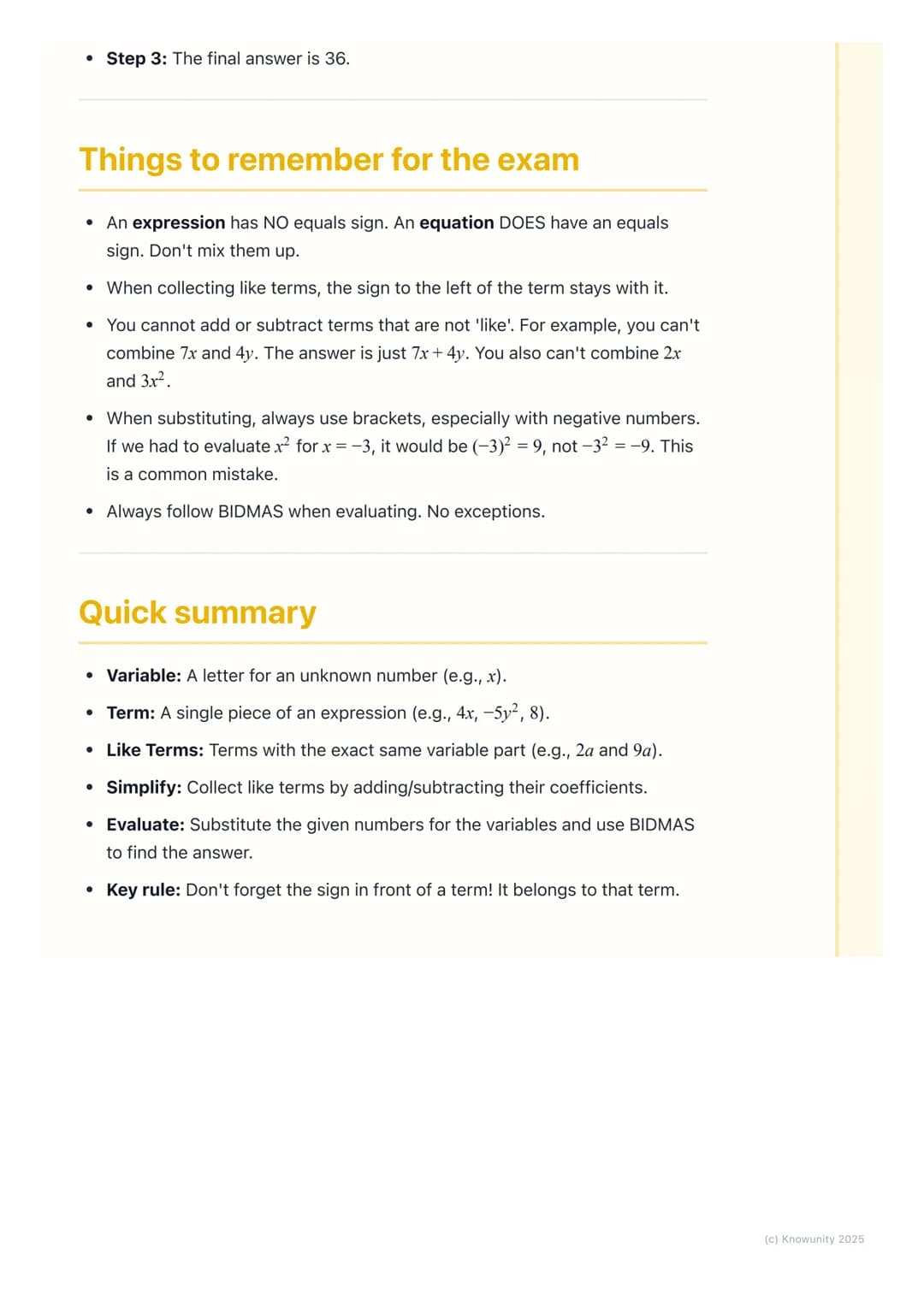
Key Points for Success
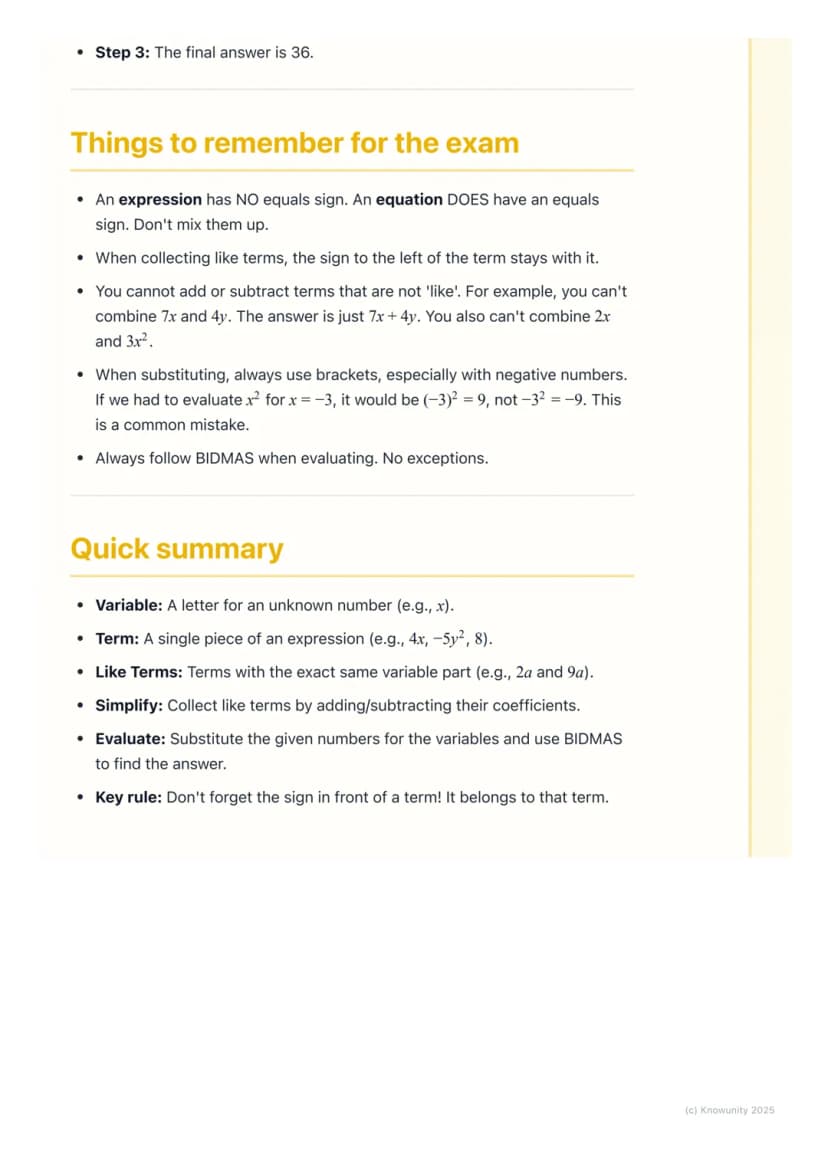
The most important thing to remember is that expressions have no equals sign, while equations do. Don't mix them up in exams!
When collecting like terms, that + or - sign stays with its term. You can't combine terms that aren't alike - 7x and 4y stay as 7x + 4y, and 2x and 3x² can't be combined either.
Always use brackets when substituting values, and never skip BIDMAS when evaluating. These simple rules will save you from most common mistakes.
Quick recap: Variables are letters for unknown numbers, terms are the separate parts of expressions, like terms have identical variable parts, simplifying means collecting like terms, and evaluating means substituting numbers and calculating.
Exam success: Master these basics now, and algebraic expressions will become your mathematical superpower for tackling more complex problems later!
Credeam că nu vei întreba niciodată...
Ce este Companionul AI Knowunity?
Companionul nostru AI este creat special pentru nevoile studenților. Bazându-ne pe milioanele de materiale de pe platformă, putem oferi răspunsuri exacte și relevante pentru studenți. Dar nu este vorba doar despre răspunsuri, companionul este mai ales despre ghidarea studenților prin provocările zilnice de învățare, cu planuri de studiu personalizate, chestionare sau conținuturi în chat și personalizare 100% bazată pe abilitățile și evoluțiile studenților.
De unde pot descărca aplicația Knowunity?
Aplicația este disponibilă în Google Play Store și Apple App Store.
Este Knowunity chiar gratuită?
Da! Bucură-te de access la materiale de studiu, conectează-te cu alți elevi, și primește ajutor instant - toate acestea la un click distanță. În plus, câștigă puncte ca să deblochezi mai multe funcționalități!
Cel mai popular conținut la Mathematics
8MathematicsAlgebra
Algebra
5th Year91
MathematicsAlgebra 2
Algebra notes focusing on the factor theorem, completing the square, -b formula, graphs of polynomials
5th Year130
MathematicsSolving Equations
This section focuses on solving one-step and two-step linear equations to find the value of an unknown variable.
1st Year131
MathematicsArithmetic sequences and series
With examples
5th Year130
MathematicsIntroduction to Probability
This topic introduces basic probability concepts, including calculating the probability of simple events and understanding the difference between experimental and theoretical probability.
2nd Year91
MathematicsMaths jc algebra
Maths jc
1st Year230
MathematicsNatural Numbers and Integers
Students will learn about positive whole numbers, zero, and negative whole numbers, and how to add, subtract, multiply, and divide them correctly.
1st Year131
MathematicsDifferential Calculus
Calculus is a topic that comes up nearly everywhere on your maths LC. This is just starter notes that could be useful end of 5th year or start of 6th year
5th Year271
Cel mai popular conținut
9 Irish
IrishIrish oral questions and answers
Questions and answers for the leaving cert oral
5th Year4264
 English
Key Quotes : Sive
Key Quotes and explanations: Sive
6th Year2842
IrishIrish oral questions
Outline of oral questions
5th Year2055
IrishIníon- le hÁine Durkin
Aine Durkin’s poem, Iníon: Themes & summary
5th Year850
IrishIrish poetry 2027
Iníon + Dínit an Bhróin
5th Year1133
IrishLC HL notes- Iníon (poem)
Includes poem in English and Irish, theme, key words & phrases
5th Year2284
EnglishCultural Context : Shawshank Redemption : Sive : Small Things Like These
Comparative Study : Cultural Context : Shawshank Redemption, Sive and Small Things Like These
6th Year1430
IrishMo Ghrá-sa (Idir Lúibíní)
Notes on mo ghrá-sa
5th Year380
IrishAn Gaeilge Aiste
Irish Language essay
6th Year1320
Nu găsești ce cauți? Explorează alte MATERII.
Recenzii de la utilizatorii noștri. Ei iubesc să folosească Knowunity — și tu o vei face.
4.6/5App Store
4.7/5Google Play
Aplicația este foarte ușor de utilizat și bine concepută. Am găsit tot ce căutam până acum și am reușit să învăț multe din prezentări! Cu siguranță voi folosi aplicația pentru o temă la clasă! Și desigur, ajută mult ca sursă de inspirație.
Ștefan Sutilizator iOS
Această aplicație este super. Sunt atât de multe materiale de studiu și ajutor pentru elevi [...]. Materia mea mai problematică este franceza, de exemplu, și aplicația oferă foarte multe materiale ajutătoare. Mulțumită acestei aplicații, mi-am îmbunătățit franceza. Aș recomanda-o oricui.
Samantha Klichutilizator Android
Wow, sunt cu adevărat impresionat. Am încercat aplicația pentru că am văzut-o promovată de multe ori și am rămas uimit. Aceasta este AJUTORUL de care ai nevoie pentru școală și, mai presus de toate, oferă atât de multe lucruri, precum exerciții și fișe de informații, care mi-au fost FOARTE de ajutor.
Annautilizator iOS
Mathematics13 vizualizări·Actualizat Jun 7, 2026·5 paginiUnderstanding and Simplifying Algebraic Expressions
Ever wondered why we use letters in maths? Algebraic expressions are like mathematical recipes that use letters (called variables) to represent unknown numbers. They're the building blocks you'll need to master before tackling equations, and once you get the hang...
1
of 5
Înscrie-te pentru a vedea CONȚINUTUL. E gratuit!
- Acces la toate documentele
- Îmbunătățește notele tale!
- Alătură-te milioanelor de elevi
What are Algebraic Expressions?
Think of algebraic expressions as mathematical phrases that mix numbers, letters, and operation signs (+, -, ×, ÷). Unlike equations, expressions don't have an equals sign - they're just a collection of mathematical terms waiting to be worked with.
The letters in expressions are called variables, and they represent unknown numbers. A term is each separate part of an expression, like 4x, -5y, or just 8 on its own.
Like terms are terms that have exactly the same variable part, including any powers. For example, 3x and -5x are like terms because they both have just 'x'. However, 3x and 3x² are NOT like terms because one has x and the other has x².
Remember: Expressions are the foundation for solving equations later, so getting comfortable with these basics now will make your life much easier!
2
of 5Înscrie-te pentru a vedea CONȚINUTUL. E gratuit!
- Acces la toate documentele
- Îmbunătățește notele tale!
- Alătură-te milioanelor de elevi
Writing Expressions from Words
Converting word problems into algebraic expressions is all about spotting the right keywords. Once you know what to look for, it becomes like translating from English to maths.
Addition keywords: plus, sum, more than, increased by
Subtraction keywords: minus, difference, less than, decreased by
Multiplication keywords: times, product, of (like "half of a number")
Division keywords: divided by, quotient, shared between
Watch out for tricky phrases like "8 less than a number x" - this becomes x - 8, not 8 - x. The order matters! "A number n increased by 10" simply becomes n + 10, while "the product of 7 and a number y" becomes 7y (no multiplication sign needed).
Top tip: Always double-check the order, especially with subtraction. "Less than" flips the order around!
3
of 5Înscrie-te pentru a vedea CONȚINUTUL. E gratuit!
- Acces la toate documentele
- Îmbunătățește notele tale!
- Alătură-te milioanelor de elevi
Simplifying by Collecting Like Terms
Simplifying expressions is like tidying your room - you group similar things together. You can only combine terms that are exactly the same type, just like you can add apples to apples but not apples to oranges.
Here's your step-by-step process: First, identify all the terms in the expression. Next, find groups of like terms - it helps to circle them in different colours. Remember to include the + or - sign with each term!
Then add or subtract the coefficients (the numbers in front) of like terms. Finally, write your simplified expression.
Let's try: 5x + 3y - 2x + 7y + 4. Group the x terms , the y terms (3y and 7y), and the constant (4). Combine: 5x - 2x = 3x, 3y + 7y = 10y, and 4 stays as is. Your answer: 3x + 10y + 4.
Watch out: The sign in front of a term belongs to that term! So -2x means negative 2x, not positive 2x that you subtract later.
4
of 5Înscrie-te pentru a vedea CONȚINUTUL. E gratuit!
- Acces la toate documentele
- Îmbunătățește notele tale!
- Alătură-te milioanelor de elevi
Evaluating Expressions
Evaluating expressions means finding the actual number value when you're given specific values for the variables. It's like following a recipe when you finally know all the ingredients.
Your method is simple: write the expression, replace each variable with its given number (use brackets to avoid mistakes!), then use BIDMAS to calculate your final answer.
BIDMAS stands for: Brackets, Indices (powers), Division and Multiplication (left to right), Addition and Subtraction (left to right).
Example: Evaluate 4a - 2b when a = 5 and b = 3. Substitute: 4(5) - 2(3). Calculate: 20 - 6 = 14.
Pro tip: Always use brackets when substituting, especially with negative numbers. If x = -3, then x² = (-3)² = 9, not -3² = -9!
5
of 5Înscrie-te pentru a vedea CONȚINUTUL. E gratuit!
- Acces la toate documentele
- Îmbunătățește notele tale!
- Alătură-te milioanelor de elevi
Key Points for Success
The most important thing to remember is that expressions have no equals sign, while equations do. Don't mix them up in exams!
When collecting like terms, that + or - sign stays with its term. You can't combine terms that aren't alike - 7x and 4y stay as 7x + 4y, and 2x and 3x² can't be combined either.
Always use brackets when substituting values, and never skip BIDMAS when evaluating. These simple rules will save you from most common mistakes.
Quick recap: Variables are letters for unknown numbers, terms are the separate parts of expressions, like terms have identical variable parts, simplifying means collecting like terms, and evaluating means substituting numbers and calculating.
Exam success: Master these basics now, and algebraic expressions will become your mathematical superpower for tackling more complex problems later!
Credeam că nu vei întreba niciodată...
Ce este Companionul AI Knowunity?
Companionul nostru AI este creat special pentru nevoile studenților. Bazându-ne pe milioanele de materiale de pe platformă, putem oferi răspunsuri exacte și relevante pentru studenți. Dar nu este vorba doar despre răspunsuri, companionul este mai ales despre ghidarea studenților prin provocările zilnice de învățare, cu planuri de studiu personalizate, chestionare sau conținuturi în chat și personalizare 100% bazată pe abilitățile și evoluțiile studenților.
De unde pot descărca aplicația Knowunity?
Aplicația este disponibilă în Google Play Store și Apple App Store.
Este Knowunity chiar gratuită?
Da! Bucură-te de access la materiale de studiu, conectează-te cu alți elevi, și primește ajutor instant - toate acestea la un click distanță. În plus, câștigă puncte ca să deblochezi mai multe funcționalități!
Cel mai popular conținut la Mathematics
8MathematicsAlgebra
Algebra
5th Year91
MathematicsAlgebra 2
Algebra notes focusing on the factor theorem, completing the square, -b formula, graphs of polynomials
5th Year130
MathematicsSolving Equations
This section focuses on solving one-step and two-step linear equations to find the value of an unknown variable.
1st Year131
MathematicsArithmetic sequences and series
With examples
5th Year130
MathematicsIntroduction to Probability
This topic introduces basic probability concepts, including calculating the probability of simple events and understanding the difference between experimental and theoretical probability.
2nd Year91
MathematicsMaths jc algebra
Maths jc
1st Year230
MathematicsNatural Numbers and Integers
Students will learn about positive whole numbers, zero, and negative whole numbers, and how to add, subtract, multiply, and divide them correctly.
1st Year131
MathematicsDifferential Calculus
Calculus is a topic that comes up nearly everywhere on your maths LC. This is just starter notes that could be useful end of 5th year or start of 6th year
5th Year271
Cel mai popular conținut
9IrishIrish oral questions and answers
Questions and answers for the leaving cert oral
5th Year4264
EnglishKey Quotes : Sive
Key Quotes and explanations: Sive
6th Year2842
IrishIrish oral questions
Outline of oral questions
5th Year2055
IrishIníon- le hÁine Durkin
Aine Durkin’s poem, Iníon: Themes & summary
5th Year850
IrishIrish poetry 2027
Iníon + Dínit an Bhróin
5th Year1133
IrishLC HL notes- Iníon (poem)
Includes poem in English and Irish, theme, key words & phrases
5th Year2284
EnglishCultural Context : Shawshank Redemption : Sive : Small Things Like These
Comparative Study : Cultural Context : Shawshank Redemption, Sive and Small Things Like These
6th Year1430
IrishMo Ghrá-sa (Idir Lúibíní)
Notes on mo ghrá-sa
5th Year380
IrishAn Gaeilge Aiste
Irish Language essay
6th Year1320
Nu găsești ce cauți? Explorează alte MATERII.
Recenzii de la utilizatorii noștri. Ei iubesc să folosească Knowunity — și tu o vei face.
4.6/5App Store
4.7/5Google Play
Aplicația este foarte ușor de utilizat și bine concepută. Am găsit tot ce căutam până acum și am reușit să învăț multe din prezentări! Cu siguranță voi folosi aplicația pentru o temă la clasă! Și desigur, ajută mult ca sursă de inspirație.
Ștefan Sutilizator iOS
Această aplicație este super. Sunt atât de multe materiale de studiu și ajutor pentru elevi [...]. Materia mea mai problematică este franceza, de exemplu, și aplicația oferă foarte multe materiale ajutătoare. Mulțumită acestei aplicații, mi-am îmbunătățit franceza. Aș recomanda-o oricui.
Samantha Klichutilizator Android
Wow, sunt cu adevărat impresionat. Am încercat aplicația pentru că am văzut-o promovată de multe ori și am rămas uimit. Aceasta este AJUTORUL de care ai nevoie pentru școală și, mai presus de toate, oferă atât de multe lucruri, precum exerciții și fișe de informații, care mi-au fost FOARTE de ajutor.
Annautilizator iOS