
The genitive case (An Tuiseal Ginideach) is basically the 'of'... Afișează mai mult
 Irish25 vizualizări·Actualizat May 18, 2026·6 pagini
Mastering the Genitive Case: An Tuiseal Ginideach Demystified
1 / 6
1
of 6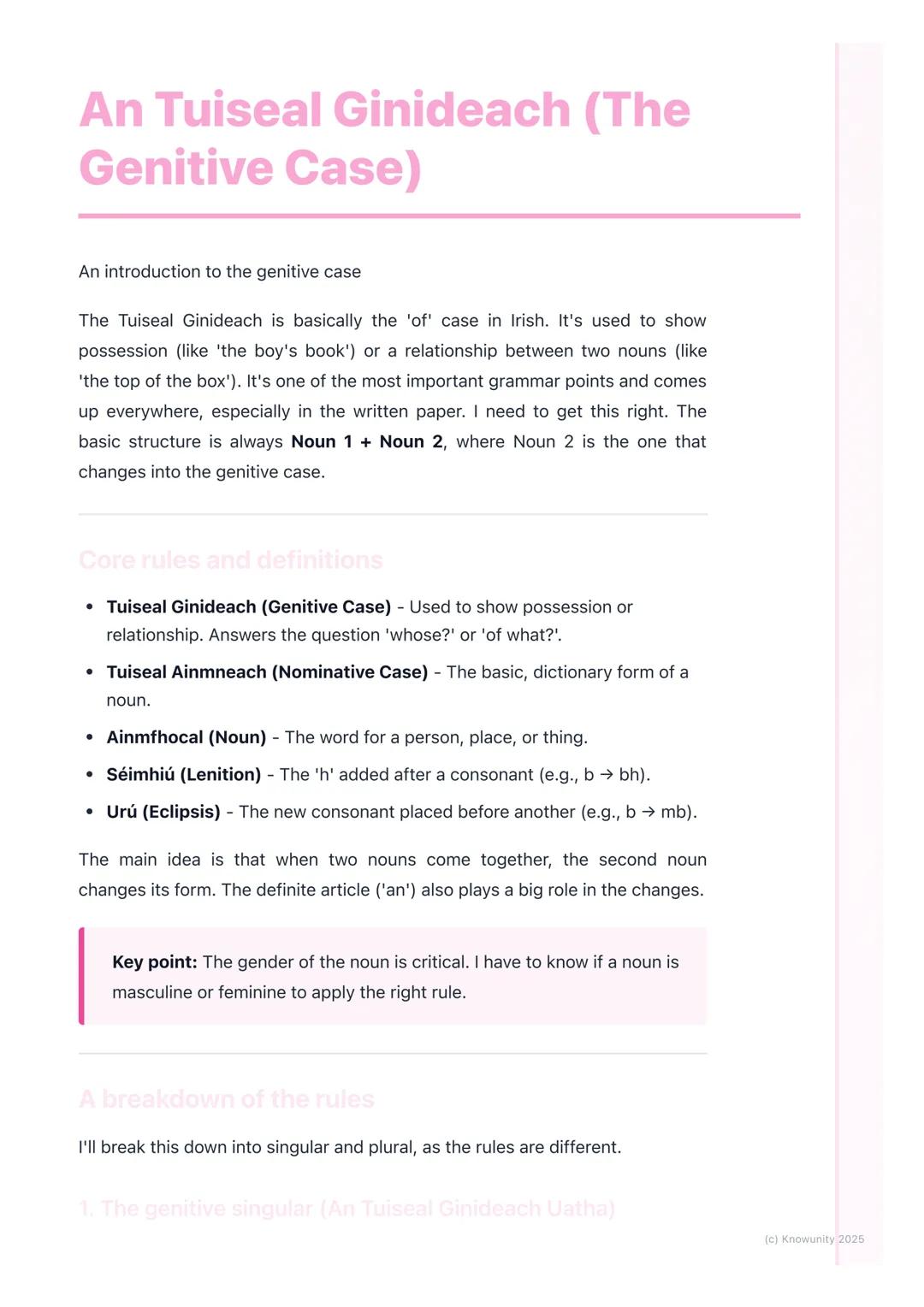
What Is the Genitive Case?
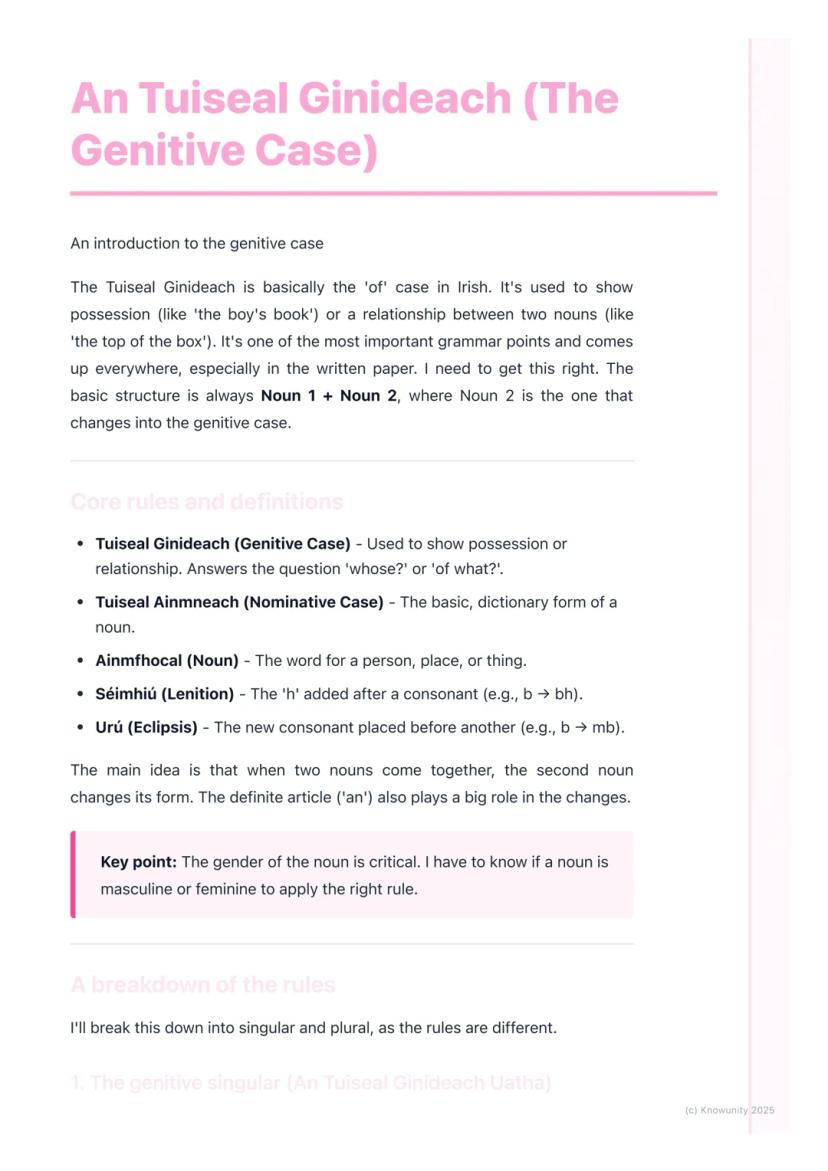
Think of the genitive as the Irish way of saying "John's car" or "the top of the mountain" - it connects two nouns together. The tuiseal ginideach always follows the same pattern: Noun 1 + Noun 2, where the second noun changes its form.
Here's what makes it tricky: the gender of your noun is absolutely everything. You can't apply the right rule without knowing if a noun is masculine or feminine first. The definite article also changes and affects how the noun mutates.
The basic building blocks you need to know are séimhiú (adding 'h' after consonants) and urú (placing new consonants before others). These mutations happen depending on which rules apply.
Quick Tip: Always identify the gender of the second noun first - this determines everything else that follows.
2
of 6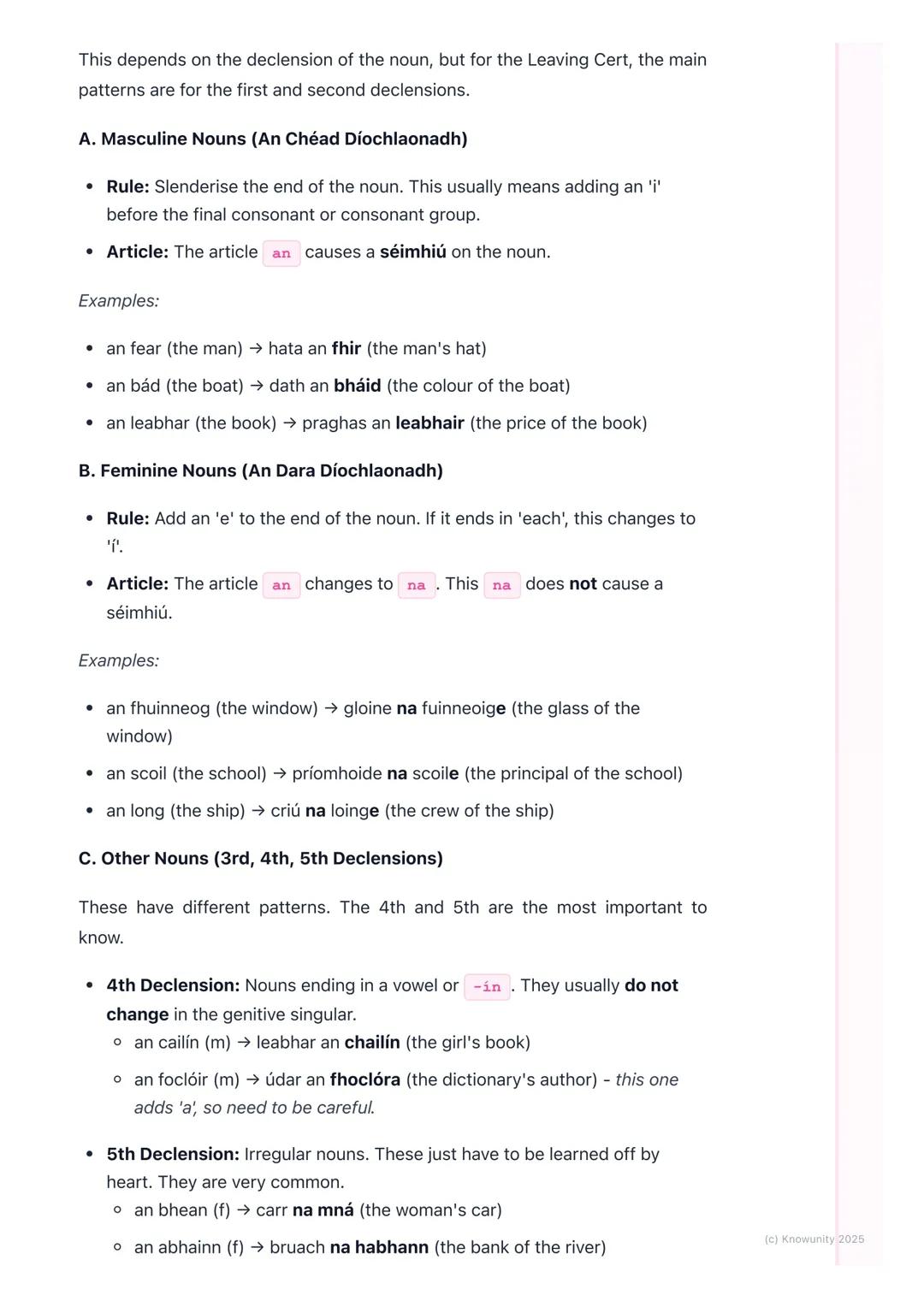
Singular Genitive Rules
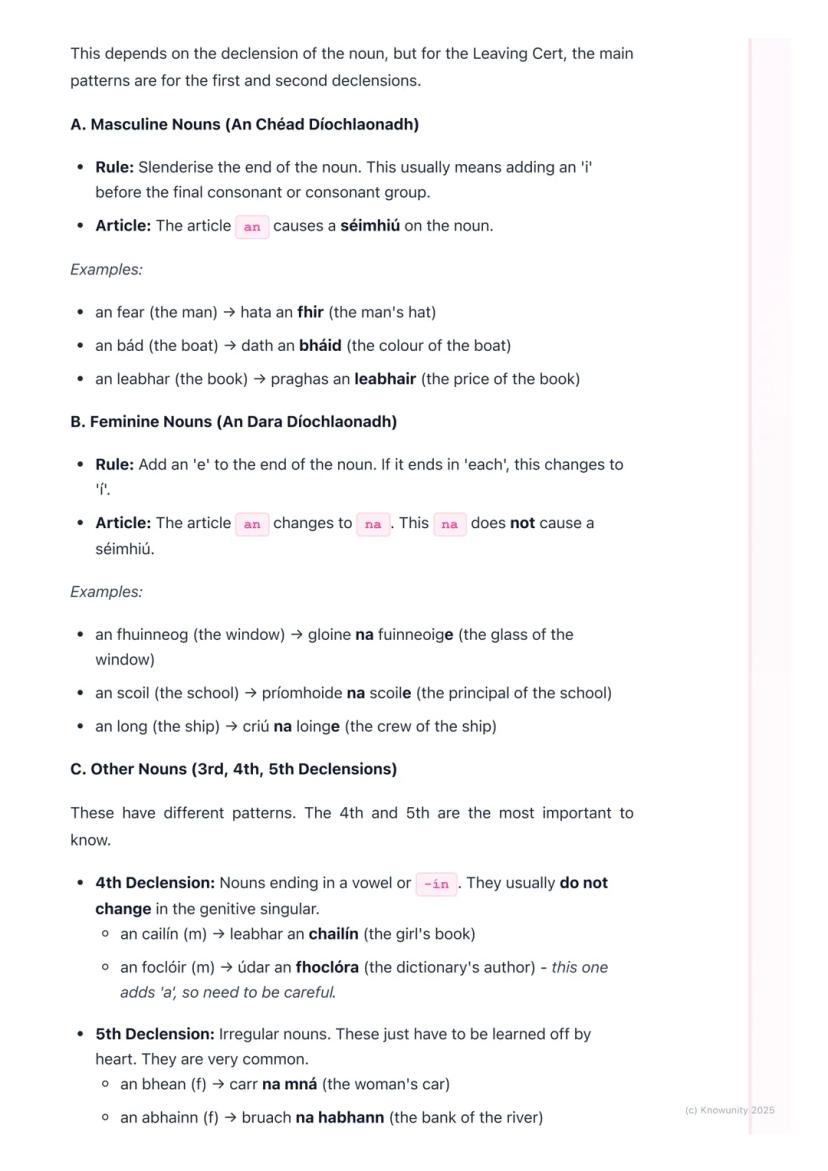
Masculine nouns follow a simple pattern: slenderise the ending (usually add 'i' before the final consonant) and use an + séimhiú. So "an fear" (the man) becomes "hata an fhir" (the man's hat), and "an bád" (the boat) becomes "dath an bháid" (the colour of the boat).
Feminine nouns work differently: add 'e' to the end and change an to na (no séimhiú). "An scoil" (the school) becomes "príomhoide na scoile" (the principal of the school).
Some nouns belong to other declensions with their own rules. Fourth declension nouns (like "an cailín") often don't change at all. Fifth declension nouns are completely irregular - "an bhean" becomes "carr na mná" (the woman's car).
Remember: The article change is crucial - "an" with séimhiú for masculine, "na" without séimhiú for feminine.
3
of 6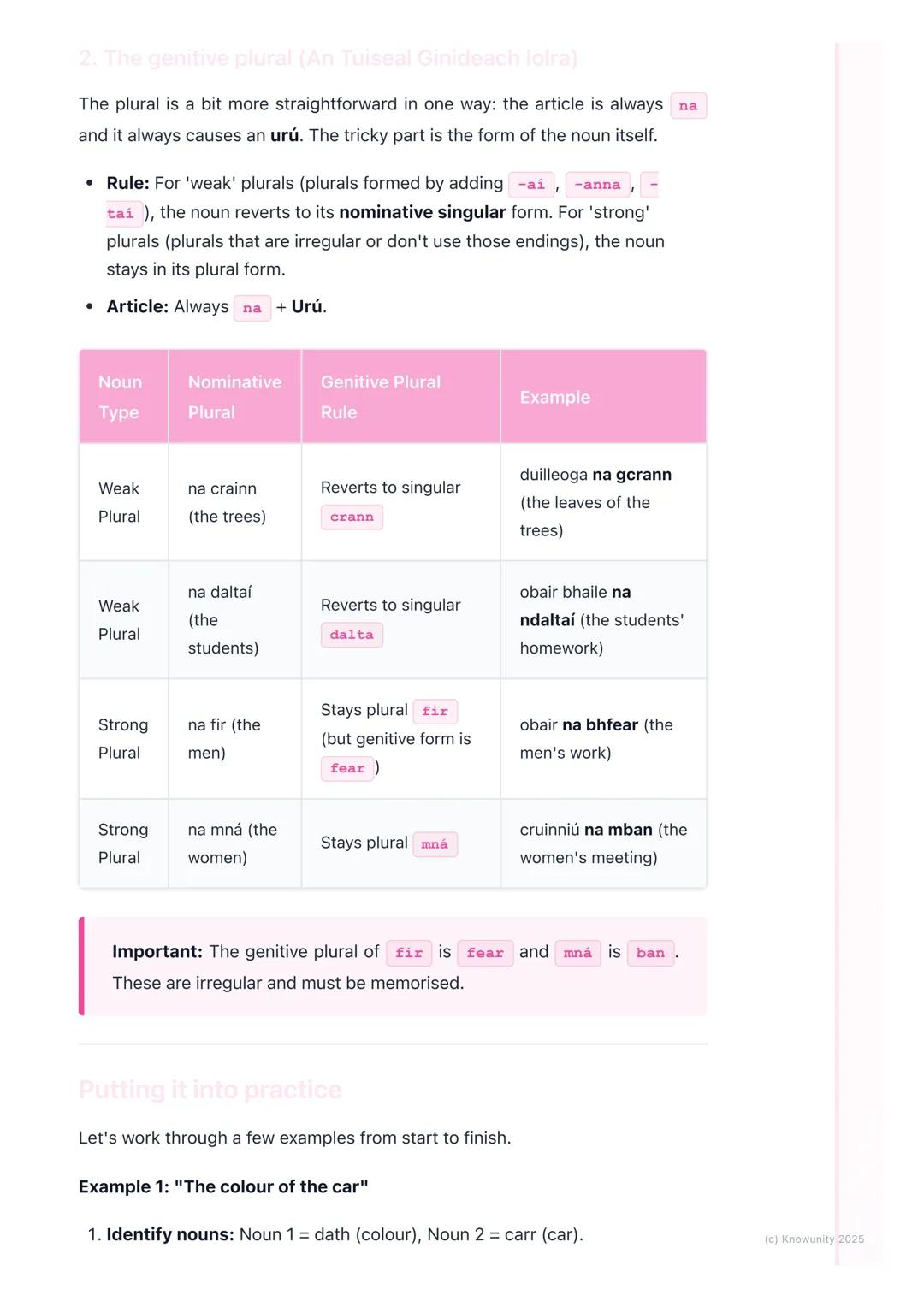
Plural Genitive Rules
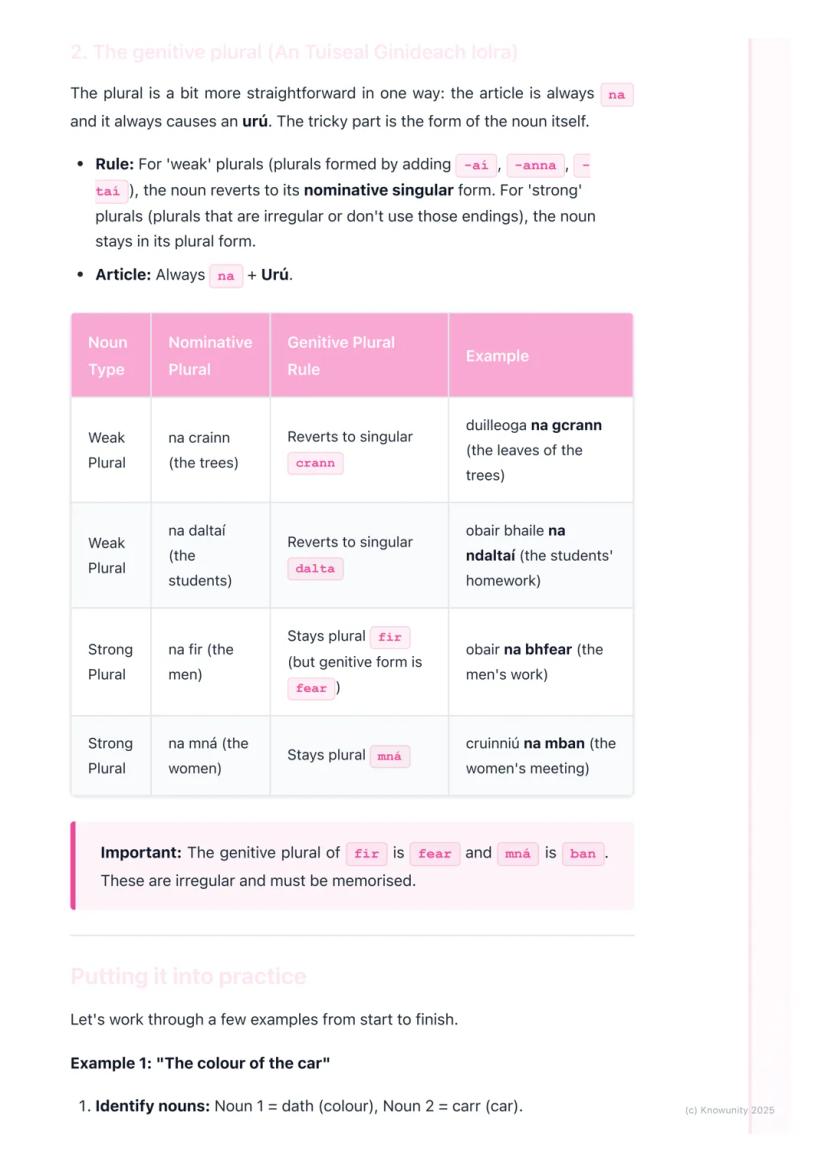
The plural genitive is actually more straightforward in one way: you always use na + urú, regardless of gender. The tricky bit is figuring out what form the noun takes.
Weak plurals typically revert to their singular form. So "na crainn" (the trees) becomes "duilleoga na gcrann" (the leaves of the trees). Strong plurals (irregular ones) usually keep their plural form but may have special genitive versions.
The most important irregulars to memorise are "na fir" → "obair na bhfear" (the men's work) and "na mná" → "cruinniú na mban" (the women's meeting). These come up constantly in exams.
Don't stress too much about whether the noun reverts to singular or stays plural - focus on getting na + urú right first, as that's where most of the marks are.
Exam Focus: Master "na + urú" for all plurals - this consistent rule will save you marks even when the noun form gets confusing.
4
of 6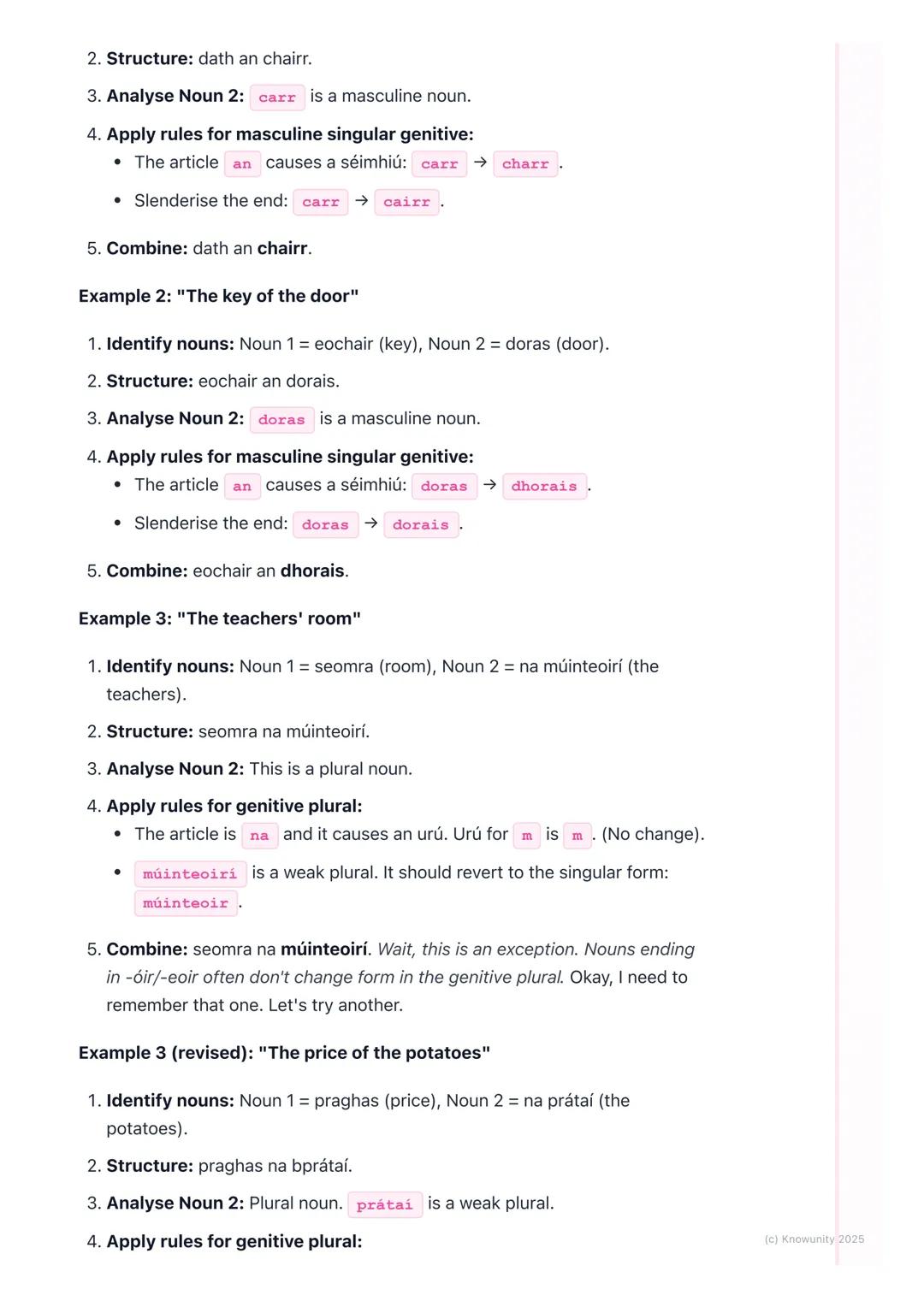
Working Through Examples
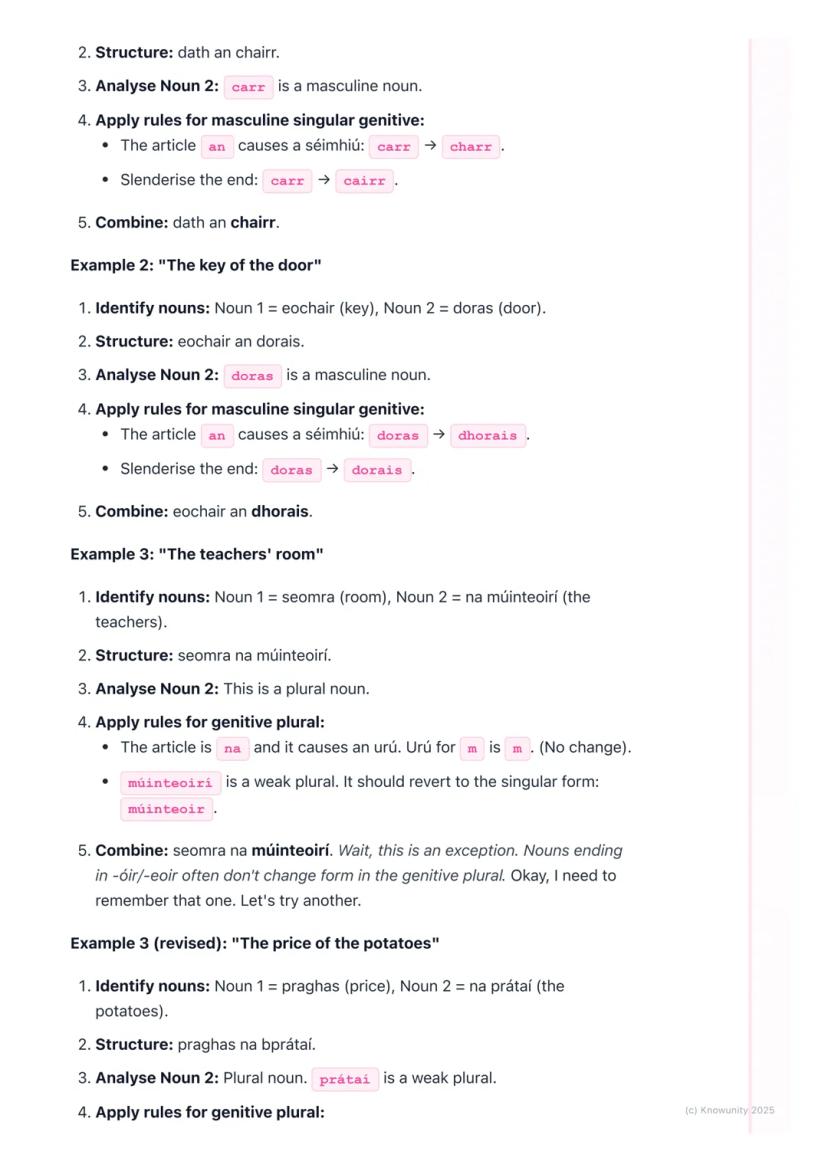
Let's break down "dath an chairr" (the colour of the car) step by step. First, identify your nouns: "dath" (colour) and "carr" (car). Since "carr" is masculine, you slenderise it to "cairr" and use "an" with séimhiú to get "an chairr".
For "eochair an dhorais" (the key of the door), "doras" is masculine, so it becomes "dorais" (slenderised) with "an" + séimhiú giving "an dhorais". The pattern is always the same once you know the gender.
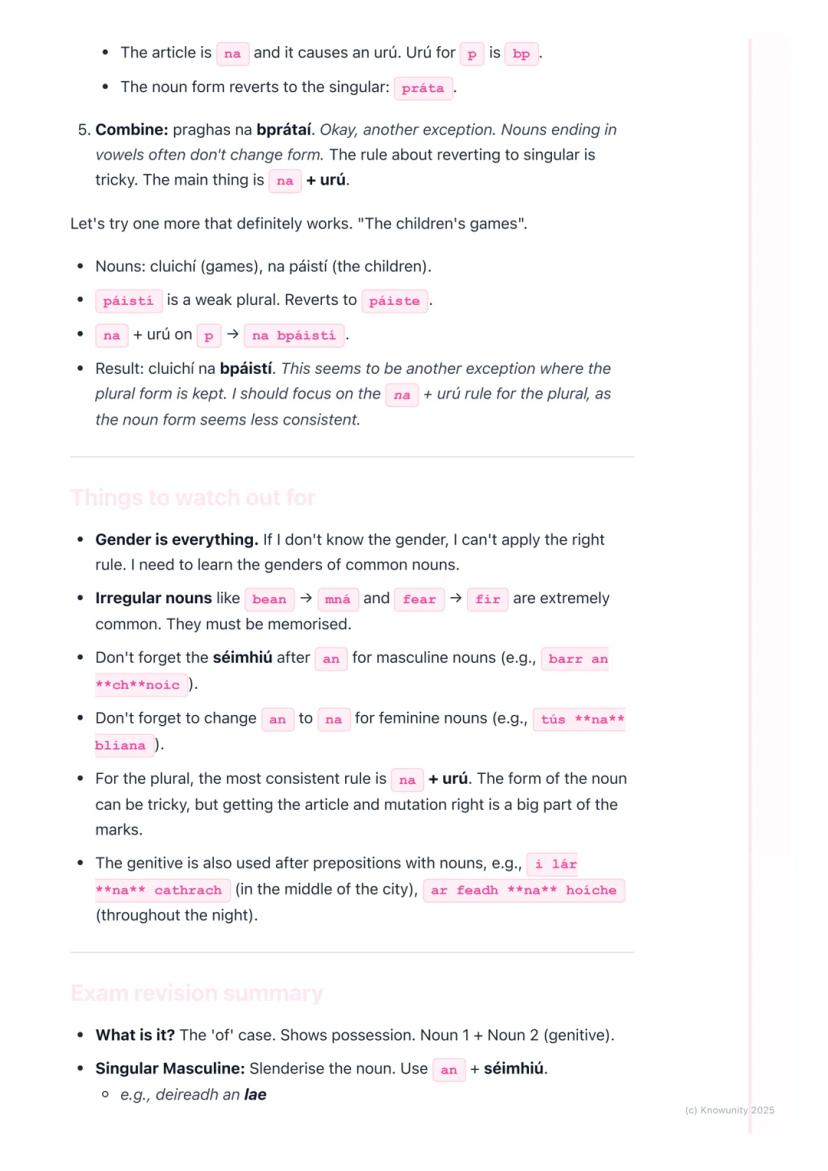
Plural examples like "praghas na bprátaí" (the price of the potatoes) show the na + urú rule in action. The 'p' gets urú to become 'bp', giving "na bprátaí".
Practice these step-by-step breakdowns with different nouns, and you'll start spotting the patterns automatically.
Practice Tip: Always work through examples in the same order - identify nouns, check gender, apply rules, then combine.
5
of 6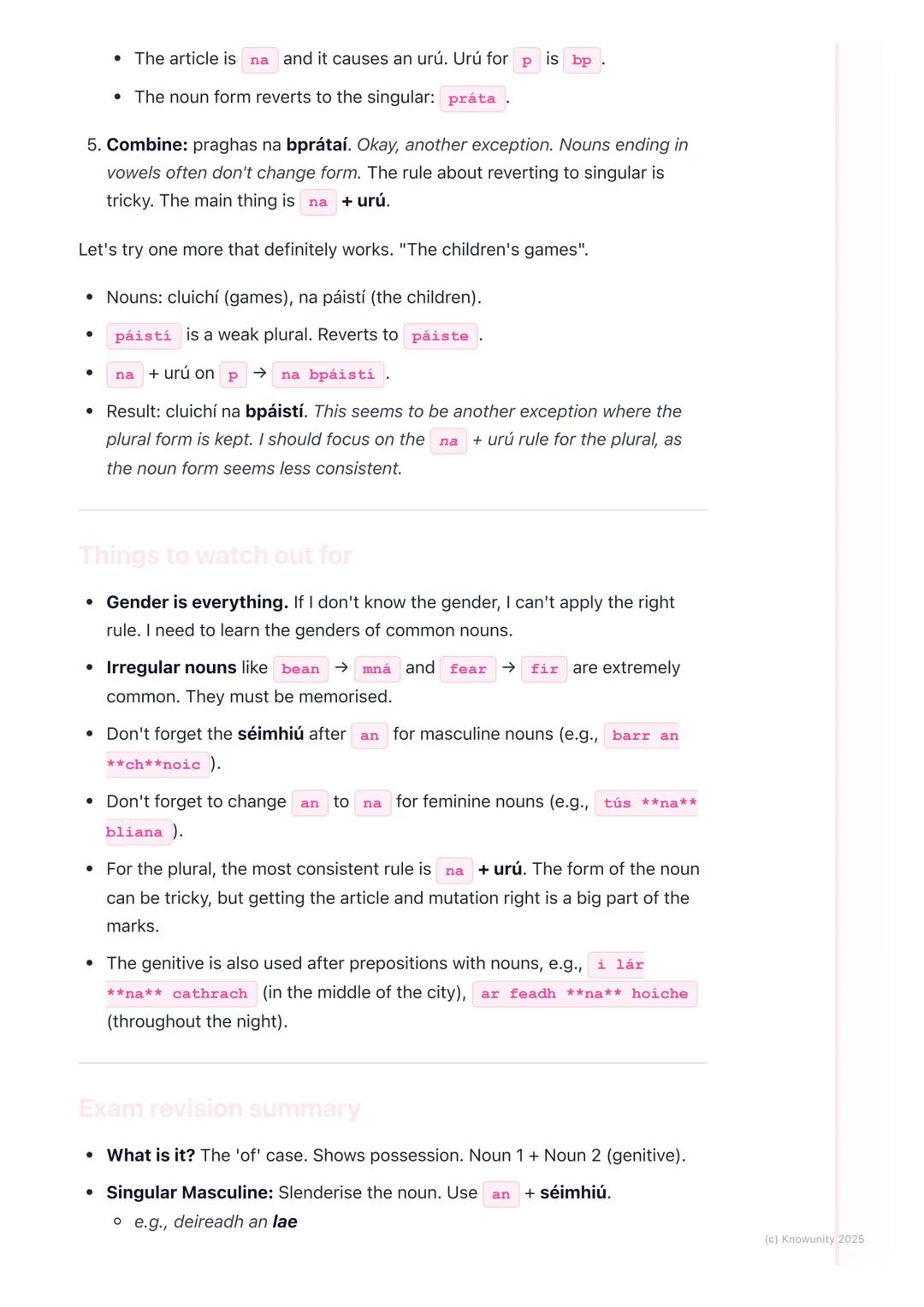
Common Pitfalls and Exam Tips
Gender confusion is the biggest trap - if you guess wrong, your entire answer falls apart. Learn the genders of common nouns by heart, especially ones that appear frequently in exam questions.
The irregular nouns like "bean → mná" and "fear → fir" are absolute exam favourites. They're so common that forgetting them will cost you marks across multiple questions.
Don't forget the mutations: séimhiú after "an" for masculine nouns, and urú after "na" in plurals. These small details add up to significant marks.
The genitive also appears after certain prepositions - phrases like "i lár na cathrach" (in the middle of the city) use genitive forms, so watch out for these in comprehensions.
Memory Aid: Create flashcards for the most common irregulars - "bean/mná", "fear/fir", "lá/lae" - these will appear in every exam.
6
of 6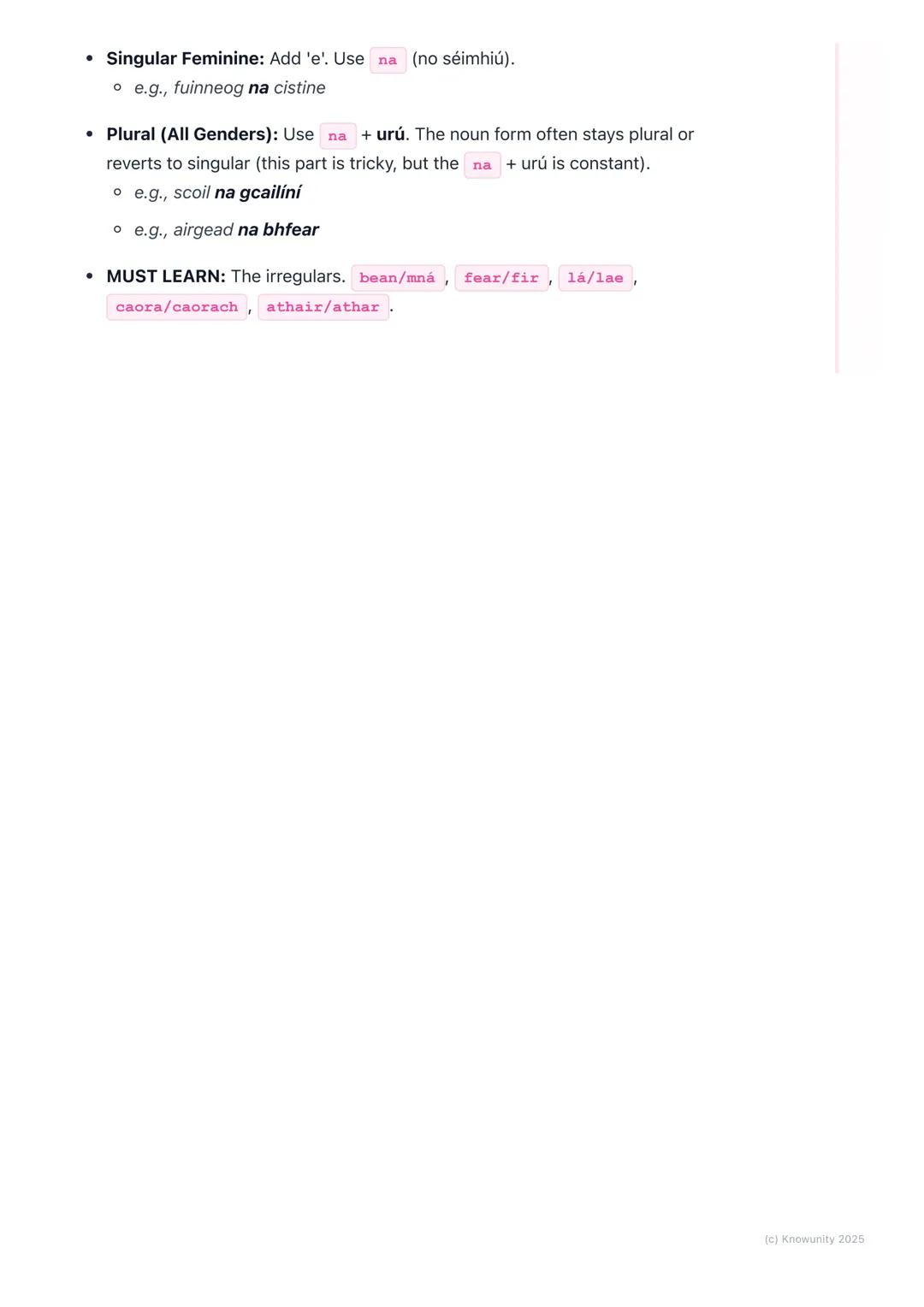
Quick Revision Summary
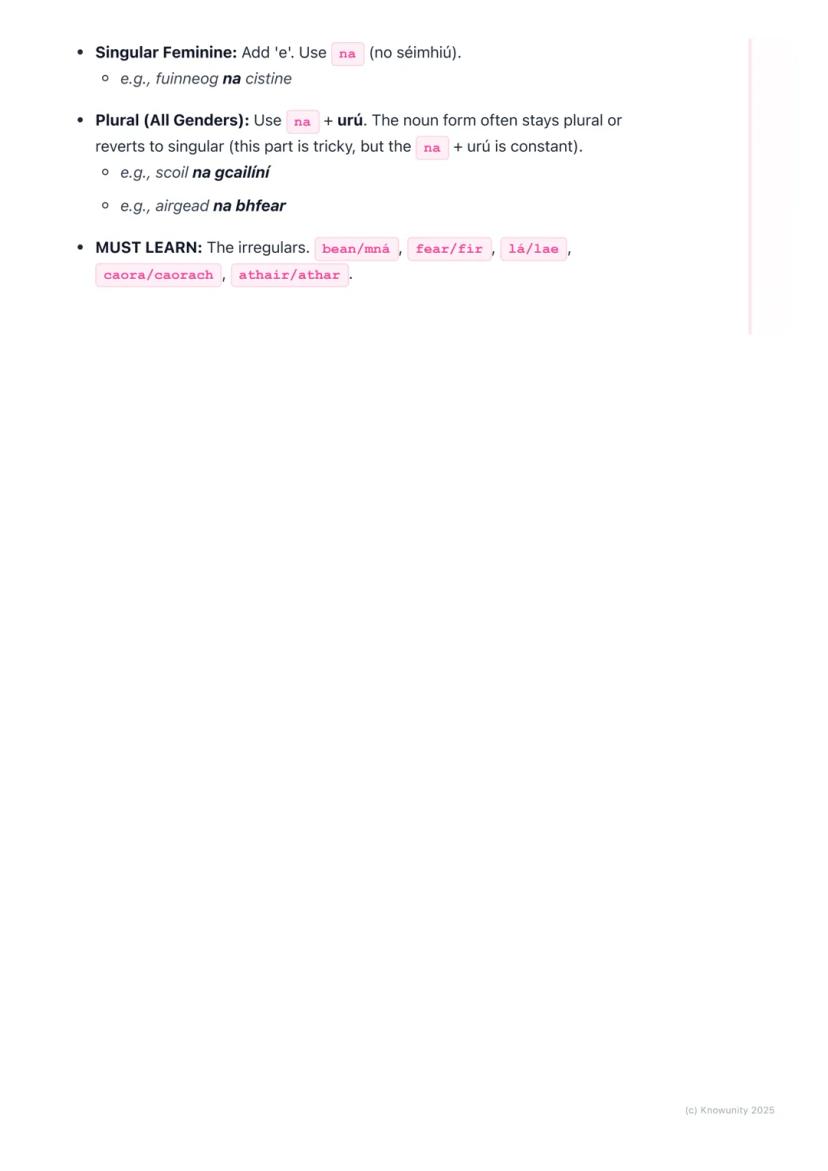
Here's your cheat sheet for exam day: Singular masculine = slenderise + an + séimhiú (like "deireadh an lae"). Singular feminine = add 'e' + na (no séimhiú) (like "fuinneog na cistine").
All plurals = na + urú, regardless of gender. Examples: "scoil na gcailíní" and "airgead na bhfear". The urú is non-negotiable - get this right for guaranteed marks.
Your must-learn irregulars are: "bean/mná", "fear/fir", "lá/lae", "caora/caorach", and "athair/athar". These show up everywhere and examiners expect you to know them perfectly.
Remember, the genitive case isn't just grammar for grammar's sake - it's how Irish naturally expresses relationships between things, and mastering it will make your Irish sound much more fluent and natural.
Final Tip: Focus on the most common patterns first - you'll cover 80% of exam questions with just the basic masculine, feminine, and plural rules.
Credeam că nu vei întreba niciodată...
Ce este Companionul AI Knowunity?
Companionul nostru AI este creat special pentru nevoile studenților. Bazându-ne pe milioanele de materiale de pe platformă, putem oferi răspunsuri exacte și relevante pentru studenți. Dar nu este vorba doar despre răspunsuri, companionul este mai ales despre ghidarea studenților prin provocările zilnice de învățare, cu planuri de studiu personalizate, chestionare sau conținuturi în chat și personalizare 100% bazată pe abilitățile și evoluțiile studenților.
De unde pot descărca aplicația Knowunity?
Aplicația este disponibilă în Google Play Store și Apple App Store.
Este Knowunity chiar gratuită?
Da! Bucură-te de access la materiale de studiu, conectează-te cu alți elevi, și primește ajutor instant - toate acestea la un click distanță. În plus, câștigă puncte ca să deblochezi mai multe funcționalități!
Cel mai popular conținut la Irish
9IrishIrish oral questions and answers
Questions and answers for the leaving cert oral
5th Year4254
IrishIrish oral questions
Outline of oral questions
5th Year2055
IrishIníon- le hÁine Durkin
Aine Durkin’s poem, Iníon: Themes & summary
5th Year850
IrishIrish poetry 2027
Iníon + Dínit an Bhróin
5th Year1133
IrishLC HL notes- Iníon (poem)
Includes poem in English and Irish, theme, key words & phrases
5th Year2284
IrishGaeilge Grammar Office
All the basics you need to know on Irish grammar.
6th Year943
IrishAn Gaeilge Aiste
Irish Language essay
6th Year1290
IrishMo Ghrá-sa (Idir Lúibíní)
Notes on mo ghrá-sa
5th Year350
IrishMé Féin & Mo Chlann (Myself & My Family)
Students will learn vocabulary to describe themselves, their family members, and daily routines. This helps in personal introductions and discussions.
TY291
Cel mai popular conținut
9IrishIrish oral questions and answers
Questions and answers for the leaving cert oral
5th Year4254
IrishIrish oral questions
Outline of oral questions
5th Year2055
IrishIníon- le hÁine Durkin
Aine Durkin’s poem, Iníon: Themes & summary
5th Year850
 English
Key Quotes : Sive
Key Quotes and explanations: Sive
6th Year2822
IrishIrish poetry 2027
Iníon + Dínit an Bhróin
5th Year1133
IrishLC HL notes- Iníon (poem)
Includes poem in English and Irish, theme, key words & phrases
5th Year2284
IrishGaeilge Grammar Office
All the basics you need to know on Irish grammar.
6th Year943
IrishMo Ghrá-sa (Idir Lúibíní)
Notes on mo ghrá-sa
5th Year350
IrishAn Gaeilge Aiste
Irish Language essay
6th Year1290
Nu găsești ce cauți? Explorează alte MATERII.
Recenzii de la utilizatorii noștri. Ei iubesc să folosească Knowunity — și tu o vei face.
4.6/5App Store
4.7/5Google Play
Aplicația este foarte ușor de utilizat și bine concepută. Am găsit tot ce căutam până acum și am reușit să învăț multe din prezentări! Cu siguranță voi folosi aplicația pentru o temă la clasă! Și desigur, ajută mult ca sursă de inspirație.
Ștefan Sutilizator iOS
Această aplicație este super. Sunt atât de multe materiale de studiu și ajutor pentru elevi [...]. Materia mea mai problematică este franceza, de exemplu, și aplicația oferă foarte multe materiale ajutătoare. Mulțumită acestei aplicații, mi-am îmbunătățit franceza. Aș recomanda-o oricui.
Samantha Klichutilizator Android
Wow, sunt cu adevărat impresionat. Am încercat aplicația pentru că am văzut-o promovată de multe ori și am rămas uimit. Aceasta este AJUTORUL de care ai nevoie pentru școală și, mai presus de toate, oferă atât de multe lucruri, precum exerciții și fișe de informații, care mi-au fost FOARTE de ajutor.
Annautilizator iOS
Irish25 vizualizări·Actualizat May 18, 2026·6 paginiMastering the Genitive Case: An Tuiseal Ginideach Demystified
The genitive case (An Tuiseal Ginideach) is basically the 'of' case in Irish - it shows who owns what or how things relate to each other. You'll see it everywhere in your exams, so getting these rules down will seriously... Afișează mai mult
1
of 6Înscrie-te pentru a vedea CONȚINUTUL. E gratuit!
- Acces la toate documentele
- Îmbunătățește notele tale!
- Alătură-te milioanelor de elevi
What Is the Genitive Case?
Think of the genitive as the Irish way of saying "John's car" or "the top of the mountain" - it connects two nouns together. The tuiseal ginideach always follows the same pattern: Noun 1 + Noun 2, where the second noun changes its form.
Here's what makes it tricky: the gender of your noun is absolutely everything. You can't apply the right rule without knowing if a noun is masculine or feminine first. The definite article also changes and affects how the noun mutates.
The basic building blocks you need to know are séimhiú (adding 'h' after consonants) and urú (placing new consonants before others). These mutations happen depending on which rules apply.
Quick Tip: Always identify the gender of the second noun first - this determines everything else that follows.
2
of 6Înscrie-te pentru a vedea CONȚINUTUL. E gratuit!
- Acces la toate documentele
- Îmbunătățește notele tale!
- Alătură-te milioanelor de elevi
Singular Genitive Rules
Masculine nouns follow a simple pattern: slenderise the ending (usually add 'i' before the final consonant) and use an + séimhiú. So "an fear" (the man) becomes "hata an fhir" (the man's hat), and "an bád" (the boat) becomes "dath an bháid" (the colour of the boat).
Feminine nouns work differently: add 'e' to the end and change an to na (no séimhiú). "An scoil" (the school) becomes "príomhoide na scoile" (the principal of the school).
Some nouns belong to other declensions with their own rules. Fourth declension nouns (like "an cailín") often don't change at all. Fifth declension nouns are completely irregular - "an bhean" becomes "carr na mná" (the woman's car).
Remember: The article change is crucial - "an" with séimhiú for masculine, "na" without séimhiú for feminine.
3
of 6Înscrie-te pentru a vedea CONȚINUTUL. E gratuit!
- Acces la toate documentele
- Îmbunătățește notele tale!
- Alătură-te milioanelor de elevi
Plural Genitive Rules
The plural genitive is actually more straightforward in one way: you always use na + urú, regardless of gender. The tricky bit is figuring out what form the noun takes.
Weak plurals typically revert to their singular form. So "na crainn" (the trees) becomes "duilleoga na gcrann" (the leaves of the trees). Strong plurals (irregular ones) usually keep their plural form but may have special genitive versions.
The most important irregulars to memorise are "na fir" → "obair na bhfear" (the men's work) and "na mná" → "cruinniú na mban" (the women's meeting). These come up constantly in exams.
Don't stress too much about whether the noun reverts to singular or stays plural - focus on getting na + urú right first, as that's where most of the marks are.
Exam Focus: Master "na + urú" for all plurals - this consistent rule will save you marks even when the noun form gets confusing.
4
of 6Înscrie-te pentru a vedea CONȚINUTUL. E gratuit!
- Acces la toate documentele
- Îmbunătățește notele tale!
- Alătură-te milioanelor de elevi
Working Through Examples
Let's break down "dath an chairr" (the colour of the car) step by step. First, identify your nouns: "dath" (colour) and "carr" (car). Since "carr" is masculine, you slenderise it to "cairr" and use "an" with séimhiú to get "an chairr".
For "eochair an dhorais" (the key of the door), "doras" is masculine, so it becomes "dorais" (slenderised) with "an" + séimhiú giving "an dhorais". The pattern is always the same once you know the gender.
Plural examples like "praghas na bprátaí" (the price of the potatoes) show the na + urú rule in action. The 'p' gets urú to become 'bp', giving "na bprátaí".
Practice these step-by-step breakdowns with different nouns, and you'll start spotting the patterns automatically.
Practice Tip: Always work through examples in the same order - identify nouns, check gender, apply rules, then combine.
5
of 6Înscrie-te pentru a vedea CONȚINUTUL. E gratuit!
- Acces la toate documentele
- Îmbunătățește notele tale!
- Alătură-te milioanelor de elevi
Common Pitfalls and Exam Tips
Gender confusion is the biggest trap - if you guess wrong, your entire answer falls apart. Learn the genders of common nouns by heart, especially ones that appear frequently in exam questions.
The irregular nouns like "bean → mná" and "fear → fir" are absolute exam favourites. They're so common that forgetting them will cost you marks across multiple questions.
Don't forget the mutations: séimhiú after "an" for masculine nouns, and urú after "na" in plurals. These small details add up to significant marks.
The genitive also appears after certain prepositions - phrases like "i lár na cathrach" (in the middle of the city) use genitive forms, so watch out for these in comprehensions.
Memory Aid: Create flashcards for the most common irregulars - "bean/mná", "fear/fir", "lá/lae" - these will appear in every exam.
6
of 6Înscrie-te pentru a vedea CONȚINUTUL. E gratuit!
- Acces la toate documentele
- Îmbunătățește notele tale!
- Alătură-te milioanelor de elevi
Quick Revision Summary
Here's your cheat sheet for exam day: Singular masculine = slenderise + an + séimhiú (like "deireadh an lae"). Singular feminine = add 'e' + na (no séimhiú) (like "fuinneog na cistine").
All plurals = na + urú, regardless of gender. Examples: "scoil na gcailíní" and "airgead na bhfear". The urú is non-negotiable - get this right for guaranteed marks.
Your must-learn irregulars are: "bean/mná", "fear/fir", "lá/lae", "caora/caorach", and "athair/athar". These show up everywhere and examiners expect you to know them perfectly.
Remember, the genitive case isn't just grammar for grammar's sake - it's how Irish naturally expresses relationships between things, and mastering it will make your Irish sound much more fluent and natural.
Final Tip: Focus on the most common patterns first - you'll cover 80% of exam questions with just the basic masculine, feminine, and plural rules.
Credeam că nu vei întreba niciodată...
Ce este Companionul AI Knowunity?
Companionul nostru AI este creat special pentru nevoile studenților. Bazându-ne pe milioanele de materiale de pe platformă, putem oferi răspunsuri exacte și relevante pentru studenți. Dar nu este vorba doar despre răspunsuri, companionul este mai ales despre ghidarea studenților prin provocările zilnice de învățare, cu planuri de studiu personalizate, chestionare sau conținuturi în chat și personalizare 100% bazată pe abilitățile și evoluțiile studenților.
De unde pot descărca aplicația Knowunity?
Aplicația este disponibilă în Google Play Store și Apple App Store.
Este Knowunity chiar gratuită?
Da! Bucură-te de access la materiale de studiu, conectează-te cu alți elevi, și primește ajutor instant - toate acestea la un click distanță. În plus, câștigă puncte ca să deblochezi mai multe funcționalități!
Cel mai popular conținut la Irish
9IrishIrish oral questions and answers
Questions and answers for the leaving cert oral
5th Year4254
IrishIrish oral questions
Outline of oral questions
5th Year2055
IrishIníon- le hÁine Durkin
Aine Durkin’s poem, Iníon: Themes & summary
5th Year850
IrishIrish poetry 2027
Iníon + Dínit an Bhróin
5th Year1133
IrishLC HL notes- Iníon (poem)
Includes poem in English and Irish, theme, key words & phrases
5th Year2284
IrishGaeilge Grammar Office
All the basics you need to know on Irish grammar.
6th Year943
IrishAn Gaeilge Aiste
Irish Language essay
6th Year1290
IrishMo Ghrá-sa (Idir Lúibíní)
Notes on mo ghrá-sa
5th Year350
IrishMé Féin & Mo Chlann (Myself & My Family)
Students will learn vocabulary to describe themselves, their family members, and daily routines. This helps in personal introductions and discussions.
TY291
Cel mai popular conținut
9IrishIrish oral questions and answers
Questions and answers for the leaving cert oral
5th Year4254
IrishIrish oral questions
Outline of oral questions
5th Year2055
IrishIníon- le hÁine Durkin
Aine Durkin’s poem, Iníon: Themes & summary
5th Year850
EnglishKey Quotes : Sive
Key Quotes and explanations: Sive
6th Year2822
IrishIrish poetry 2027
Iníon + Dínit an Bhróin
5th Year1133
IrishLC HL notes- Iníon (poem)
Includes poem in English and Irish, theme, key words & phrases
5th Year2284
IrishGaeilge Grammar Office
All the basics you need to know on Irish grammar.
6th Year943
IrishMo Ghrá-sa (Idir Lúibíní)
Notes on mo ghrá-sa
5th Year350
IrishAn Gaeilge Aiste
Irish Language essay
6th Year1290
Nu găsești ce cauți? Explorează alte MATERII.
Recenzii de la utilizatorii noștri. Ei iubesc să folosească Knowunity — și tu o vei face.
4.6/5App Store
4.7/5Google Play
Aplicația este foarte ușor de utilizat și bine concepută. Am găsit tot ce căutam până acum și am reușit să învăț multe din prezentări! Cu siguranță voi folosi aplicația pentru o temă la clasă! Și desigur, ajută mult ca sursă de inspirație.
Ștefan Sutilizator iOS
Această aplicație este super. Sunt atât de multe materiale de studiu și ajutor pentru elevi [...]. Materia mea mai problematică este franceza, de exemplu, și aplicația oferă foarte multe materiale ajutătoare. Mulțumită acestei aplicații, mi-am îmbunătățit franceza. Aș recomanda-o oricui.
Samantha Klichutilizator Android
Wow, sunt cu adevărat impresionat. Am încercat aplicația pentru că am văzut-o promovată de multe ori și am rămas uimit. Aceasta este AJUTORUL de care ai nevoie pentru școală și, mai presus de toate, oferă atât de multe lucruri, precum exerciții și fișe de informații, care mi-au fost FOARTE de ajutor.
Annautilizator iOS