
Learning the German verb 'haben' (to have) is absolutely essential...
 German4 vizualizări·Actualizat Jun 7, 2026·4 pagini
Mastering the German Verb 'haben' (to have)
1 / 4
1
of 4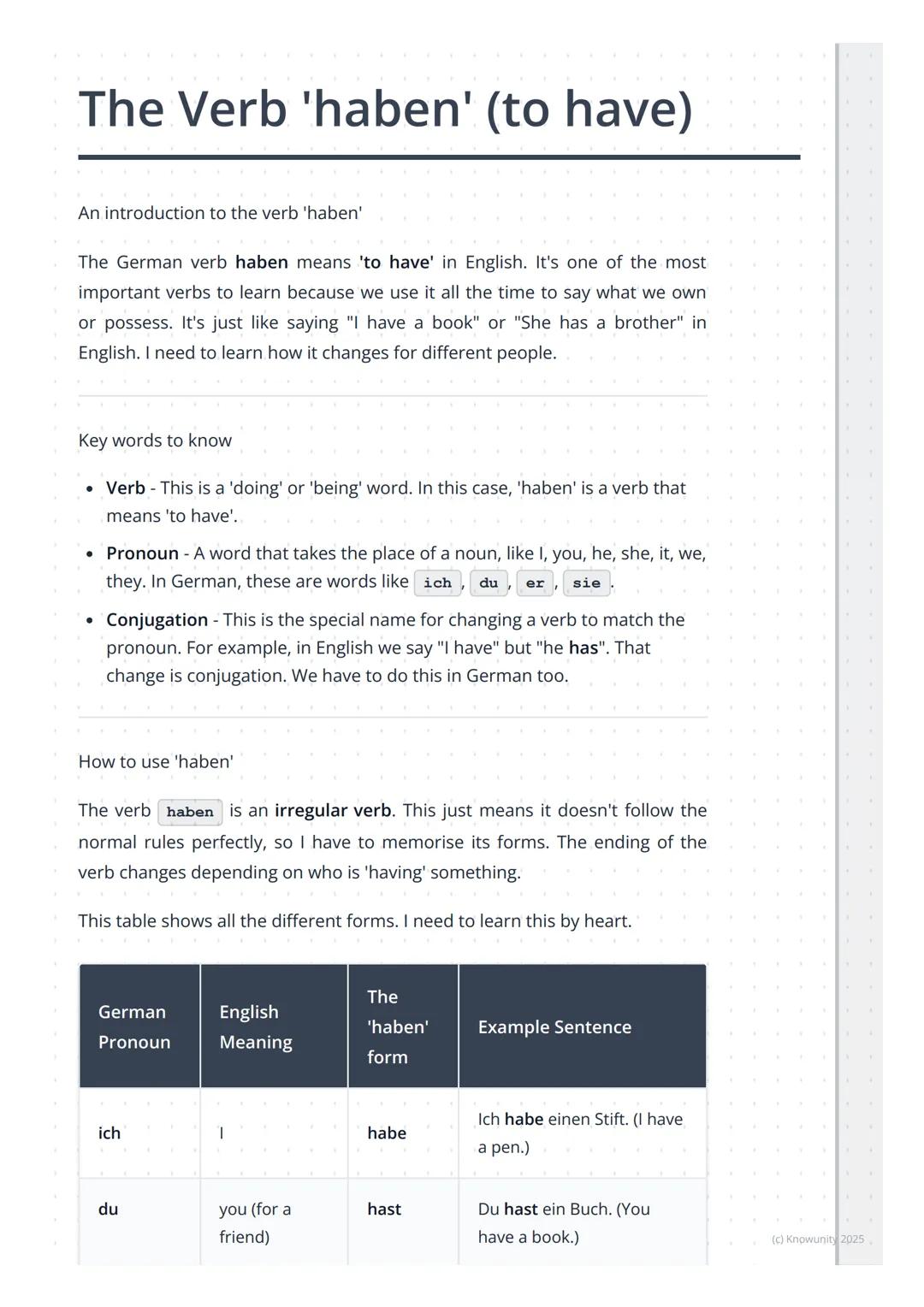
What is 'haben' and why does it matter?
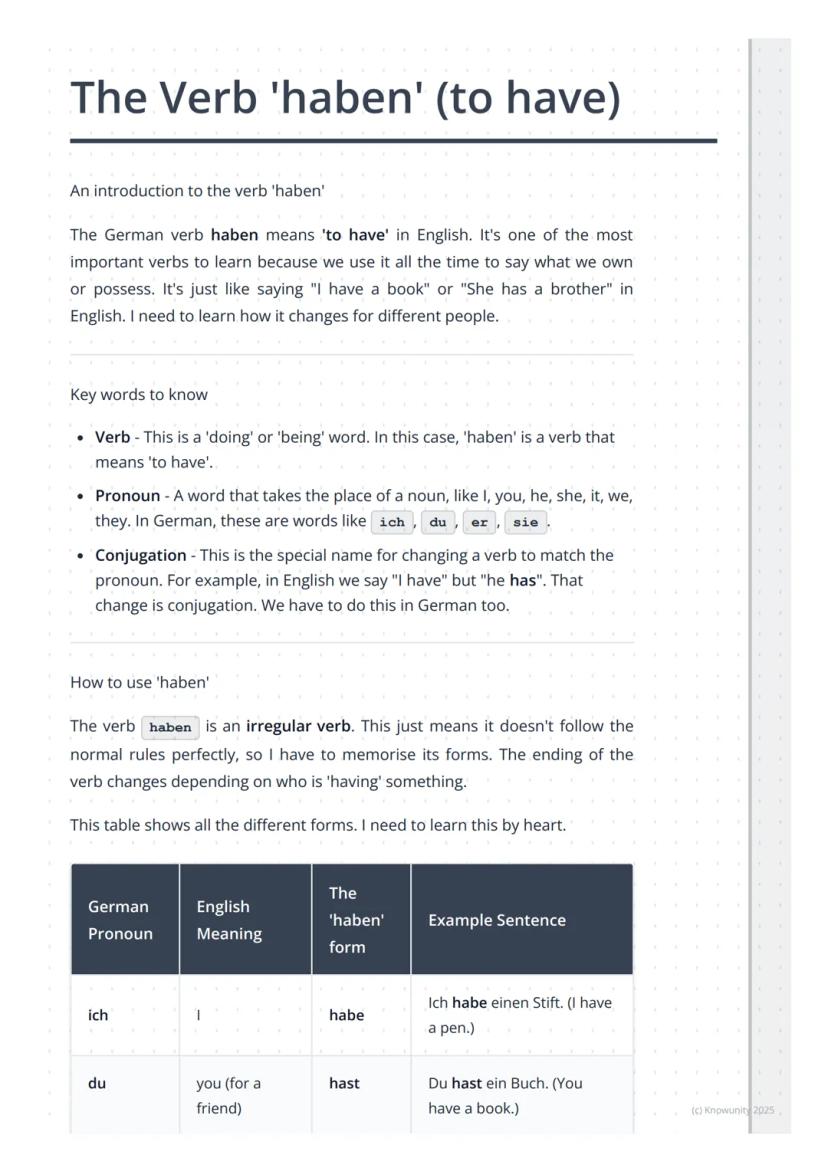
The German verb haben means 'to have' in English, and you'll use it loads to talk about what you own or possess. Think "I have a phone" or "My mate has a new bike" - that's haben in action!
Here's the thing though - haben is an irregular verb. This means it doesn't follow the normal patterns, so you can't just guess the endings. You've got to memorise how it changes for different people.
The key terms you need to know are conjugation (when verbs change to match different people) and pronouns (words like I, you, he, she). In German, these are ich, du, er, sie, and so on.
Quick Tip: Don't worry if this feels tricky at first - even native German speakers had to learn these patterns when they were young!
2
of 4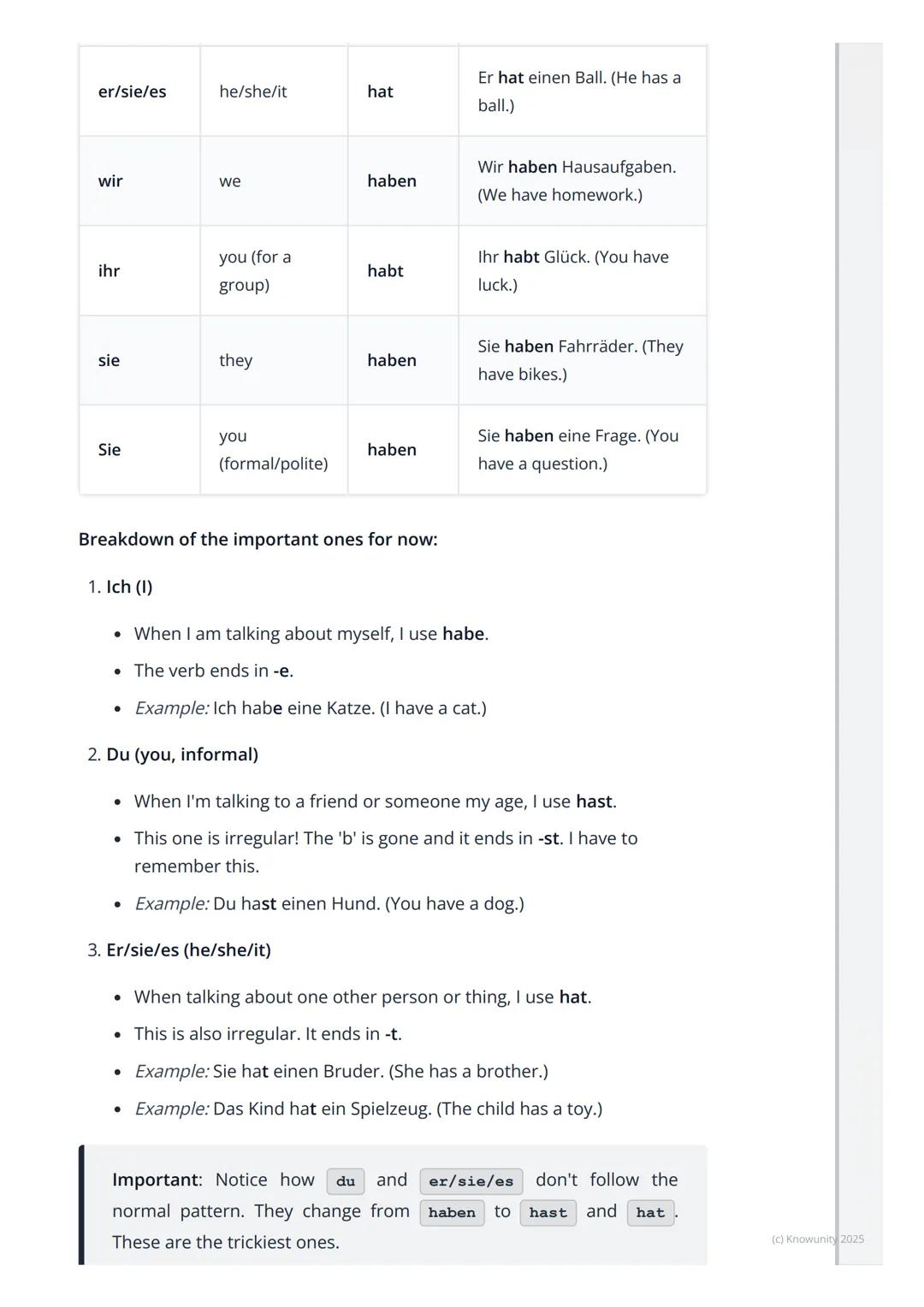
The haben forms you absolutely must know
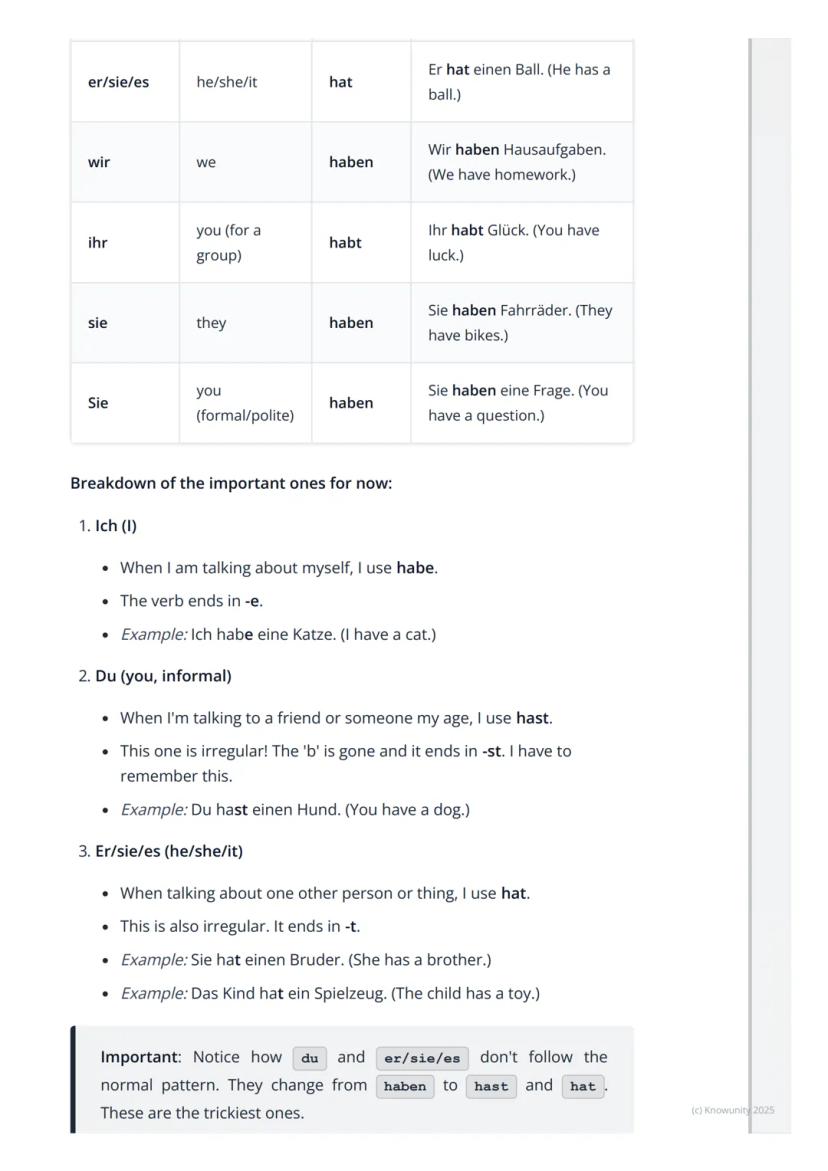
The three most important forms are the irregular ones that break the rules. Let's focus on these first: ich habe (I have), du hast (you have), and er/sie/es hat .
Notice how 'du hast' loses the 'b' completely - it's not 'du habst'! And 'hat' is super short compared to the original 'haben'. These two are the trickiest because they're so different.
The easier ones to remember are wir haben (we have) and sie haben (they have) because they stay the same as the original verb. There's also ihr habt (you all have), which just adds a 't' on the end.
Memory Trick: Think "Du HAST to remember this one!" for the du form - it's the most common mistake students make.
3
of 4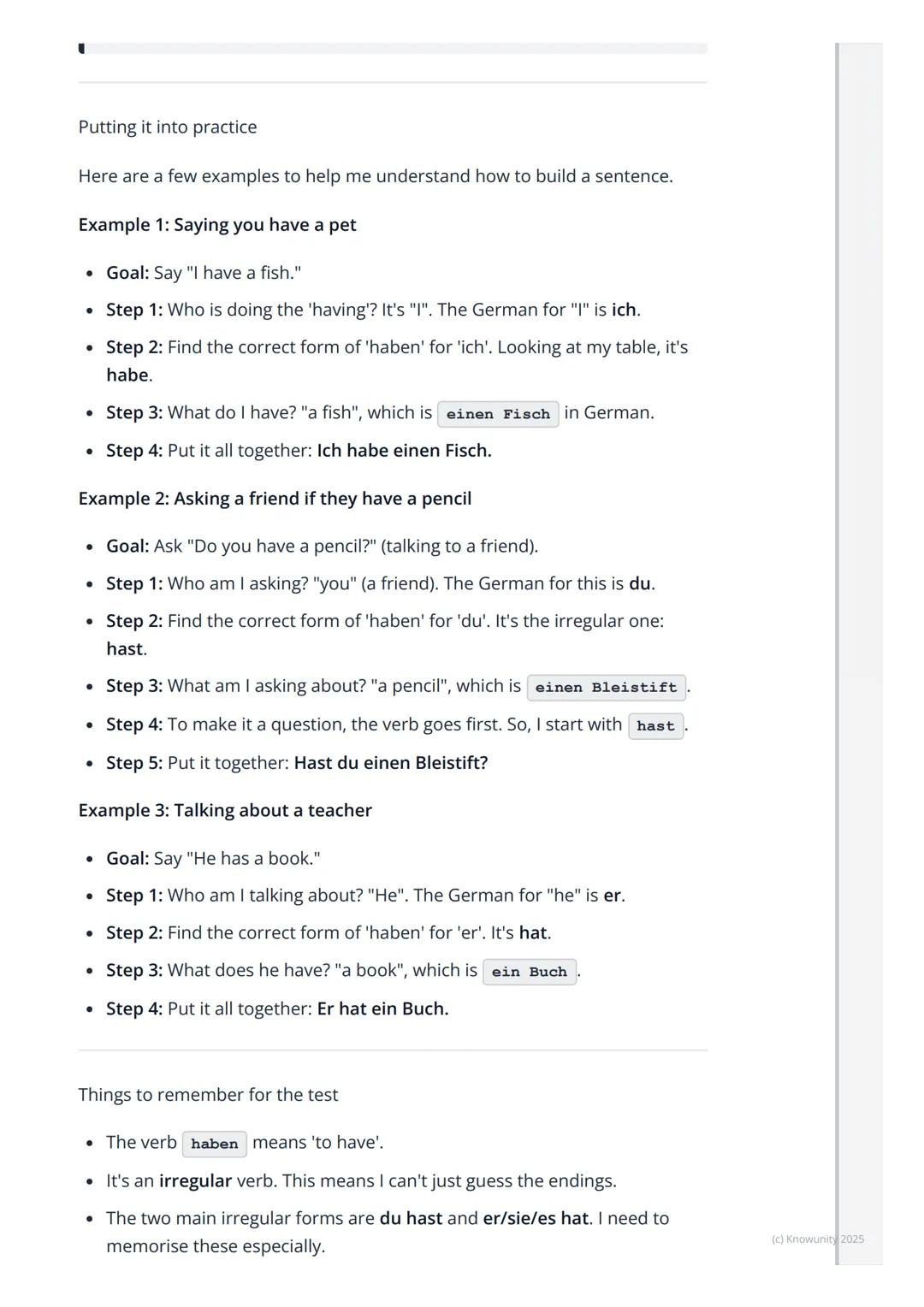
Building sentences with haben
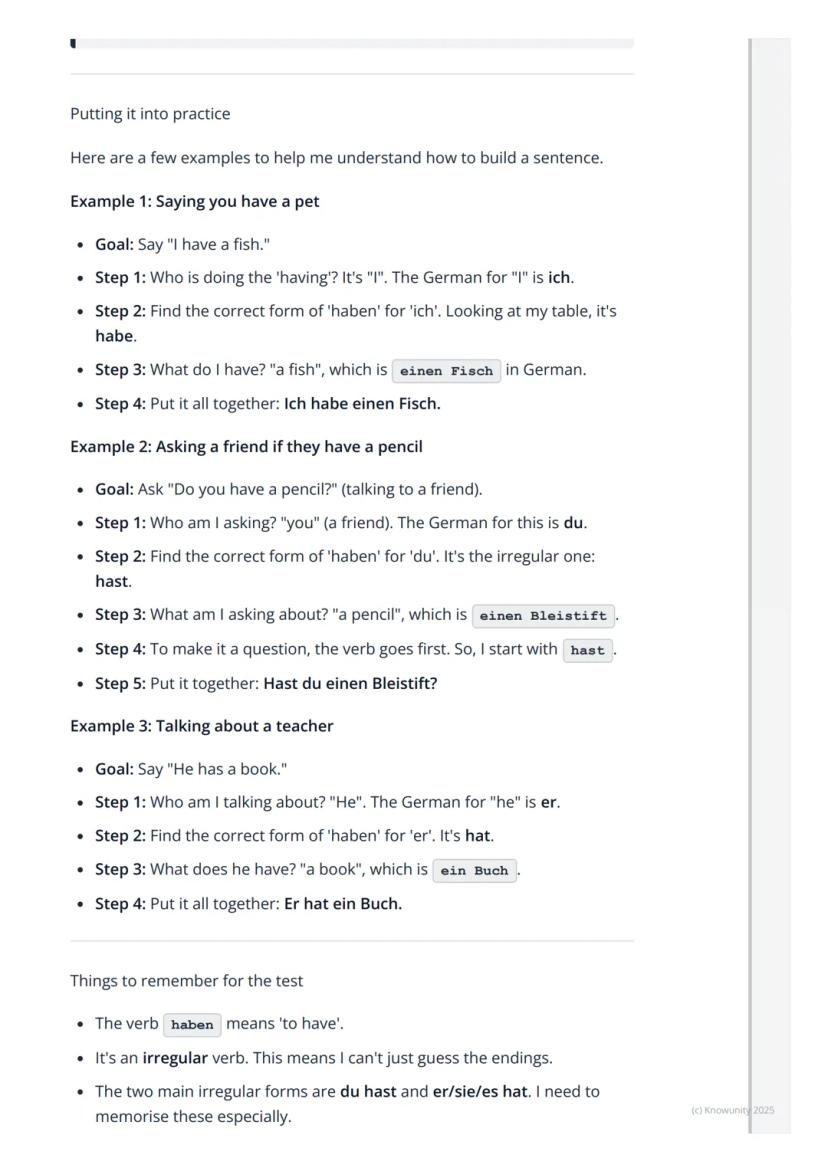
Let's put this into practice with real examples you might actually use! When saying "I have a cat", start with ich (I), then habe (have), then eine Katze (a cat). Simple as that: "Ich habe eine Katze."
For questions, flip the order around. Instead of "Du hast einen Stift" (You have a pen), ask "Hast du einen Stift?" (Do you have a pen?). The verb jumps to the front in German questions.
When talking about someone else, like "She has a brother", use sie hat einen Bruder. Remember, it's 'hat' not 'hast' because you're talking about her, not to her directly.
Pro Tip: Practice by describing what people in your class have - "Emma hat ein neues Handy" or "Wir haben Mathe heute."
4
of 4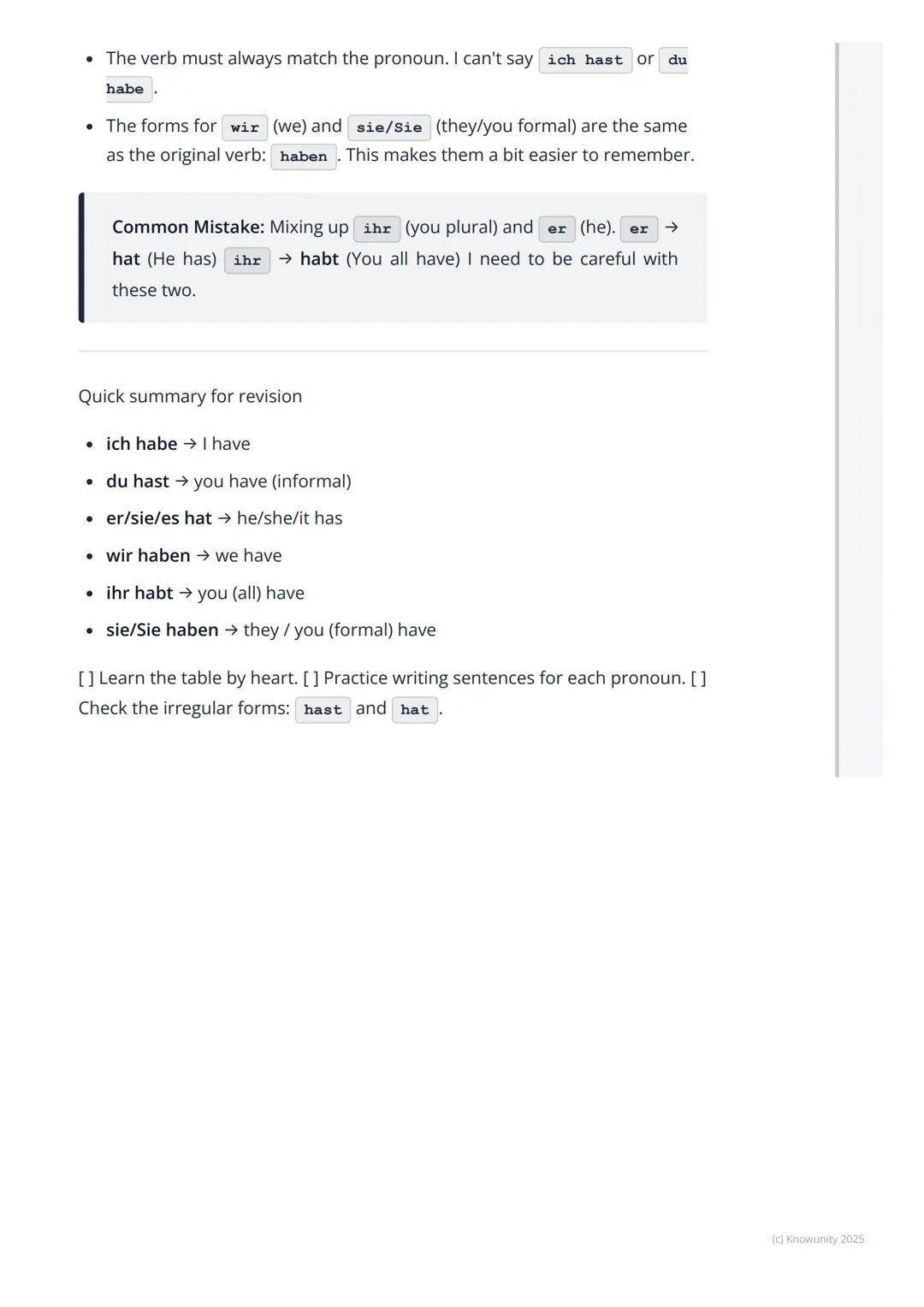
Avoiding the most common mistakes
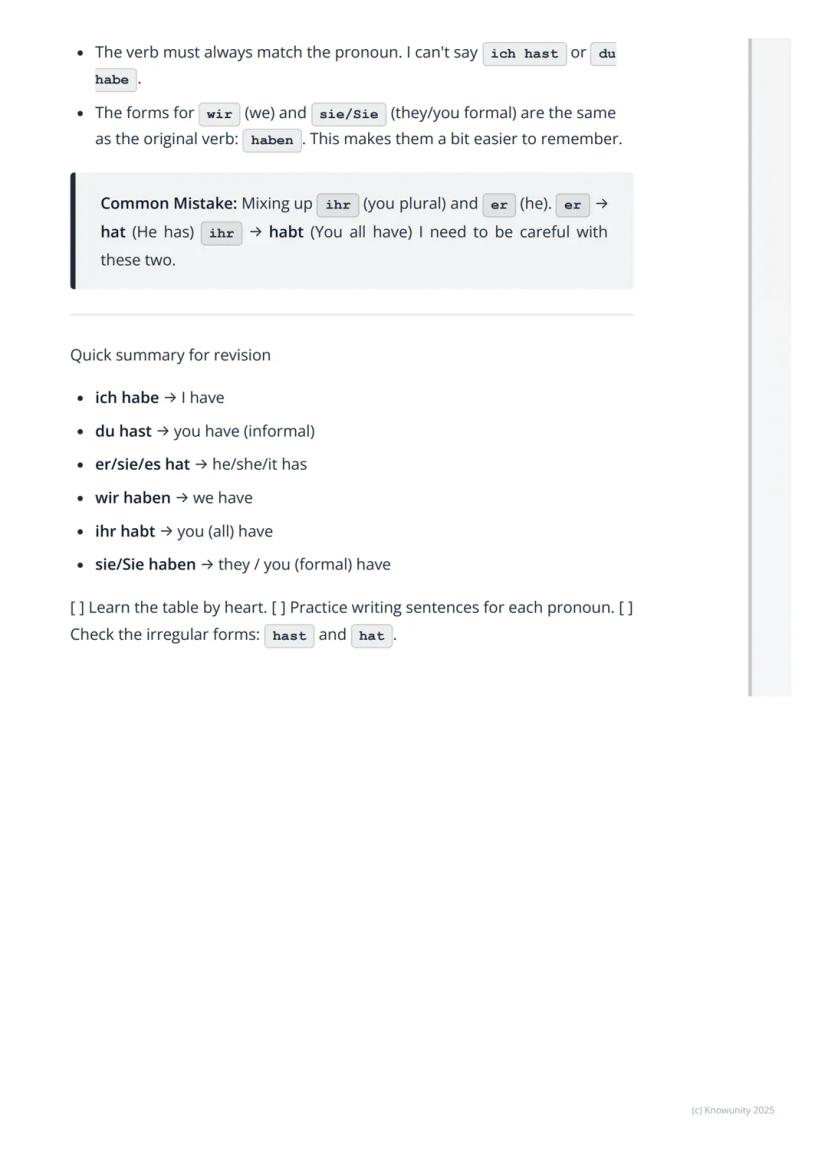
The biggest mistake is mixing up du hast and er hat. Remember: if you're talking TO someone (like your mate), use 'hast'. If you're talking ABOUT someone (like your teacher), use 'hat'.
Don't confuse ihr habt (you all have) with er hat (he has) either. 'Ihr' is when you're talking to a whole group of friends, whilst 'er' is just one person you're talking about.
Here's your quick revision list: ich habe, du hast, er/sie/es hat, wir haben, ihr habt, sie haben. The irregular ones (hast and hat) are your priority - get these rock solid first!
Test Prep: Make flashcards with just the tricky forms and quiz yourself daily until they're automatic.
Credeam că nu vei întreba niciodată...
Ce este Companionul AI Knowunity?
Companionul nostru AI este creat special pentru nevoile studenților. Bazându-ne pe milioanele de materiale de pe platformă, putem oferi răspunsuri exacte și relevante pentru studenți. Dar nu este vorba doar despre răspunsuri, companionul este mai ales despre ghidarea studenților prin provocările zilnice de învățare, cu planuri de studiu personalizate, chestionare sau conținuturi în chat și personalizare 100% bazată pe abilitățile și evoluțiile studenților.
De unde pot descărca aplicația Knowunity?
Aplicația este disponibilă în Google Play Store și Apple App Store.
Este Knowunity chiar gratuită?
Da! Bucură-te de access la materiale de studiu, conectează-te cu alți elevi, și primește ajutor instant - toate acestea la un click distanță. În plus, câștigă puncte ca să deblochezi mai multe funcționalități!
Cel mai popular conținut la German
2Cel mai popular conținut
9 Irish
IrishIrish oral questions and answers
Questions and answers for the leaving cert oral
5th Year4264
 English
Key Quotes : Sive
Key Quotes and explanations: Sive
6th Year2842
IrishIrish oral questions
Outline of oral questions
5th Year2055
IrishIníon- le hÁine Durkin
Aine Durkin’s poem, Iníon: Themes & summary
5th Year890
IrishIrish poetry 2027
Iníon + Dínit an Bhróin
5th Year1153
IrishLC HL notes- Iníon (poem)
Includes poem in English and Irish, theme, key words & phrases
5th Year2304
EnglishCultural Context : Shawshank Redemption : Sive : Small Things Like These
Comparative Study : Cultural Context : Shawshank Redemption, Sive and Small Things Like These
6th Year1430
IrishMo Ghrá-sa (Idir Lúibíní)
Notes on mo ghrá-sa
5th Year380
IrishAn Gaeilge Aiste
Irish Language essay
6th Year1320
Nu găsești ce cauți? Explorează alte MATERII.
Recenzii de la utilizatorii noștri. Ei iubesc să folosească Knowunity — și tu o vei face.
4.6/5App Store
4.7/5Google Play
Aplicația este foarte ușor de utilizat și bine concepută. Am găsit tot ce căutam până acum și am reușit să învăț multe din prezentări! Cu siguranță voi folosi aplicația pentru o temă la clasă! Și desigur, ajută mult ca sursă de inspirație.
Ștefan Sutilizator iOS
Această aplicație este super. Sunt atât de multe materiale de studiu și ajutor pentru elevi [...]. Materia mea mai problematică este franceza, de exemplu, și aplicația oferă foarte multe materiale ajutătoare. Mulțumită acestei aplicații, mi-am îmbunătățit franceza. Aș recomanda-o oricui.
Samantha Klichutilizator Android
Wow, sunt cu adevărat impresionat. Am încercat aplicația pentru că am văzut-o promovată de multe ori și am rămas uimit. Aceasta este AJUTORUL de care ai nevoie pentru școală și, mai presus de toate, oferă atât de multe lucruri, precum exerciții și fișe de informații, care mi-au fost FOARTE de ajutor.
Annautilizator iOS
German4 vizualizări·Actualizat Jun 7, 2026·4 paginiMastering the German Verb 'haben' (to have)
Learning the German verb 'haben' (to have) is absolutely essential - you'll use it constantly! Just like in English where we say "I have" but "she has", German verbs change their endings depending on who's doing the action.
1
of 4
Înscrie-te pentru a vedea CONȚINUTUL. E gratuit!
- Acces la toate documentele
- Îmbunătățește notele tale!
- Alătură-te milioanelor de elevi
What is 'haben' and why does it matter?
The German verb haben means 'to have' in English, and you'll use it loads to talk about what you own or possess. Think "I have a phone" or "My mate has a new bike" - that's haben in action!
Here's the thing though - haben is an irregular verb. This means it doesn't follow the normal patterns, so you can't just guess the endings. You've got to memorise how it changes for different people.
The key terms you need to know are conjugation (when verbs change to match different people) and pronouns (words like I, you, he, she). In German, these are ich, du, er, sie, and so on.
Quick Tip: Don't worry if this feels tricky at first - even native German speakers had to learn these patterns when they were young!
2
of 4Înscrie-te pentru a vedea CONȚINUTUL. E gratuit!
- Acces la toate documentele
- Îmbunătățește notele tale!
- Alătură-te milioanelor de elevi
The haben forms you absolutely must know
The three most important forms are the irregular ones that break the rules. Let's focus on these first: ich habe (I have), du hast (you have), and er/sie/es hat .
Notice how 'du hast' loses the 'b' completely - it's not 'du habst'! And 'hat' is super short compared to the original 'haben'. These two are the trickiest because they're so different.
The easier ones to remember are wir haben (we have) and sie haben (they have) because they stay the same as the original verb. There's also ihr habt (you all have), which just adds a 't' on the end.
Memory Trick: Think "Du HAST to remember this one!" for the du form - it's the most common mistake students make.
3
of 4Înscrie-te pentru a vedea CONȚINUTUL. E gratuit!
- Acces la toate documentele
- Îmbunătățește notele tale!
- Alătură-te milioanelor de elevi
Building sentences with haben
Let's put this into practice with real examples you might actually use! When saying "I have a cat", start with ich (I), then habe (have), then eine Katze (a cat). Simple as that: "Ich habe eine Katze."
For questions, flip the order around. Instead of "Du hast einen Stift" (You have a pen), ask "Hast du einen Stift?" (Do you have a pen?). The verb jumps to the front in German questions.
When talking about someone else, like "She has a brother", use sie hat einen Bruder. Remember, it's 'hat' not 'hast' because you're talking about her, not to her directly.
Pro Tip: Practice by describing what people in your class have - "Emma hat ein neues Handy" or "Wir haben Mathe heute."
4
of 4Înscrie-te pentru a vedea CONȚINUTUL. E gratuit!
- Acces la toate documentele
- Îmbunătățește notele tale!
- Alătură-te milioanelor de elevi
Avoiding the most common mistakes
The biggest mistake is mixing up du hast and er hat. Remember: if you're talking TO someone (like your mate), use 'hast'. If you're talking ABOUT someone (like your teacher), use 'hat'.
Don't confuse ihr habt (you all have) with er hat (he has) either. 'Ihr' is when you're talking to a whole group of friends, whilst 'er' is just one person you're talking about.
Here's your quick revision list: ich habe, du hast, er/sie/es hat, wir haben, ihr habt, sie haben. The irregular ones (hast and hat) are your priority - get these rock solid first!
Test Prep: Make flashcards with just the tricky forms and quiz yourself daily until they're automatic.
Credeam că nu vei întreba niciodată...
Ce este Companionul AI Knowunity?
Companionul nostru AI este creat special pentru nevoile studenților. Bazându-ne pe milioanele de materiale de pe platformă, putem oferi răspunsuri exacte și relevante pentru studenți. Dar nu este vorba doar despre răspunsuri, companionul este mai ales despre ghidarea studenților prin provocările zilnice de învățare, cu planuri de studiu personalizate, chestionare sau conținuturi în chat și personalizare 100% bazată pe abilitățile și evoluțiile studenților.
De unde pot descărca aplicația Knowunity?
Aplicația este disponibilă în Google Play Store și Apple App Store.
Este Knowunity chiar gratuită?
Da! Bucură-te de access la materiale de studiu, conectează-te cu alți elevi, și primește ajutor instant - toate acestea la un click distanță. În plus, câștigă puncte ca să deblochezi mai multe funcționalități!
Cel mai popular conținut la German
2Cel mai popular conținut
9IrishIrish oral questions and answers
Questions and answers for the leaving cert oral
5th Year4264
EnglishKey Quotes : Sive
Key Quotes and explanations: Sive
6th Year2842
IrishIrish oral questions
Outline of oral questions
5th Year2055
IrishIníon- le hÁine Durkin
Aine Durkin’s poem, Iníon: Themes & summary
5th Year890
IrishIrish poetry 2027
Iníon + Dínit an Bhróin
5th Year1153
IrishLC HL notes- Iníon (poem)
Includes poem in English and Irish, theme, key words & phrases
5th Year2304
EnglishCultural Context : Shawshank Redemption : Sive : Small Things Like These
Comparative Study : Cultural Context : Shawshank Redemption, Sive and Small Things Like These
6th Year1430
IrishMo Ghrá-sa (Idir Lúibíní)
Notes on mo ghrá-sa
5th Year380
IrishAn Gaeilge Aiste
Irish Language essay
6th Year1320
Nu găsești ce cauți? Explorează alte MATERII.
Recenzii de la utilizatorii noștri. Ei iubesc să folosească Knowunity — și tu o vei face.
4.6/5App Store
4.7/5Google Play
Aplicația este foarte ușor de utilizat și bine concepută. Am găsit tot ce căutam până acum și am reușit să învăț multe din prezentări! Cu siguranță voi folosi aplicația pentru o temă la clasă! Și desigur, ajută mult ca sursă de inspirație.
Ștefan Sutilizator iOS
Această aplicație este super. Sunt atât de multe materiale de studiu și ajutor pentru elevi [...]. Materia mea mai problematică este franceza, de exemplu, și aplicația oferă foarte multe materiale ajutătoare. Mulțumită acestei aplicații, mi-am îmbunătățit franceza. Aș recomanda-o oricui.
Samantha Klichutilizator Android
Wow, sunt cu adevărat impresionat. Am încercat aplicația pentru că am văzut-o promovată de multe ori și am rămas uimit. Aceasta este AJUTORUL de care ai nevoie pentru școală și, mai presus de toate, oferă atât de multe lucruri, precum exerciții și fișe de informații, care mi-au fost FOARTE de ajutor.
Annautilizator iOS