
Ever wondered why it's always raining in Cork but sunny... Afișează mai mult
 Geography2 vizualizări·Actualizat Jun 1, 2026·10 pagini
Understanding Earth's Atmosphere and Weather
1 / 10
1
of 10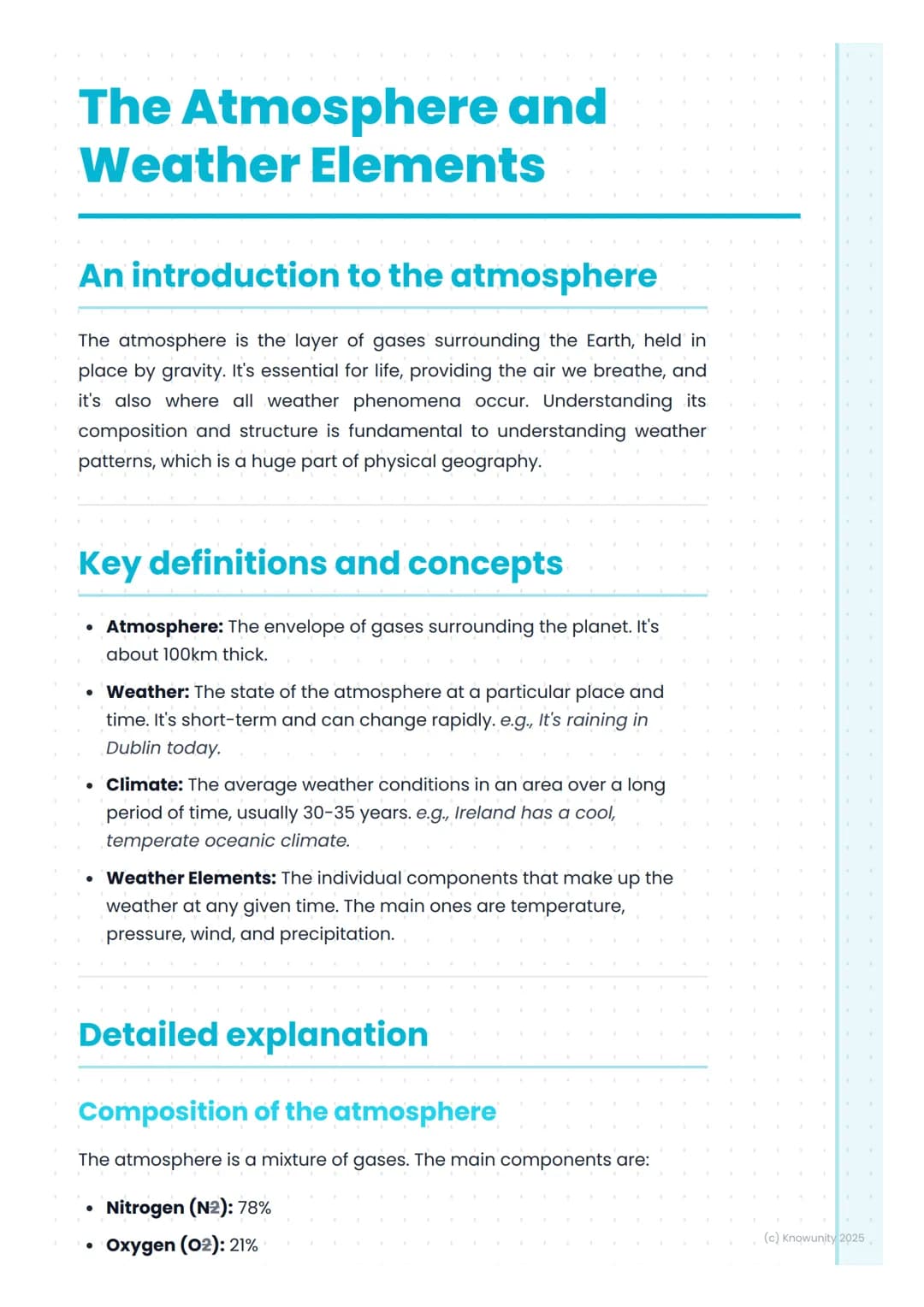
The Atmosphere Basics
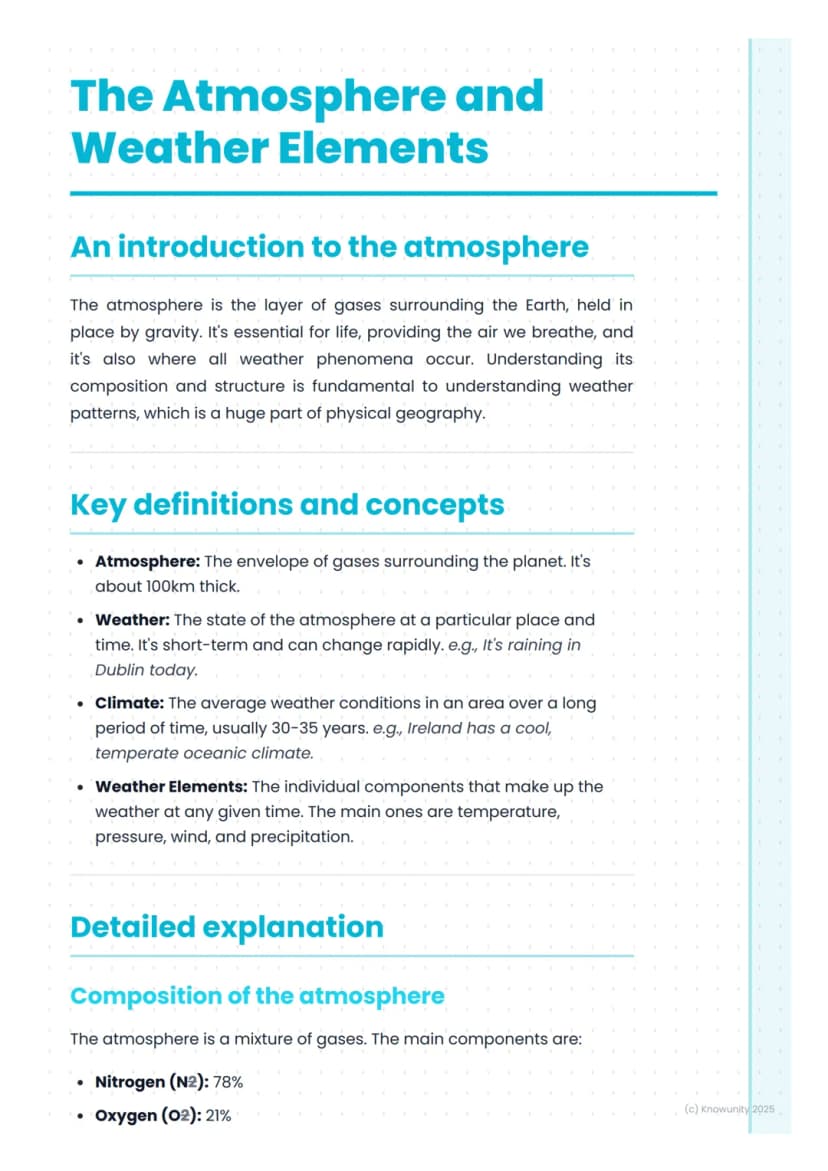
The atmosphere is essentially a 100km-thick layer of gases that keeps us alive and creates all our weather. Think of it as Earth's protective bubble that's constantly moving and changing.
Here's what you're breathing: 78% nitrogen, 21% oxygen, and just 1% of other gases including water vapour. That tiny bit of water vapour might seem insignificant, but it's responsible for every cloud, raindrop, and snowflake you've ever seen.
Weather is what's happening right now - like today's downpour in Dublin. Climate is the long-term average over 30+ years - like Ireland's famously wet reputation. Don't mix these up in your exams!
Quick Tip: Weather elements (temperature, pressure, wind, precipitation) are the building blocks of every weather forecast you check.
2
of 10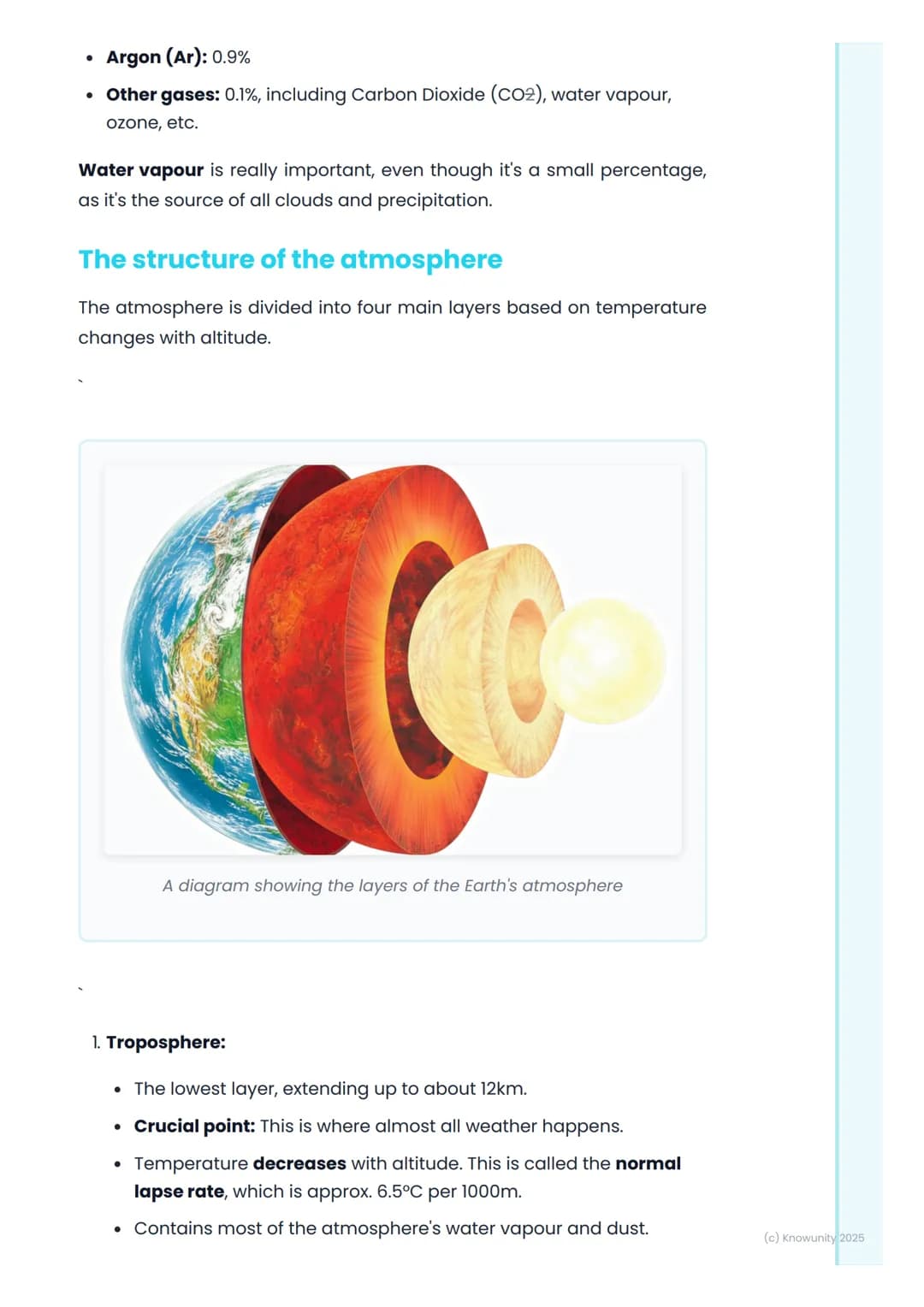
Atmospheric Layers
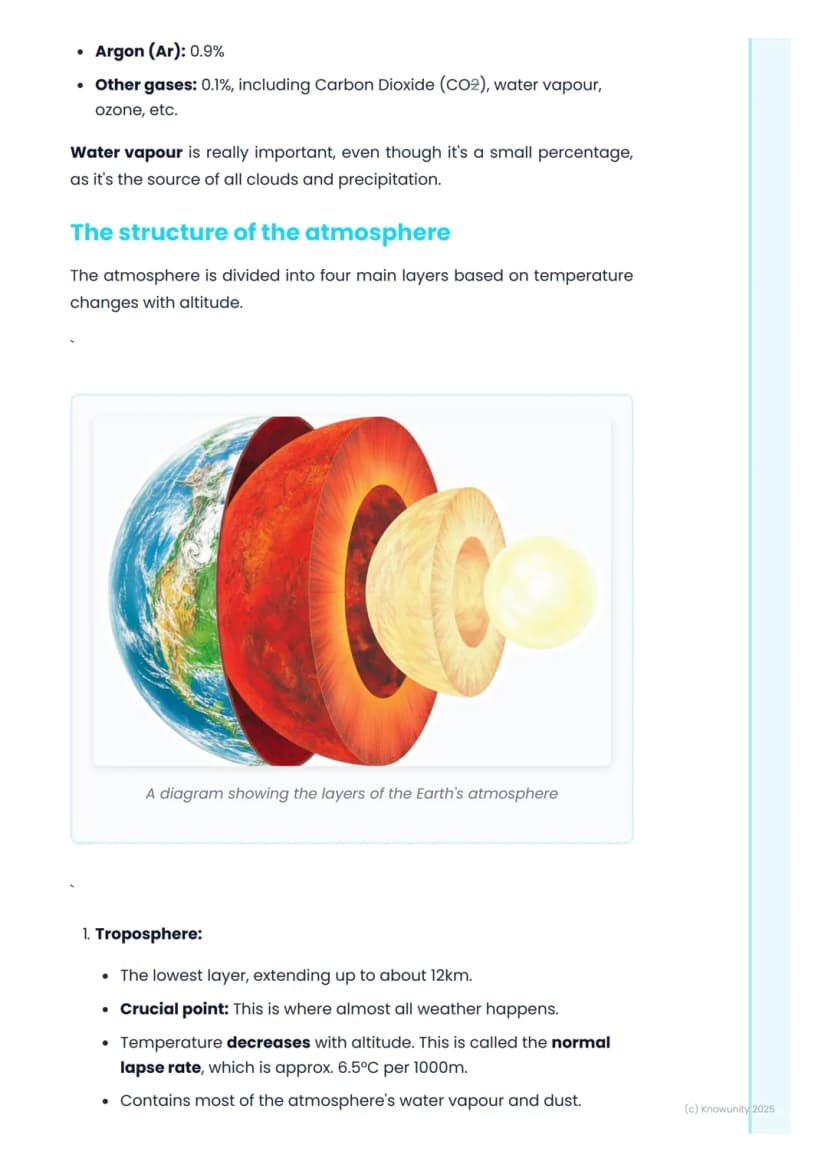
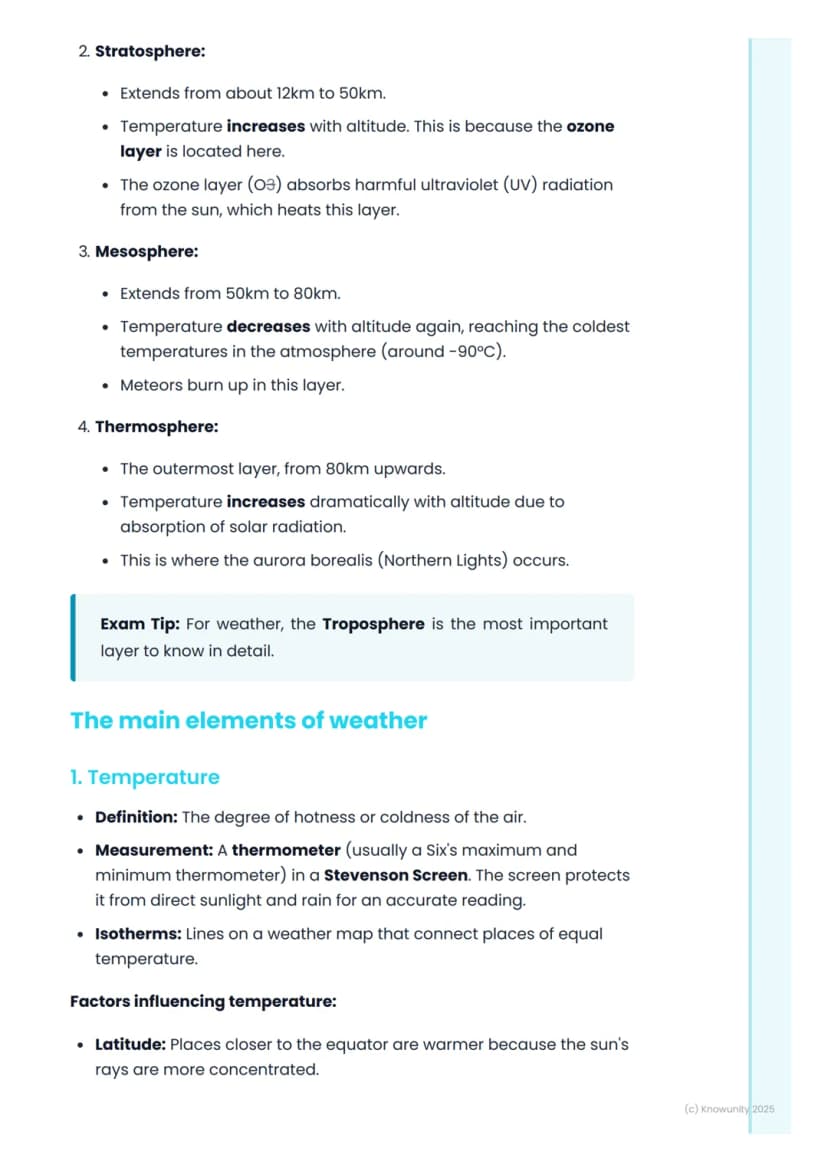
The atmosphere has four main layers, but you really need to know the first two. Here's a handy memory trick: The Sun Makes Things hot (Troposphere, Stratosphere, Mesosphere, Thermosphere).
The troposphere is where all the action happens - it's only 12km thick but contains virtually all our weather. Temperature drops as you go higher (about 6.5°C per 1000m), which explains why Carrauntoohil is always colder than sea level.
The stratosphere sits above it, containing the crucial ozone layer that blocks harmful UV rays. Unlike the troposphere, temperature actually increases with height here because ozone absorbs solar radiation.
Exam Focus: The troposphere is your priority - almost every weather question relates to this bottom layer.
3
of 10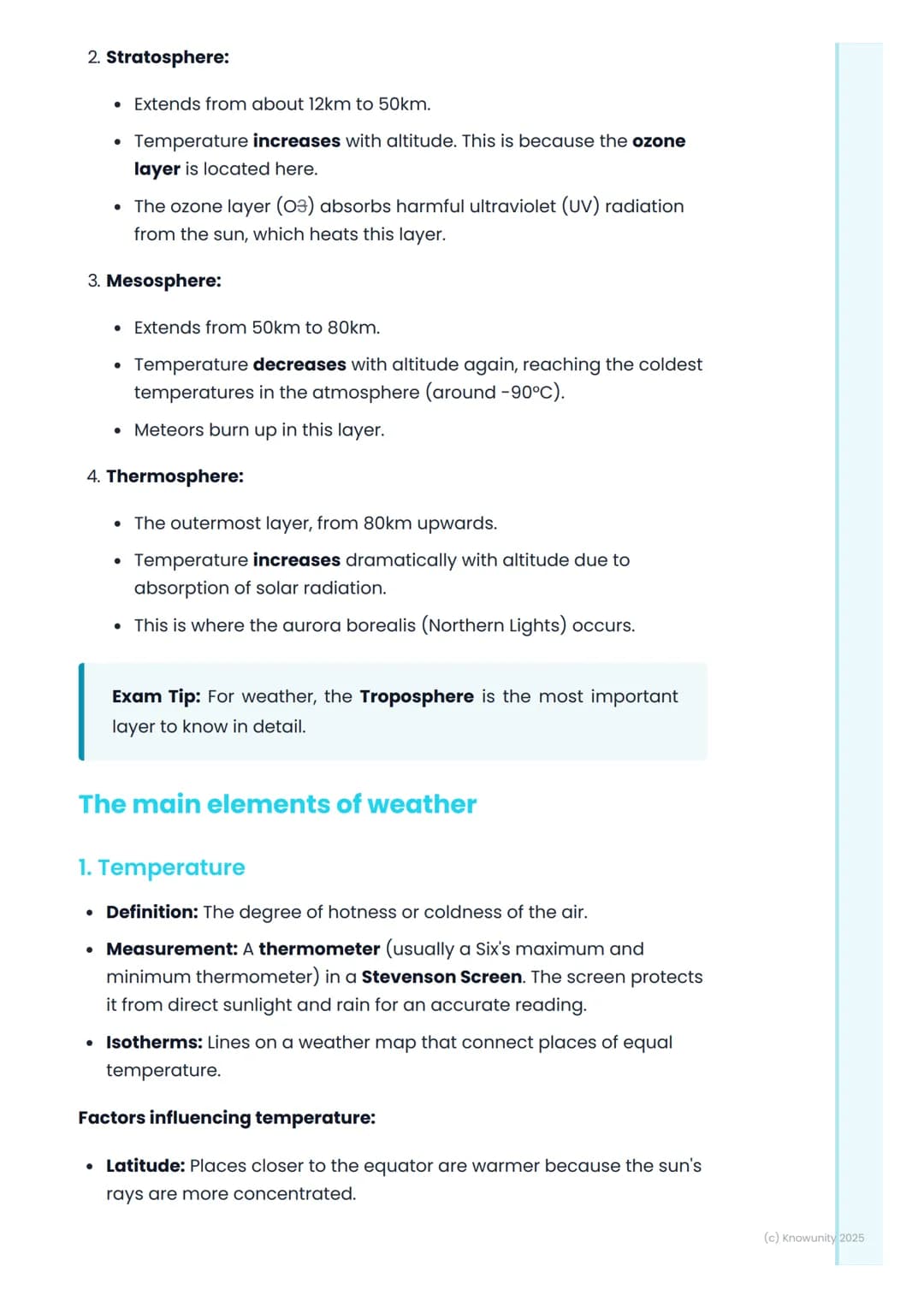
Temperature and Pressure
Temperature is measured using thermometers in Stevenson Screens (those white boxes you see at weather stations). Four main factors affect temperature: how close you are to the equator, your height above sea level, distance from the sea, and which way slopes face.
Ireland's coast stays milder year-round thanks to the sea's slow heating and cooling - that's why Galway has cooler summers but warmer winters than inland Athlone.
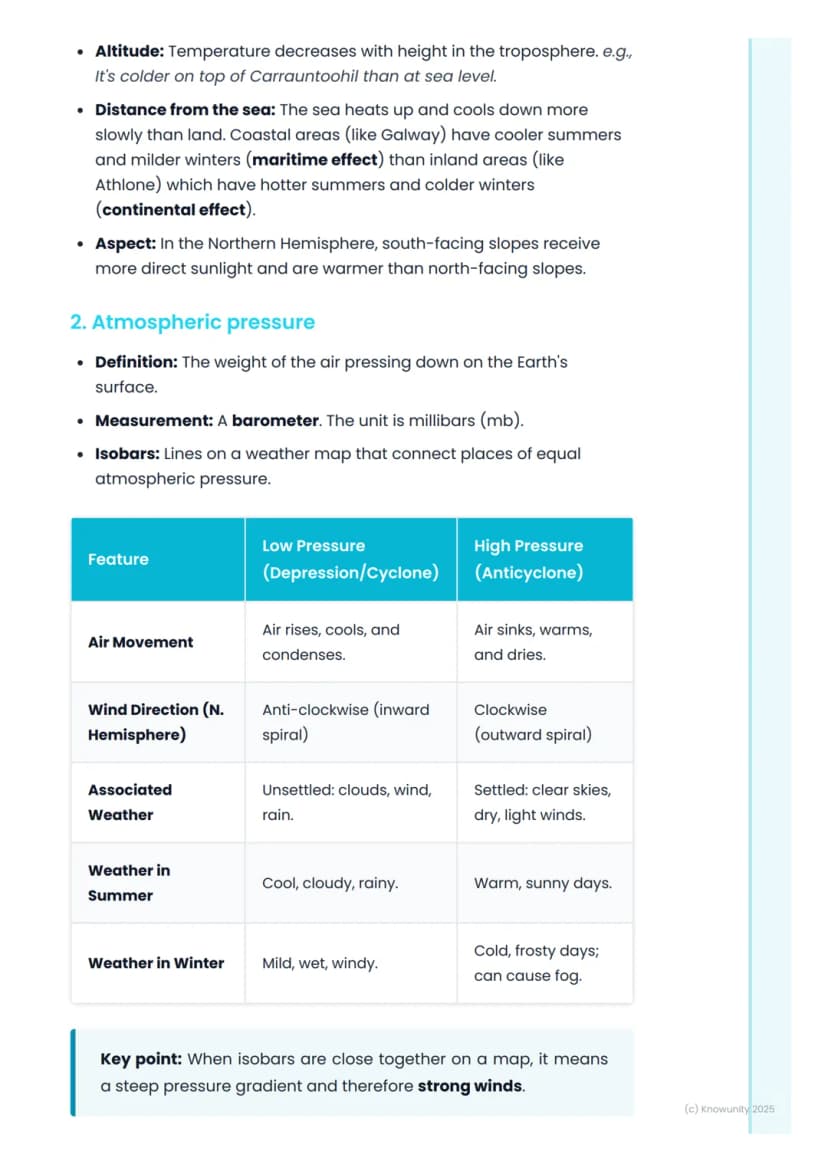
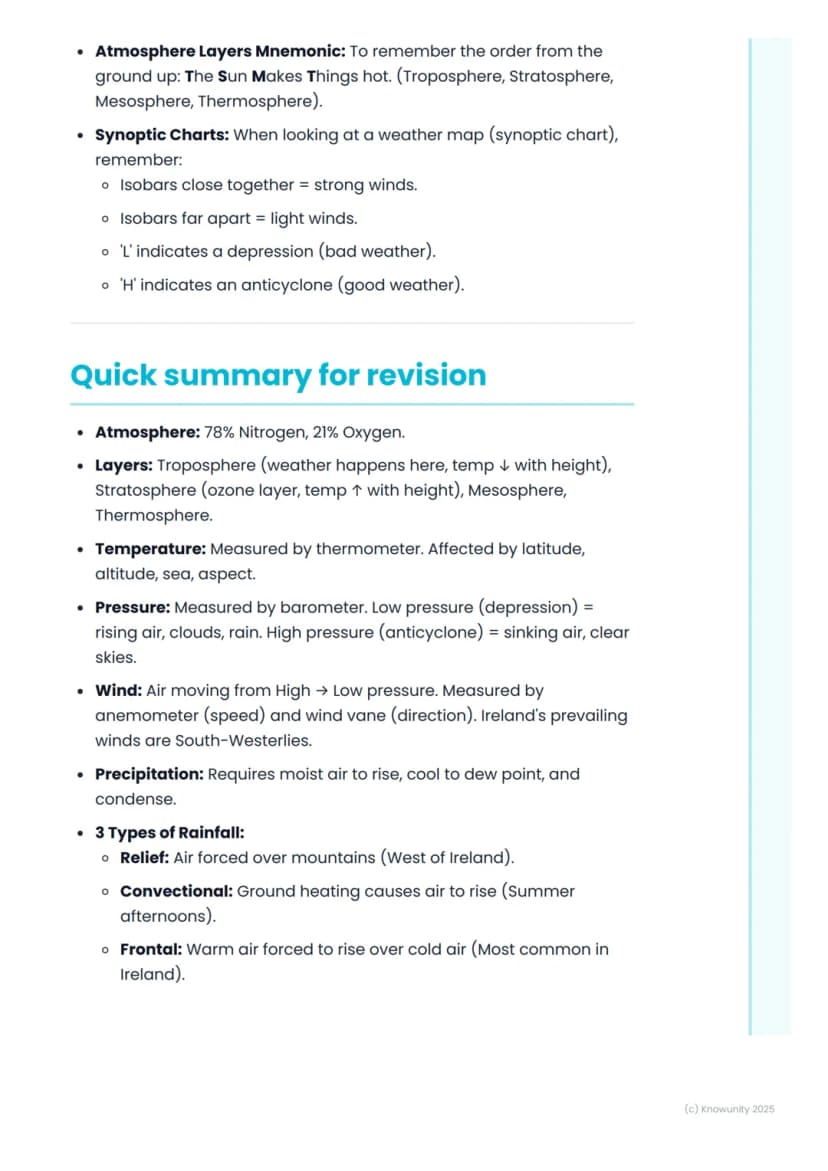
Atmospheric pressure is the weight of air pressing down on you, measured in millibars. Low pressure (depressions) means air is rising, cooling, and forming clouds - hello, rainy day! High pressure (anticyclones) means air is sinking and warming - cue the sunny weather.
Map Reading: When isobars (pressure lines) are squashed together, expect strong winds. Spread apart means light winds.
4
of 10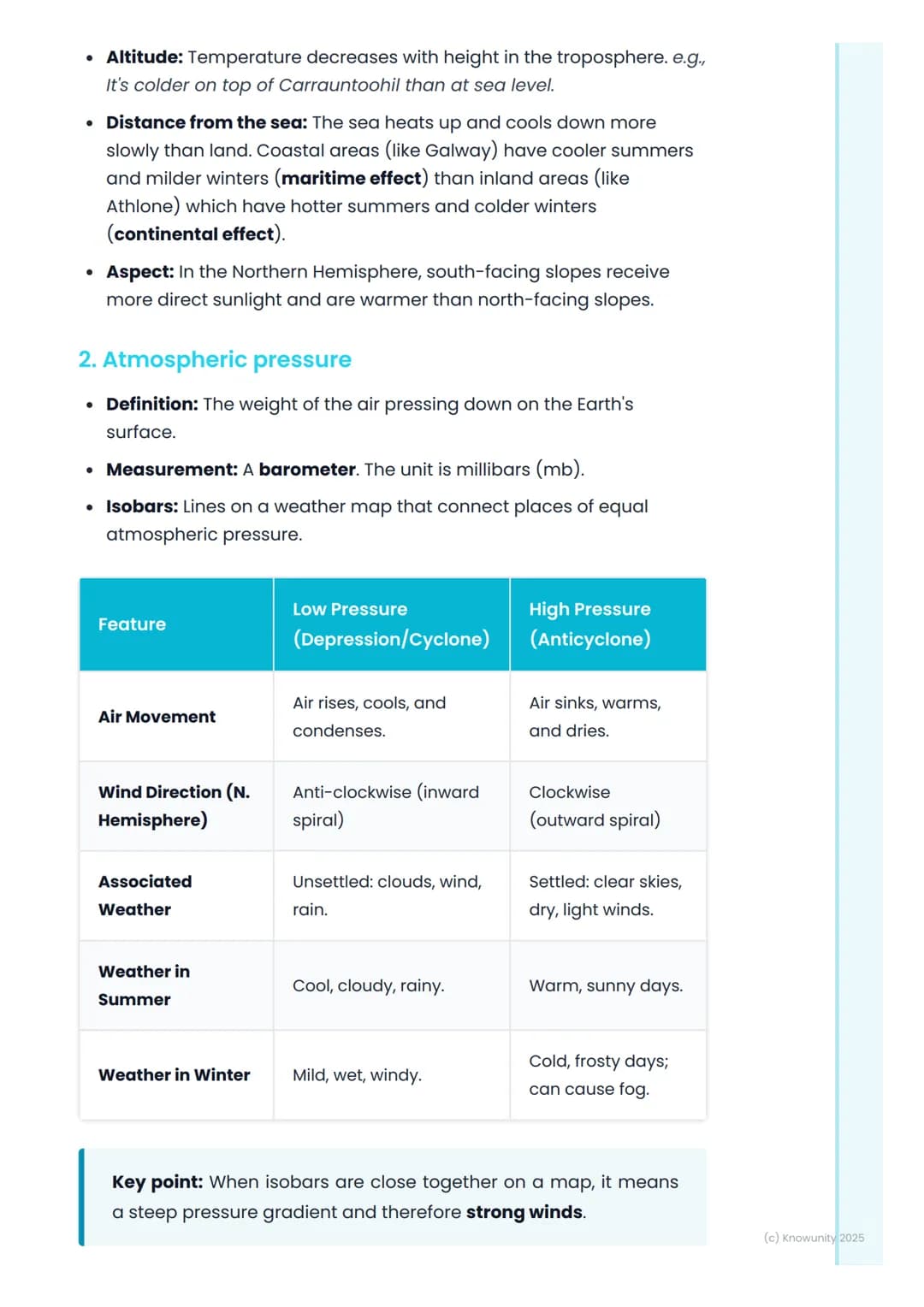
Wind and Weather Patterns
Wind is simply air rushing from high pressure to low pressure areas. In Ireland, our prevailing winds are South-Westerlies - they bring all that Atlantic moisture that keeps our grass so green!
Due to Earth's rotation, winds curve to the right in the Northern Hemisphere (called the Coriolis effect). This is why low-pressure systems spin anti-clockwise and high-pressure systems spin clockwise.
When you see a weather map, look for the 'L' and 'H' symbols. An 'L' means expect clouds, wind, and rain. An 'H' means settled, clear conditions - though in winter, this can bring frost and fog.
Wind Direction: Remember, winds are named from where they're coming from, not where they're going!
5
of 10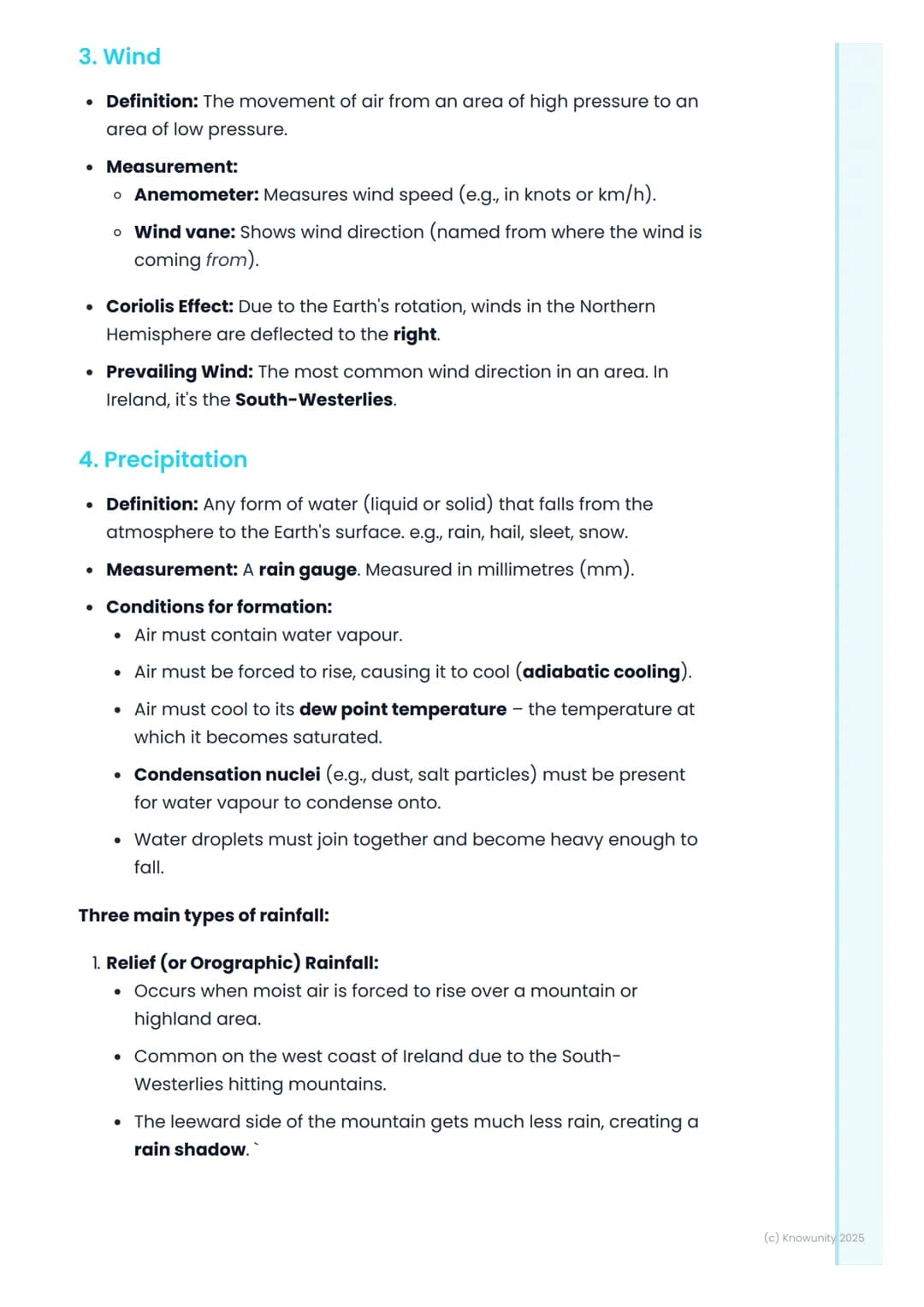
Rainfall Types
For precipitation to form, you need moist air that's forced to rise and cool to its dew point (saturation temperature). There are three main types you'll encounter in Ireland.
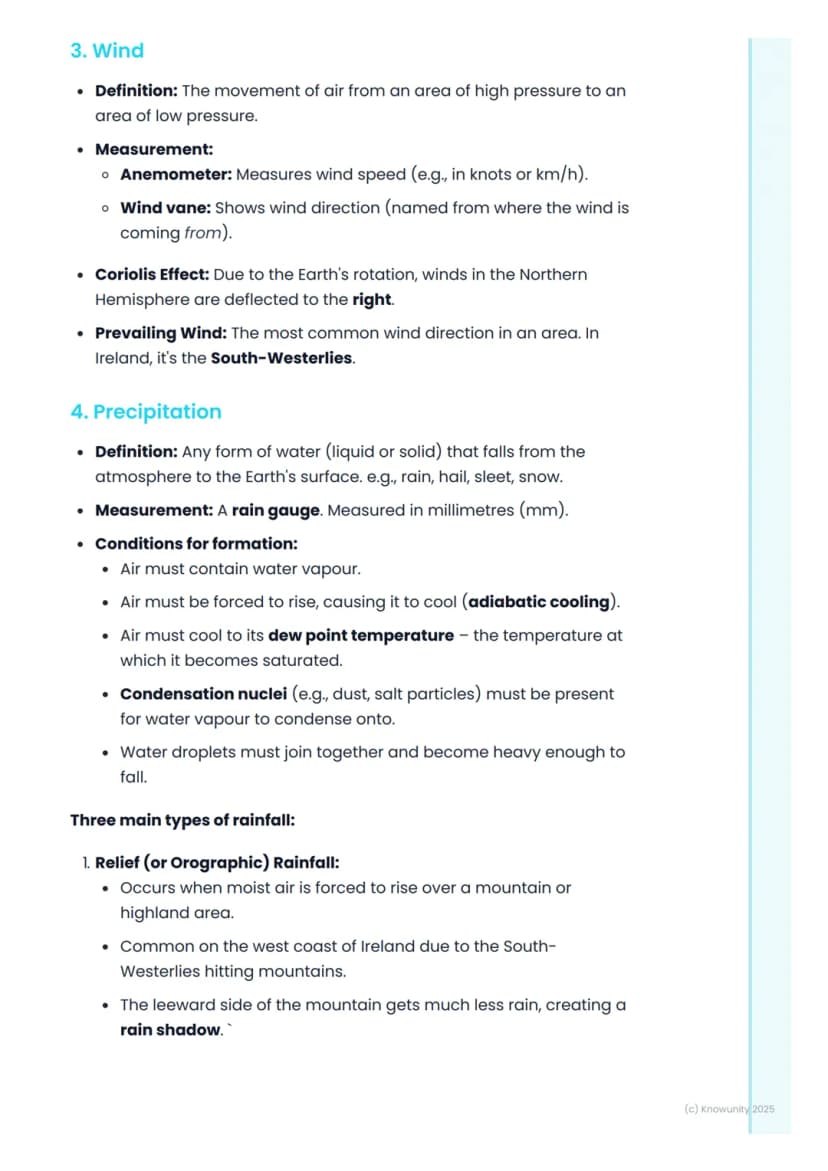
Relief rainfall happens when our South-Westerly winds hit western mountains like the MacGillycuddy's Reeks. The air is forced upwards, cools, and dumps heavy rain on the western slopes. This creates a rain shadow effect - which is why Dublin gets less than 750mm of rain yearly while Valentia Island gets over 1400mm.
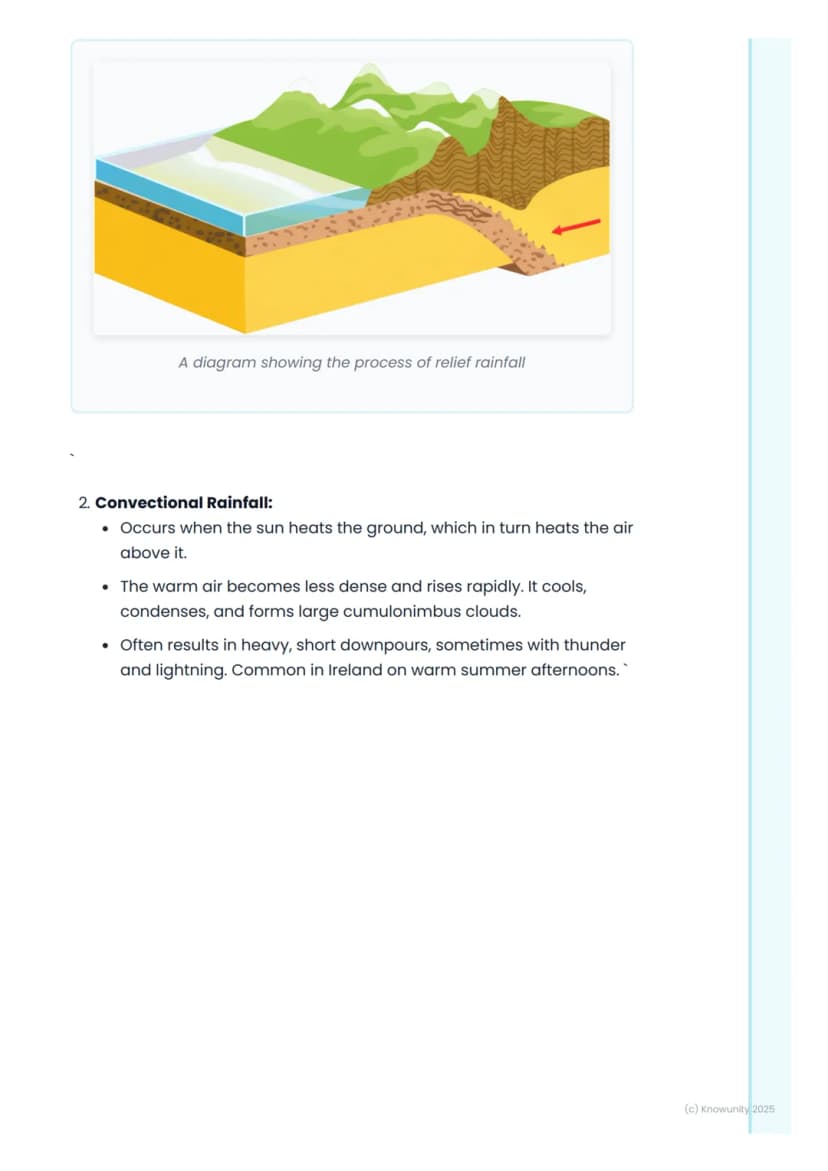
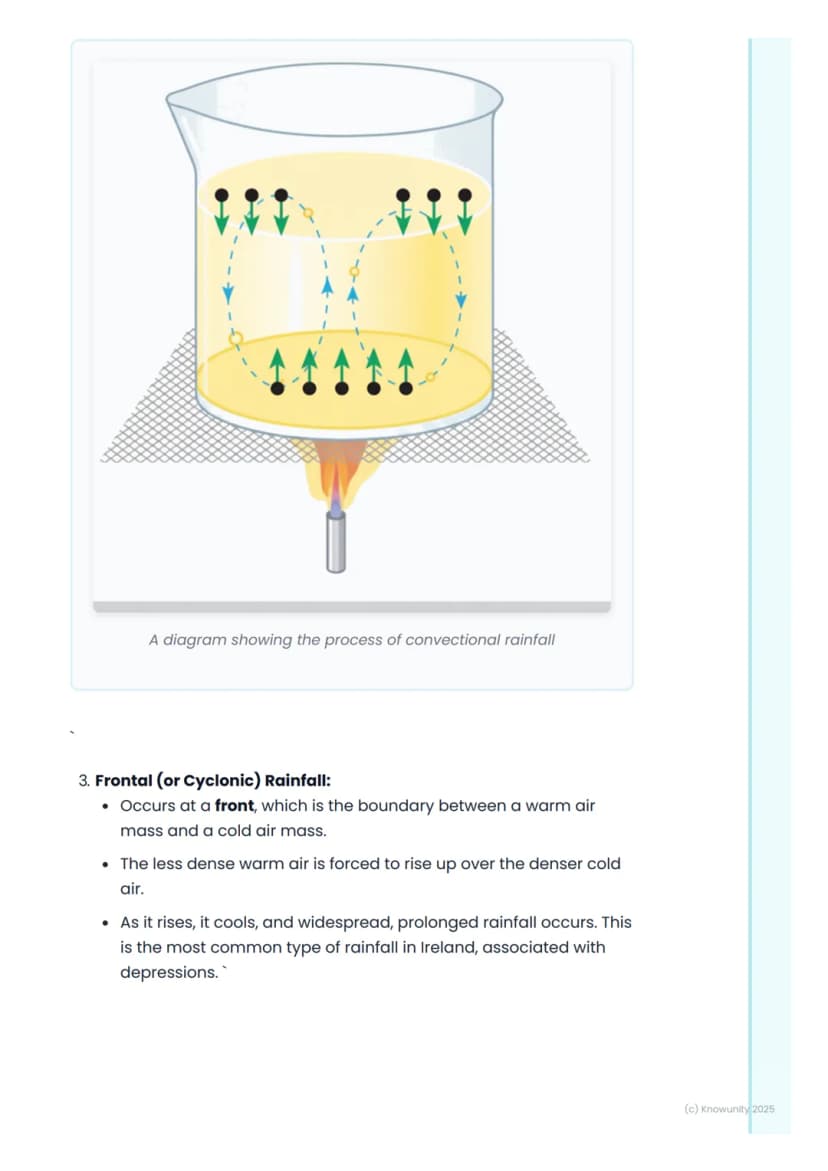
Convectional rainfall occurs on hot summer afternoons when heated ground causes air to rise rapidly, forming towering cumulonimbus clouds. These create those sudden heavy downpours with thunder and lightning.
Ireland's Reality: Most of our rain is frontal rainfall from Atlantic depressions - those weather systems that seem to queue up to soak us!
6
of 10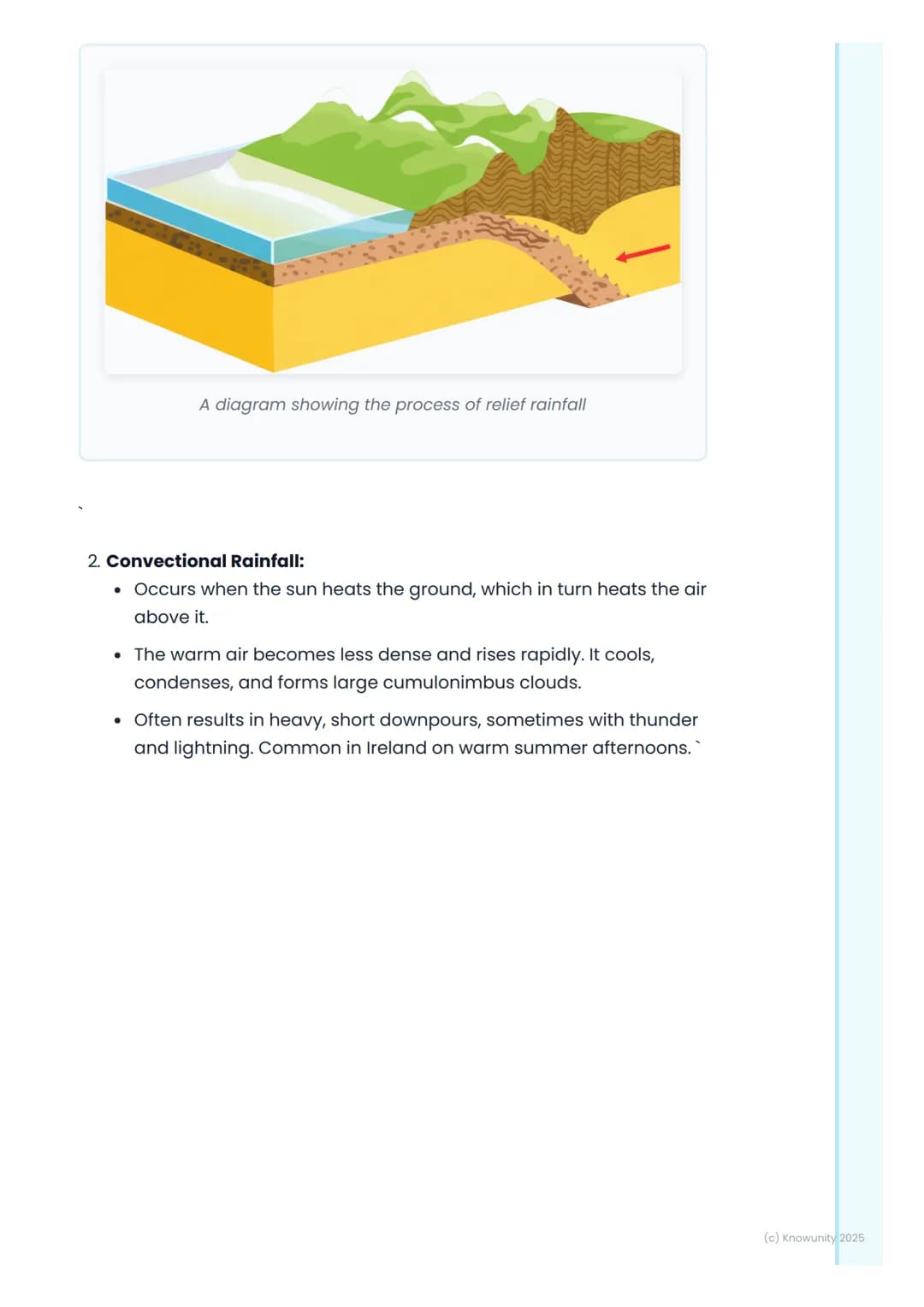
Frontal Systems and Depressions
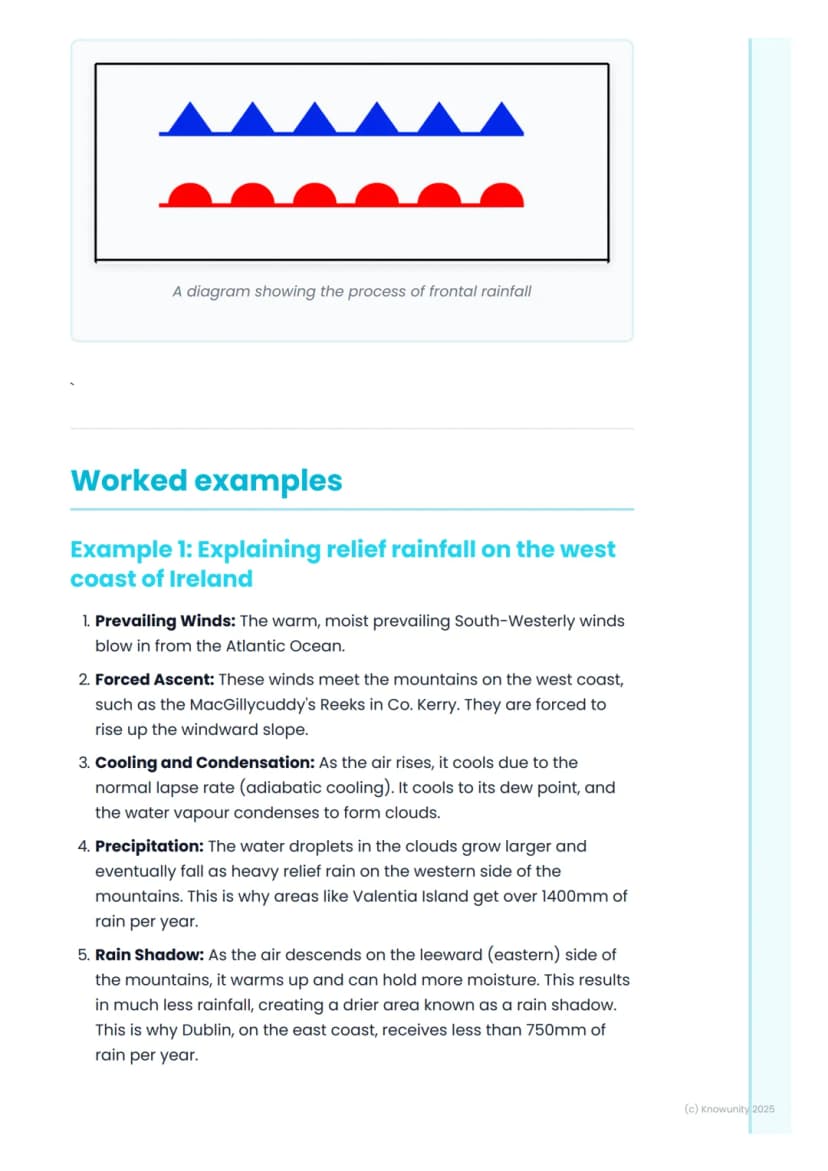
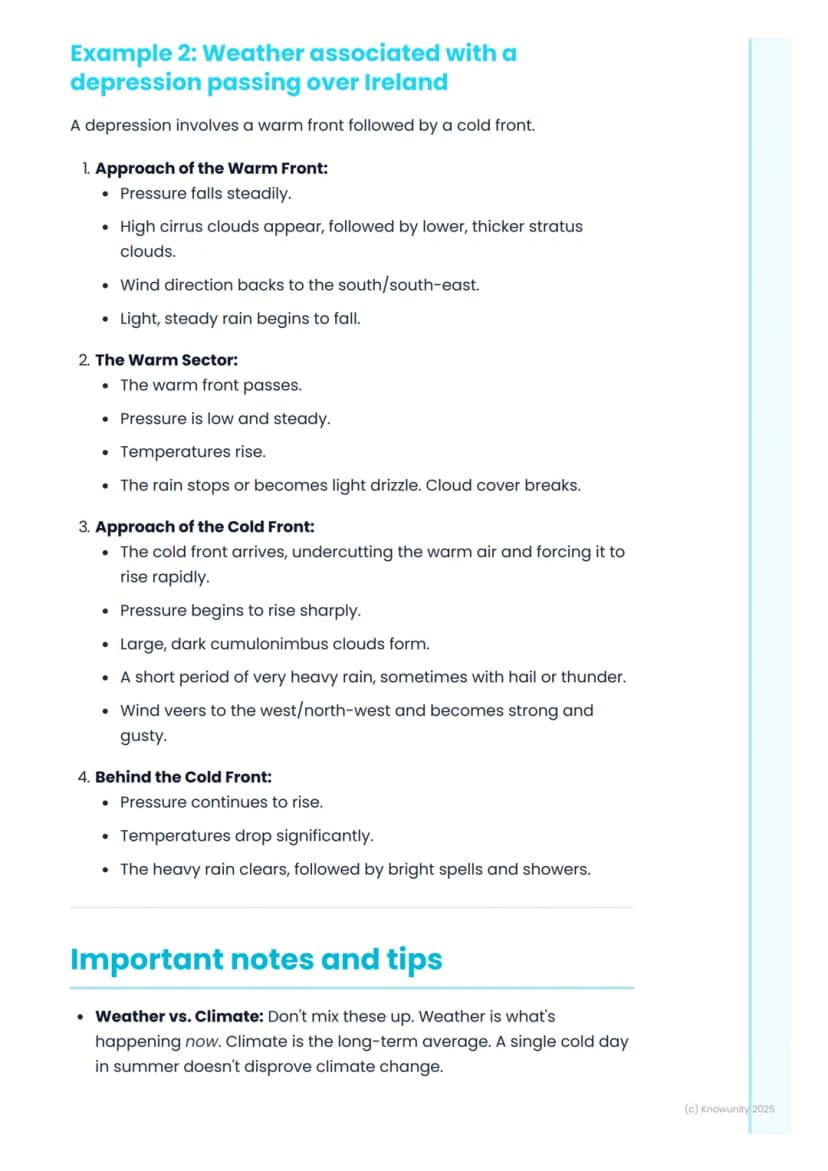
Frontal rainfall is Ireland's specialty - it happens when warm and cold air masses meet at weather fronts. The lighter warm air is forced upwards over the denser cold air, creating widespread, prolonged rainfall.
When a depression passes over Ireland, you'll experience a predictable sequence. First, the warm front approaches with falling pressure, high clouds, and steady light rain. Then comes the warm sector with higher temperatures and broken cloud.
Next, the cold front arrives like nature's drama queen - pressure rises sharply, massive dark clouds form, and you get a short burst of very heavy rain, possibly with hail and thunder. Finally, behind the cold front, temperatures drop, pressure continues rising, and you get those classic Irish "bright spells and showers."
Weather Watching: Cold fronts move faster than warm fronts, which is why they eventually catch up and create more complex weather systems.
7
of 10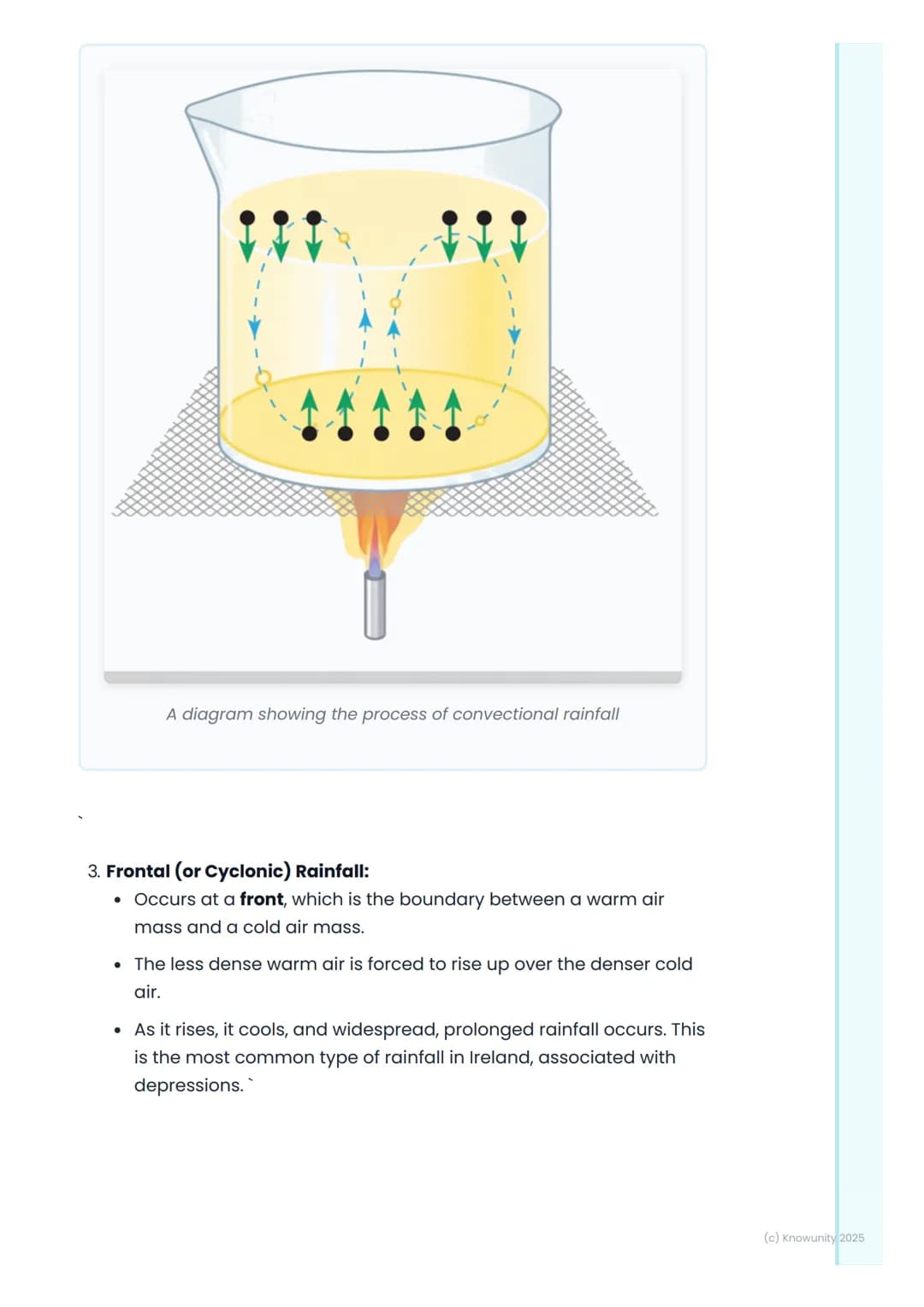
8
of 10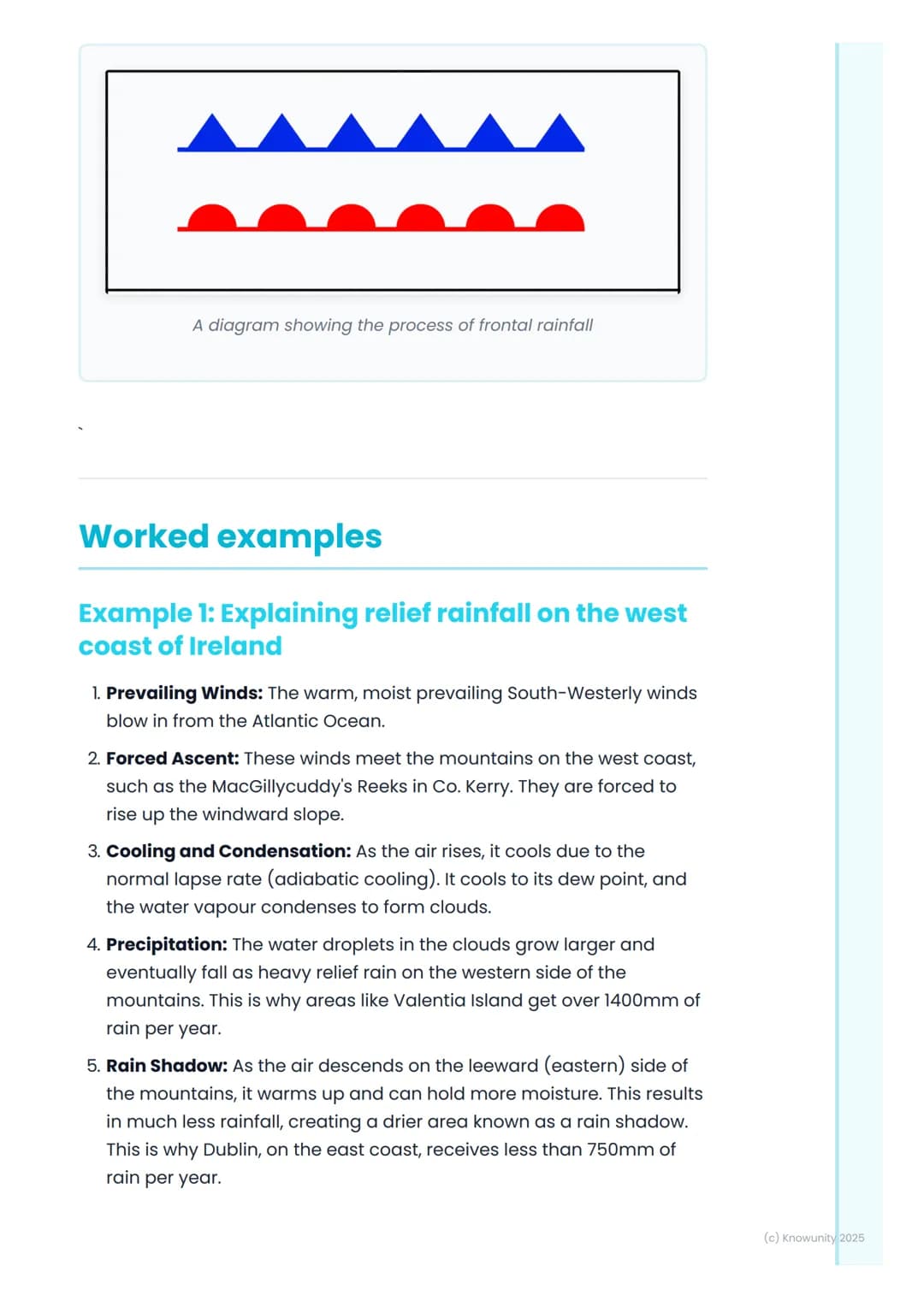
9
of 10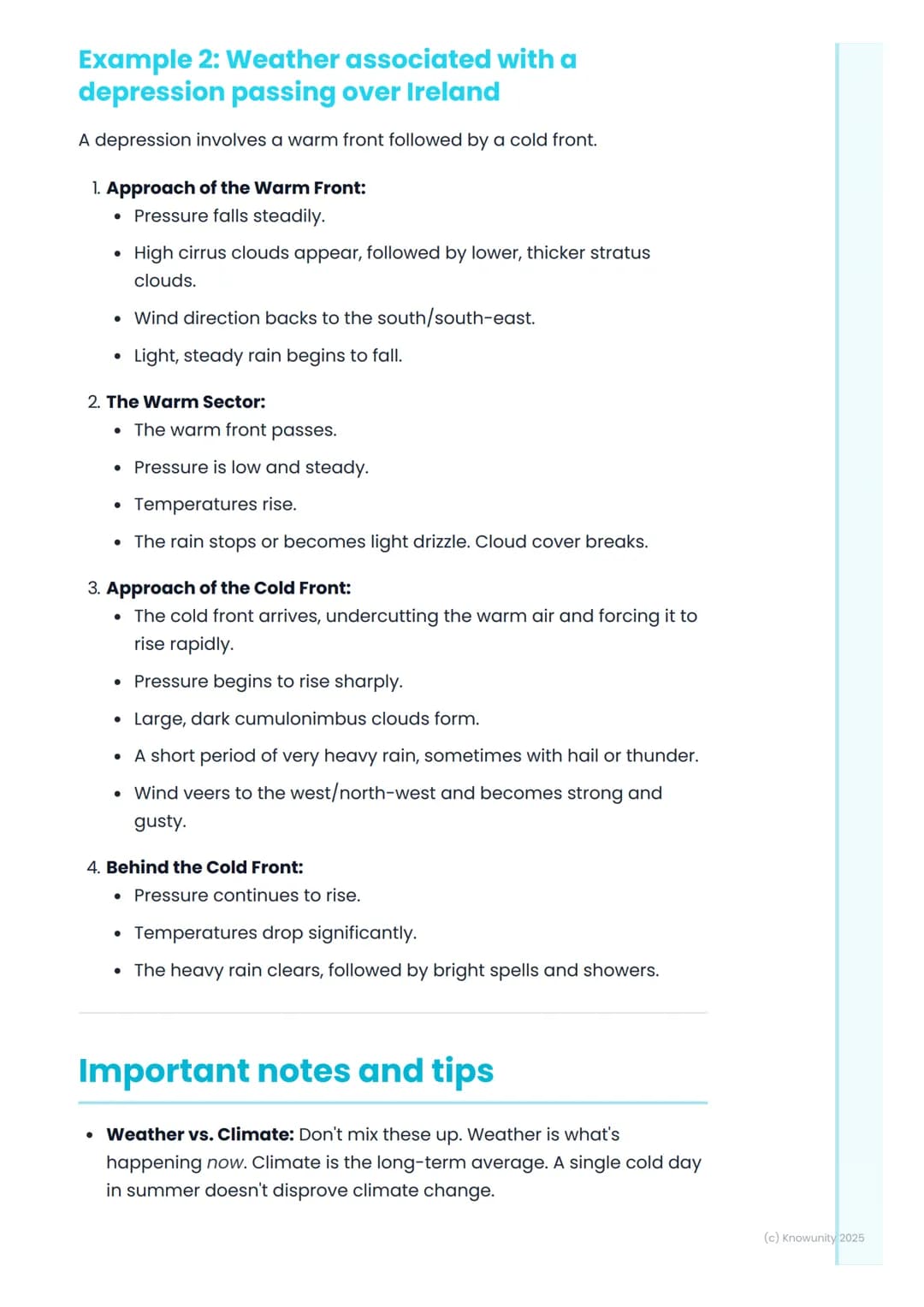
10
of 10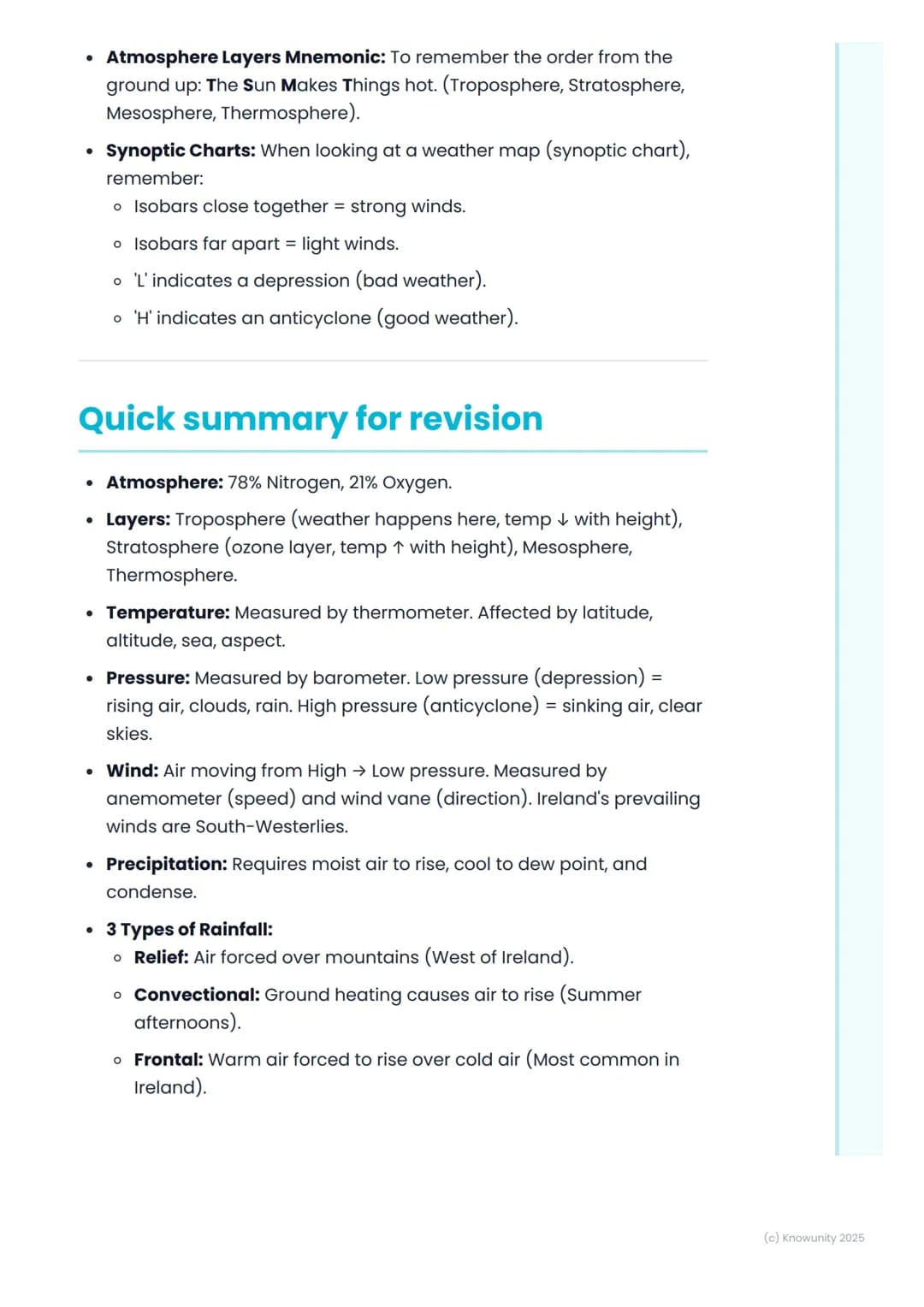
Credeam că nu vei întreba niciodată...
Ce este Companionul AI Knowunity?
Companionul nostru AI este creat special pentru nevoile studenților. Bazându-ne pe milioanele de materiale de pe platformă, putem oferi răspunsuri exacte și relevante pentru studenți. Dar nu este vorba doar despre răspunsuri, companionul este mai ales despre ghidarea studenților prin provocările zilnice de învățare, cu planuri de studiu personalizate, chestionare sau conținuturi în chat și personalizare 100% bazată pe abilitățile și evoluțiile studenților.
De unde pot descărca aplicația Knowunity?
Aplicația este disponibilă în Google Play Store și Apple App Store.
Este Knowunity chiar gratuită?
Da! Bucură-te de access la materiale de studiu, conectează-te cu alți elevi, și primește ajutor instant - toate acestea la un click distanță. În plus, câștigă puncte ca să deblochezi mai multe funcționalități!
Cel mai popular conținut la Geography
9Cel mai popular conținut
9Nu găsești ce cauți? Explorează alte MATERII.
Recenzii de la utilizatorii noștri. Ei iubesc să folosească Knowunity — și tu o vei face.
4.6/5App Store
4.7/5Google Play
Aplicația este foarte ușor de utilizat și bine concepută. Am găsit tot ce căutam până acum și am reușit să învăț multe din prezentări! Cu siguranță voi folosi aplicația pentru o temă la clasă! Și desigur, ajută mult ca sursă de inspirație.
Ștefan Sutilizator iOS
Această aplicație este super. Sunt atât de multe materiale de studiu și ajutor pentru elevi [...]. Materia mea mai problematică este franceza, de exemplu, și aplicația oferă foarte multe materiale ajutătoare. Mulțumită acestei aplicații, mi-am îmbunătățit franceza. Aș recomanda-o oricui.
Samantha Klichutilizator Android
Wow, sunt cu adevărat impresionat. Am încercat aplicația pentru că am văzut-o promovată de multe ori și am rămas uimit. Aceasta este AJUTORUL de care ai nevoie pentru școală și, mai presus de toate, oferă atât de multe lucruri, precum exerciții și fișe de informații, care mi-au fost FOARTE de ajutor.
Annautilizator iOS
Geography2 vizualizări·Actualizat Jun 1, 2026·10 paginiUnderstanding Earth's Atmosphere and Weather
Ever wondered why it's always raining in Cork but sunny in Dublin, or why it's freezing on top of a mountain even in summer? The atmosphere is like Earth's protective blanket, and understanding how it works is the key to... Afișează mai mult
1
of 10Înscrie-te pentru a vedea CONȚINUTUL. E gratuit!
- Acces la toate documentele
- Îmbunătățește notele tale!
- Alătură-te milioanelor de elevi
The Atmosphere Basics
The atmosphere is essentially a 100km-thick layer of gases that keeps us alive and creates all our weather. Think of it as Earth's protective bubble that's constantly moving and changing.
Here's what you're breathing: 78% nitrogen, 21% oxygen, and just 1% of other gases including water vapour. That tiny bit of water vapour might seem insignificant, but it's responsible for every cloud, raindrop, and snowflake you've ever seen.
Weather is what's happening right now - like today's downpour in Dublin. Climate is the long-term average over 30+ years - like Ireland's famously wet reputation. Don't mix these up in your exams!
Quick Tip: Weather elements (temperature, pressure, wind, precipitation) are the building blocks of every weather forecast you check.
2
of 10Înscrie-te pentru a vedea CONȚINUTUL. E gratuit!
- Acces la toate documentele
- Îmbunătățește notele tale!
- Alătură-te milioanelor de elevi
Atmospheric Layers
The atmosphere has four main layers, but you really need to know the first two. Here's a handy memory trick: The Sun Makes Things hot (Troposphere, Stratosphere, Mesosphere, Thermosphere).
The troposphere is where all the action happens - it's only 12km thick but contains virtually all our weather. Temperature drops as you go higher (about 6.5°C per 1000m), which explains why Carrauntoohil is always colder than sea level.
The stratosphere sits above it, containing the crucial ozone layer that blocks harmful UV rays. Unlike the troposphere, temperature actually increases with height here because ozone absorbs solar radiation.
Exam Focus: The troposphere is your priority - almost every weather question relates to this bottom layer.
3
of 10Înscrie-te pentru a vedea CONȚINUTUL. E gratuit!
- Acces la toate documentele
- Îmbunătățește notele tale!
- Alătură-te milioanelor de elevi
Temperature and Pressure
Temperature is measured using thermometers in Stevenson Screens (those white boxes you see at weather stations). Four main factors affect temperature: how close you are to the equator, your height above sea level, distance from the sea, and which way slopes face.
Ireland's coast stays milder year-round thanks to the sea's slow heating and cooling - that's why Galway has cooler summers but warmer winters than inland Athlone.
Atmospheric pressure is the weight of air pressing down on you, measured in millibars. Low pressure (depressions) means air is rising, cooling, and forming clouds - hello, rainy day! High pressure (anticyclones) means air is sinking and warming - cue the sunny weather.
Map Reading: When isobars (pressure lines) are squashed together, expect strong winds. Spread apart means light winds.
4
of 10Înscrie-te pentru a vedea CONȚINUTUL. E gratuit!
- Acces la toate documentele
- Îmbunătățește notele tale!
- Alătură-te milioanelor de elevi
Wind and Weather Patterns
Wind is simply air rushing from high pressure to low pressure areas. In Ireland, our prevailing winds are South-Westerlies - they bring all that Atlantic moisture that keeps our grass so green!
Due to Earth's rotation, winds curve to the right in the Northern Hemisphere (called the Coriolis effect). This is why low-pressure systems spin anti-clockwise and high-pressure systems spin clockwise.
When you see a weather map, look for the 'L' and 'H' symbols. An 'L' means expect clouds, wind, and rain. An 'H' means settled, clear conditions - though in winter, this can bring frost and fog.
Wind Direction: Remember, winds are named from where they're coming from, not where they're going!
5
of 10Înscrie-te pentru a vedea CONȚINUTUL. E gratuit!
- Acces la toate documentele
- Îmbunătățește notele tale!
- Alătură-te milioanelor de elevi
Rainfall Types
For precipitation to form, you need moist air that's forced to rise and cool to its dew point (saturation temperature). There are three main types you'll encounter in Ireland.
Relief rainfall happens when our South-Westerly winds hit western mountains like the MacGillycuddy's Reeks. The air is forced upwards, cools, and dumps heavy rain on the western slopes. This creates a rain shadow effect - which is why Dublin gets less than 750mm of rain yearly while Valentia Island gets over 1400mm.
Convectional rainfall occurs on hot summer afternoons when heated ground causes air to rise rapidly, forming towering cumulonimbus clouds. These create those sudden heavy downpours with thunder and lightning.
Ireland's Reality: Most of our rain is frontal rainfall from Atlantic depressions - those weather systems that seem to queue up to soak us!
6
of 10Înscrie-te pentru a vedea CONȚINUTUL. E gratuit!
- Acces la toate documentele
- Îmbunătățește notele tale!
- Alătură-te milioanelor de elevi
Frontal Systems and Depressions
Frontal rainfall is Ireland's specialty - it happens when warm and cold air masses meet at weather fronts. The lighter warm air is forced upwards over the denser cold air, creating widespread, prolonged rainfall.
When a depression passes over Ireland, you'll experience a predictable sequence. First, the warm front approaches with falling pressure, high clouds, and steady light rain. Then comes the warm sector with higher temperatures and broken cloud.
Next, the cold front arrives like nature's drama queen - pressure rises sharply, massive dark clouds form, and you get a short burst of very heavy rain, possibly with hail and thunder. Finally, behind the cold front, temperatures drop, pressure continues rising, and you get those classic Irish "bright spells and showers."
Weather Watching: Cold fronts move faster than warm fronts, which is why they eventually catch up and create more complex weather systems.
7
of 10Înscrie-te pentru a vedea CONȚINUTUL. E gratuit!
- Acces la toate documentele
- Îmbunătățește notele tale!
- Alătură-te milioanelor de elevi
8
of 10Înscrie-te pentru a vedea CONȚINUTUL. E gratuit!
- Acces la toate documentele
- Îmbunătățește notele tale!
- Alătură-te milioanelor de elevi
9
of 10Înscrie-te pentru a vedea CONȚINUTUL. E gratuit!
- Acces la toate documentele
- Îmbunătățește notele tale!
- Alătură-te milioanelor de elevi
10
of 10Înscrie-te pentru a vedea CONȚINUTUL. E gratuit!
- Acces la toate documentele
- Îmbunătățește notele tale!
- Alătură-te milioanelor de elevi
Credeam că nu vei întreba niciodată...
Ce este Companionul AI Knowunity?
Companionul nostru AI este creat special pentru nevoile studenților. Bazându-ne pe milioanele de materiale de pe platformă, putem oferi răspunsuri exacte și relevante pentru studenți. Dar nu este vorba doar despre răspunsuri, companionul este mai ales despre ghidarea studenților prin provocările zilnice de învățare, cu planuri de studiu personalizate, chestionare sau conținuturi în chat și personalizare 100% bazată pe abilitățile și evoluțiile studenților.
De unde pot descărca aplicația Knowunity?
Aplicația este disponibilă în Google Play Store și Apple App Store.
Este Knowunity chiar gratuită?
Da! Bucură-te de access la materiale de studiu, conectează-te cu alți elevi, și primește ajutor instant - toate acestea la un click distanță. În plus, câștigă puncte ca să deblochezi mai multe funcționalități!
Cel mai popular conținut la Geography
9Cel mai popular conținut
9Nu găsești ce cauți? Explorează alte MATERII.
Recenzii de la utilizatorii noștri. Ei iubesc să folosească Knowunity — și tu o vei face.
4.6/5App Store
4.7/5Google Play
Aplicația este foarte ușor de utilizat și bine concepută. Am găsit tot ce căutam până acum și am reușit să învăț multe din prezentări! Cu siguranță voi folosi aplicația pentru o temă la clasă! Și desigur, ajută mult ca sursă de inspirație.
Ștefan Sutilizator iOS
Această aplicație este super. Sunt atât de multe materiale de studiu și ajutor pentru elevi [...]. Materia mea mai problematică este franceza, de exemplu, și aplicația oferă foarte multe materiale ajutătoare. Mulțumită acestei aplicații, mi-am îmbunătățit franceza. Aș recomanda-o oricui.
Samantha Klichutilizator Android
Wow, sunt cu adevărat impresionat. Am încercat aplicația pentru că am văzut-o promovată de multe ori și am rămas uimit. Aceasta este AJUTORUL de care ai nevoie pentru școală și, mai presus de toate, oferă atât de multe lucruri, precum exerciții și fișe de informații, care mi-au fost FOARTE de ajutor.
Annautilizator iOS