
Ever wondered why earthquakes happen in some places but not...
 Geography8 vizualizări·Actualizat Jun 18, 2026·6 pagini
Plate Tectonics Explained
1 / 6
1
of 6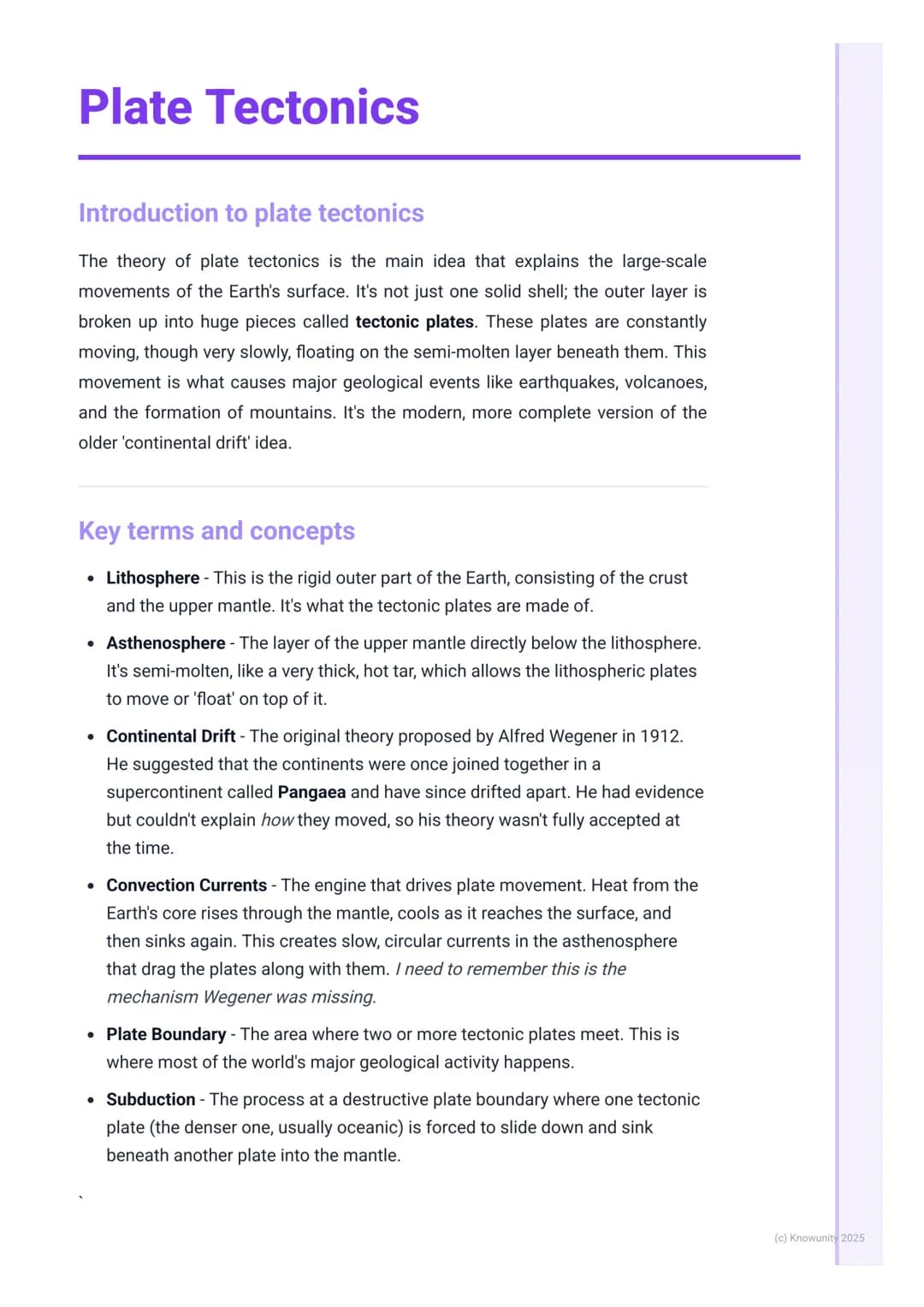
Introduction to Plate Tectonics
Think of Earth's surface like a cracked eggshell - it's not one solid piece, but broken into massive chunks called tectonic plates. These plates are constantly moving, though incredibly slowly, floating on a semi-molten layer beneath them.
This movement is what causes earthquakes, volcanoes, and mountain formation. The lithosphere (Earth's rigid outer layer) sits on top of the asthenosphere .
Convection currents are the engine that drives everything. Heat from Earth's core creates circular currents in the asthenosphere that drag the plates along - this was the missing piece that Alfred Wegener couldn't explain in his original continental drift theory.
Key Point: Remember that convection currents are what Wegener was missing when he proposed continental drift in 1912!
2
of 6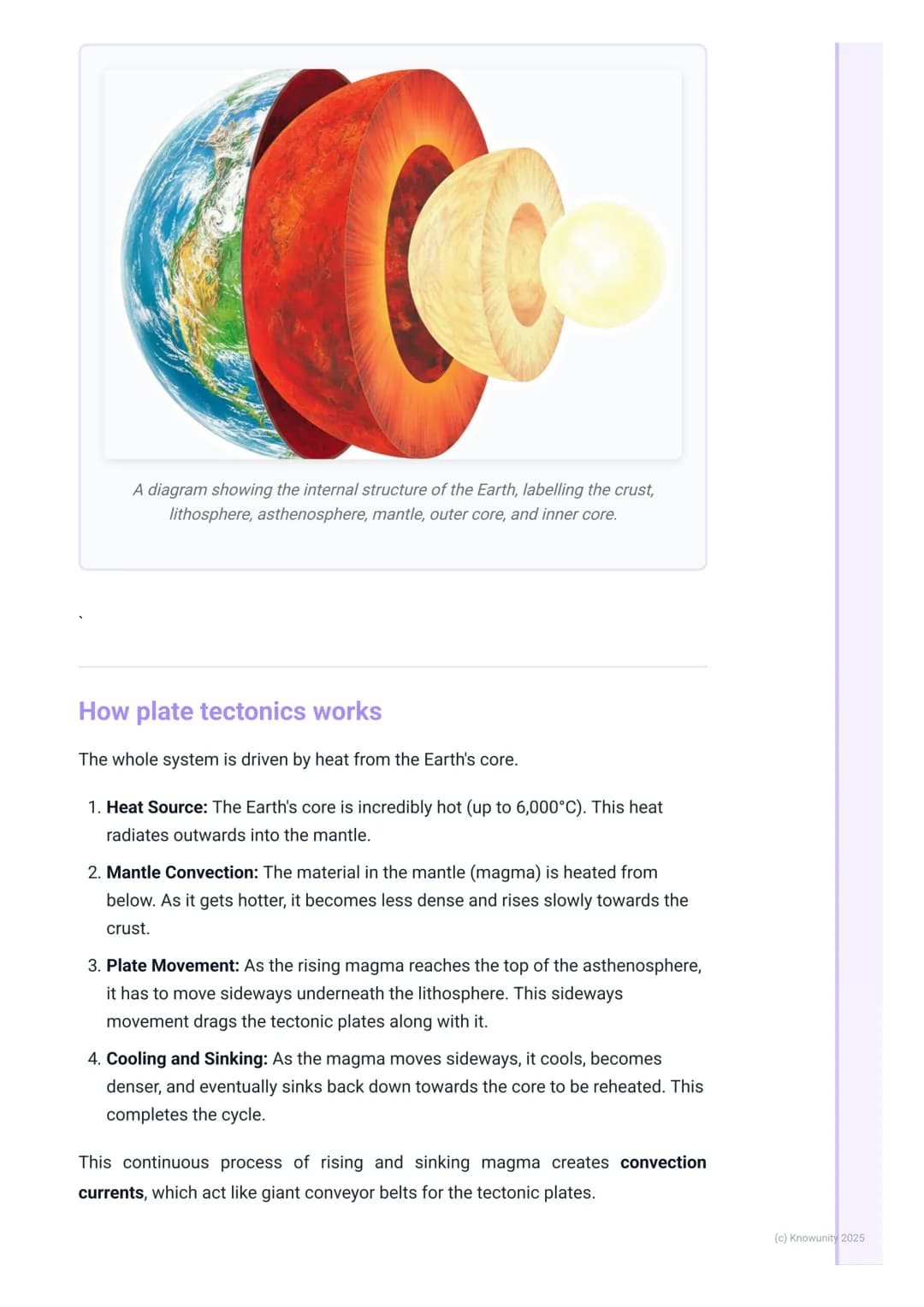
How Plate Tectonics Works
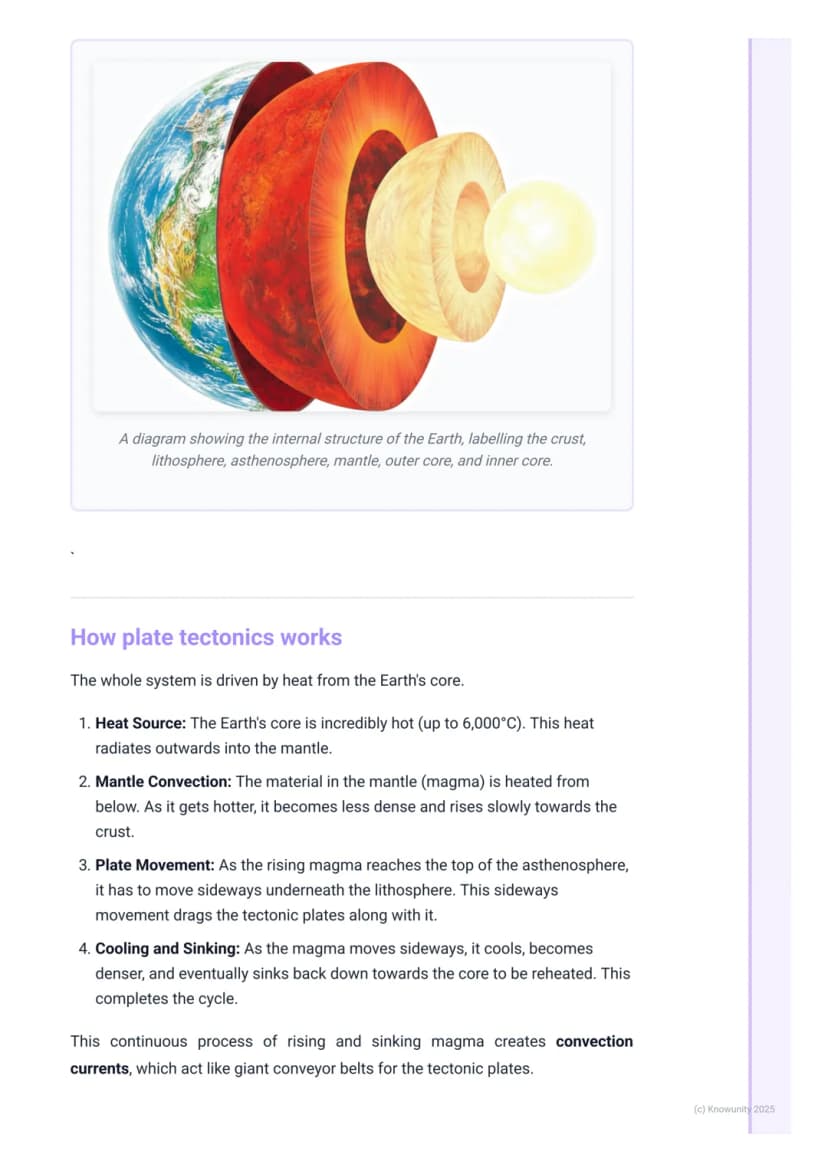
The whole system runs on heat from Earth's incredibly hot core (up to 6,000°C). Here's how the process works like a giant conveyor belt system.
Hot material in the mantle rises because it's less dense when heated. As this rising magma reaches the top of the asthenosphere, it has to move sideways underneath the lithosphere, dragging the tectonic plates along with it.
Eventually, the magma cools, becomes denser, and sinks back down towards the core to be reheated. This creates continuous convection currents that act like giant conveyor belts moving the plates around Earth's surface.
Remember: The hotter something gets, the less dense it becomes - that's why hot magma rises and cool magma sinks!
3
of 6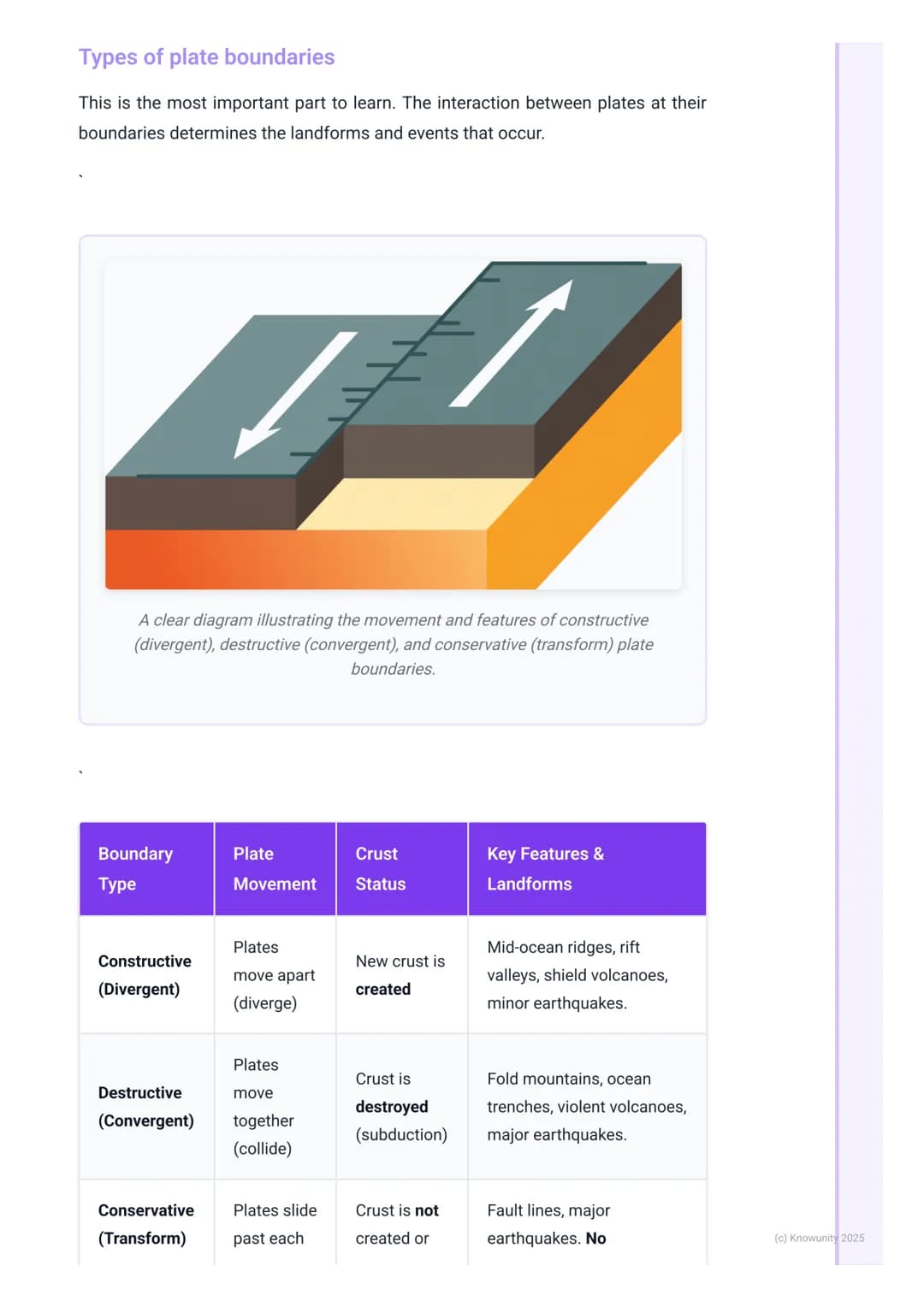
Types of Plate Boundaries
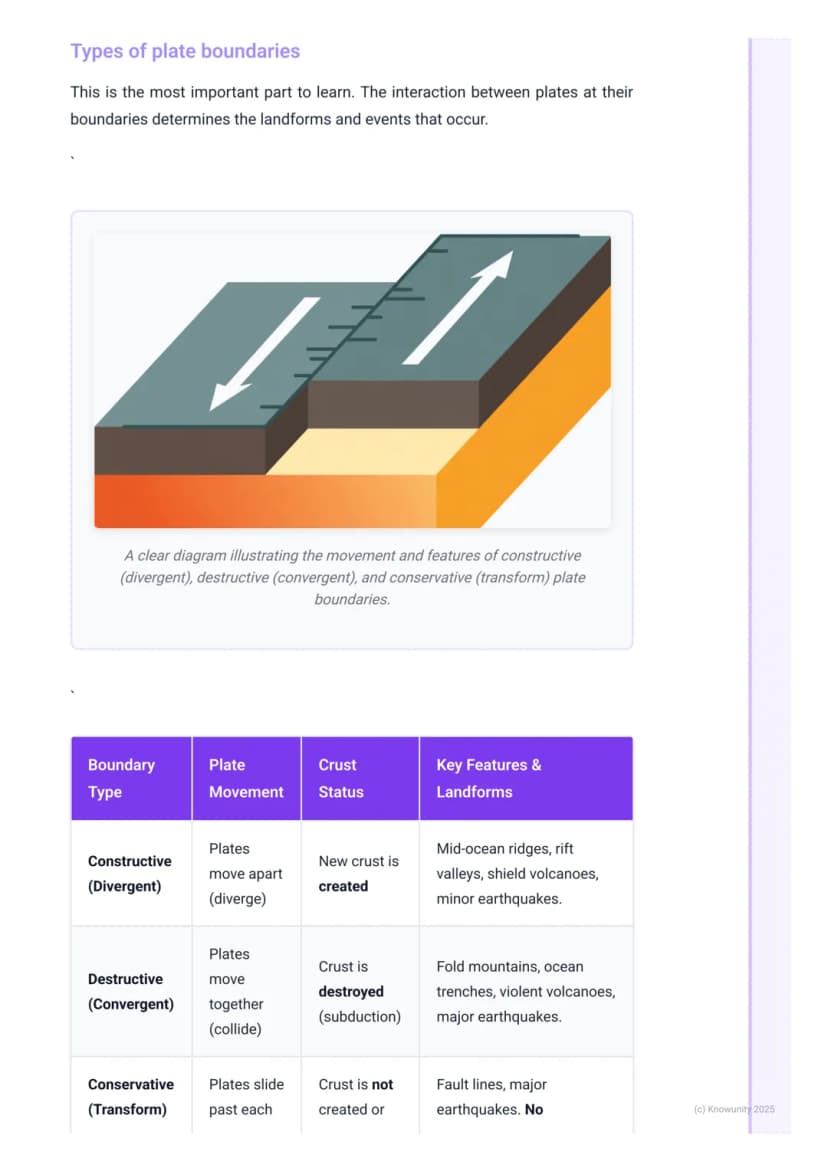
This is where the real action happens - plate boundaries are where two or more plates meet, and they determine what geological features you'll find. There are three main types you need to know.
Constructive boundaries occur where plates move apart. New crust forms as magma rises to fill the gap, creating mid-ocean ridges and shield volcanoes. Think of Iceland on the Mid-Atlantic Ridge.
Destructive boundaries happen when plates collide. The denser plate gets forced down (subduction), creating fold mountains, violent volcanoes, and major earthquakes. The Andes mountains are a perfect example.
Conservative boundaries are where plates slide past each other. No crust is created or destroyed, but the friction causes major earthquakes. The San Andreas Fault in California is the most famous example.
Memory Trick: Constructive = constructing new land, Destructive = destroying old land, Conservative = conserving the amount of land!
4
of 6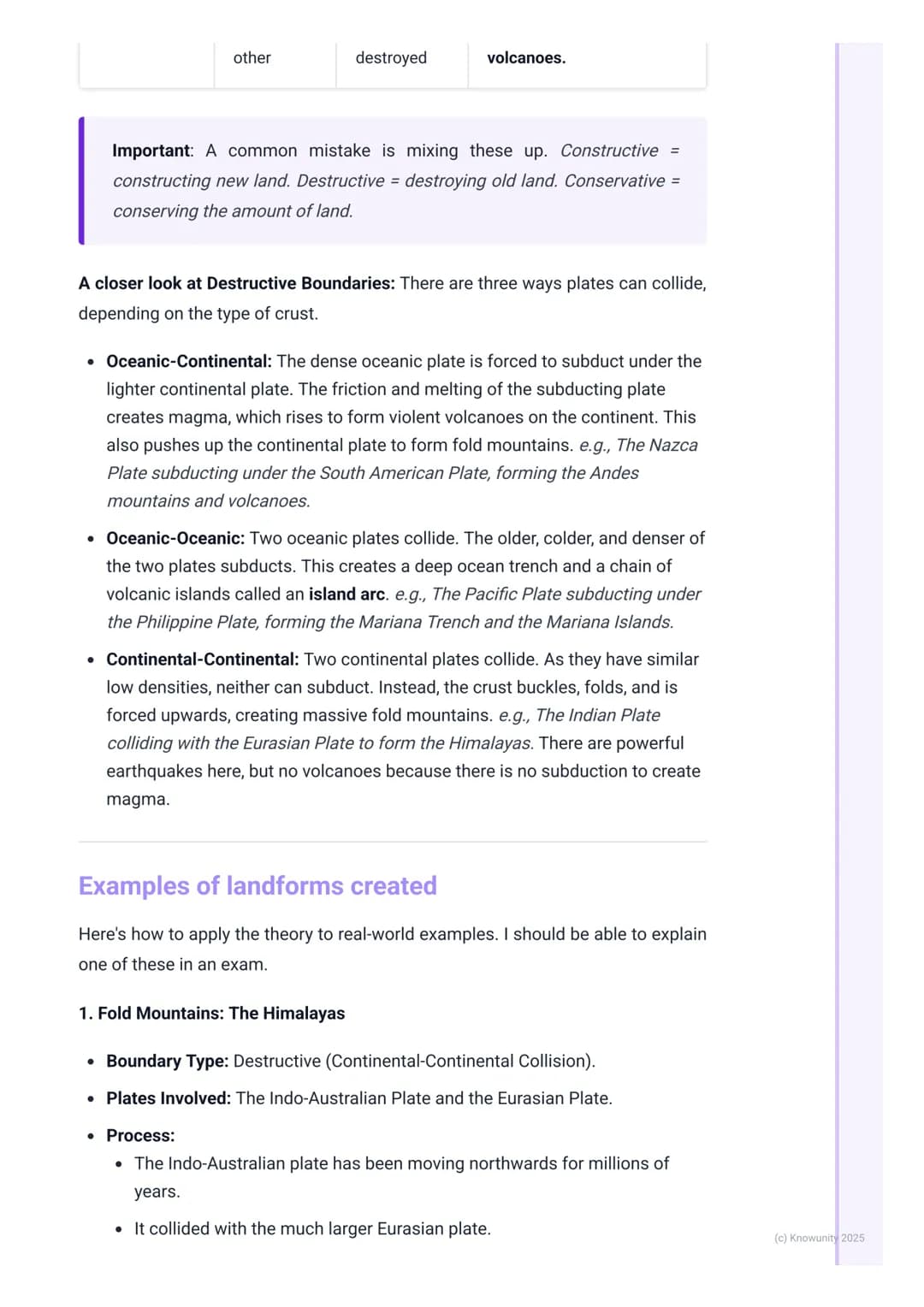
Destructive Boundaries in Detail
Destructive boundaries are the most complex because there are three different ways plates can collide, depending on what type of crust is involved. Each creates different landforms.
Oceanic-Continental collision: The dense oceanic plate subducts under the lighter continental plate. This creates violent volcanoes and fold mountains on the continent - like the Nazca Plate creating the Andes.
Oceanic-Oceanic collision: The older, denser oceanic plate subducts, forming deep ocean trenches and volcanic island chains. The Mariana Trench is the deepest example of this.
Continental-Continental collision: Neither plate can subduct because they're both low density, so the crust buckles upwards into massive fold mountains. The Himalayas formed this way when India crashed into Asia - and they're still growing today!
Exam Tip: Continental-continental collisions create earthquakes but NO volcanoes because there's no subduction to melt rock into magma.
5
of 6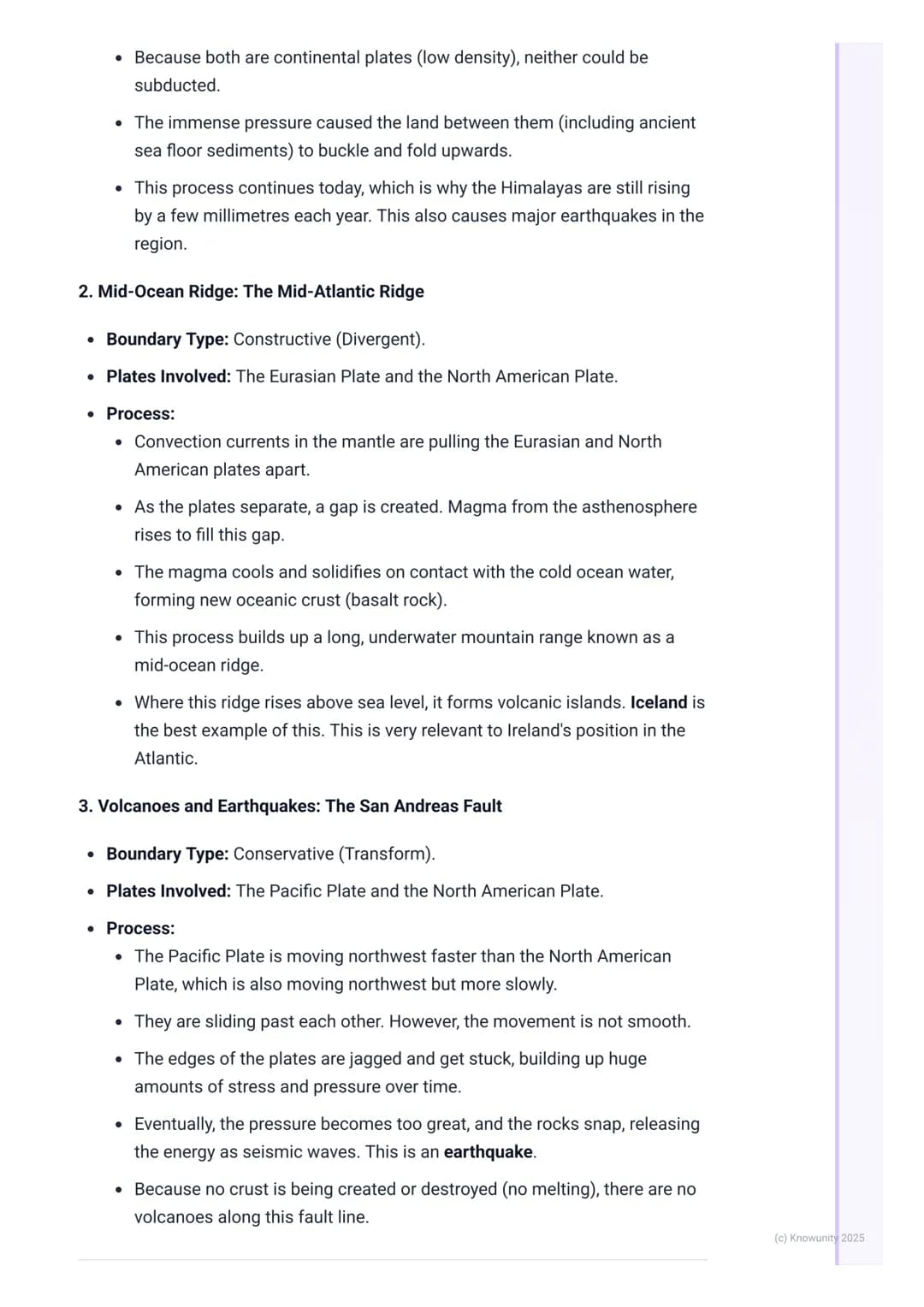
Real-World Examples
Let's look at three major examples that show plate tectonics in action - these are perfect for exam answers because they demonstrate different boundary types.
The Himalayas formed from continental-continental collision between the Indo-Australian and Eurasian plates. Neither could subduct, so the crust folded upwards into the world's highest mountains. They're still rising a few millimetres each year, causing regular earthquakes.
The Mid-Atlantic Ridge shows constructive boundaries perfectly. The Eurasian and North American plates are pulling apart, and magma rises to fill the gap, creating new oceanic crust. Iceland sits right on this ridge - that's why it's so volcanic.
The San Andreas Fault demonstrates conservative boundaries. The Pacific and North American plates slide past each other, but they don't move smoothly. They get stuck, build up pressure, then suddenly snap - creating California's famous earthquakes.
Ireland Connection: The Mid-Atlantic Ridge is particularly relevant to us because Ireland sits on the edge of the Eurasian Plate, right beside this active boundary!
6
of 6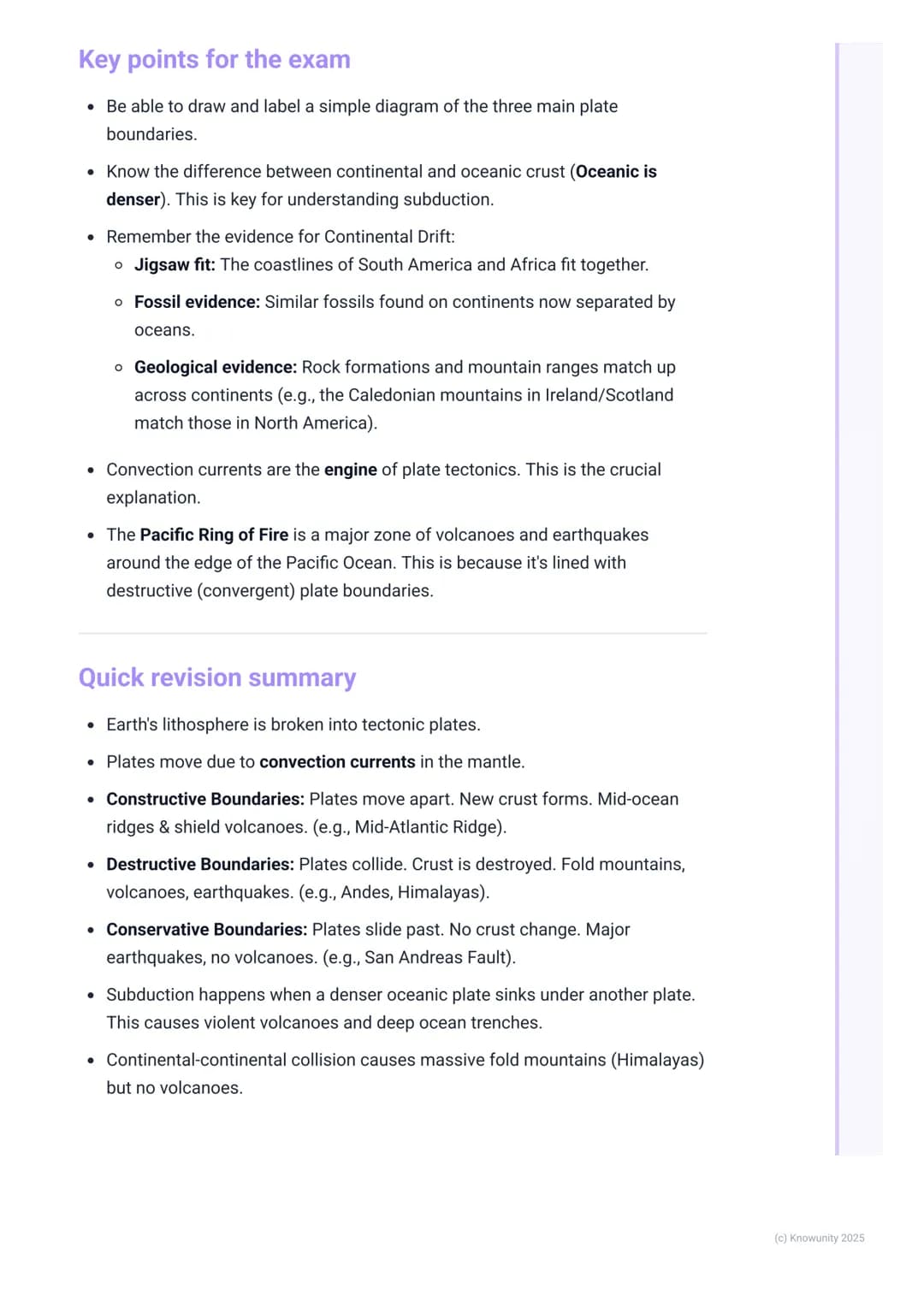
Key Points for Exams
You need to be able to draw simple diagrams of the three plate boundaries and explain what happens at each. Remember that oceanic crust is denser than continental crust - this explains why oceanic plates always subduct in collisions.
Know Wegener's evidence for continental drift: continents fit together like a jigsaw (especially South America and Africa), similar fossils found across oceans, and matching rock formations like the Caledonian mountains in Ireland and Scotland that match North America.
The Pacific Ring of Fire is lined with destructive boundaries, which explains why it has so many volcanoes and earthquakes. Subduction zones are where the most violent geological activity occurs because of the melting and pressure involved.
Quick Check: Can you explain why the Himalayas have earthquakes but no volcanoes, while the Andes have both? It's all about the type of collision!
Credeam că nu vei întreba niciodată...
Ce este Companionul AI Knowunity?
Companionul nostru AI este creat special pentru nevoile studenților. Bazându-ne pe milioanele de materiale de pe platformă, putem oferi răspunsuri exacte și relevante pentru studenți. Dar nu este vorba doar despre răspunsuri, companionul este mai ales despre ghidarea studenților prin provocările zilnice de învățare, cu planuri de studiu personalizate, chestionare sau conținuturi în chat și personalizare 100% bazată pe abilitățile și evoluțiile studenților.
De unde pot descărca aplicația Knowunity?
Aplicația este disponibilă în Google Play Store și Apple App Store.
Este Knowunity chiar gratuită?
Da! Bucură-te de access la materiale de studiu, conectează-te cu alți elevi, și primește ajutor instant - toate acestea la un click distanță. În plus, câștigă puncte ca să deblochezi mai multe funcționalități!
Cel mai popular conținut la Geography
9GeographyGeography notes on rocks
Includes types of rocks,uses of rocks, case studies
1st Year341
GeographyEarthquakes revision notes
Notes on earthquakes with diagrams
1st Year110
GeographyPopulation Change and Migration
This covers factors that cause populations to grow or shrink, including birth rates, death rates, and the reasons people migrate.
2nd Year90
GeographyRock notes geography
Geography
5th Year250
GeographyThe sea
Jc Geography
1st Year230
GeographyGeography notes On the sea
Includes costal erosion, sea cliffs, longshore drift etc.
1st Year160
GeographyInside the Earth
Students will learn about the basic layers of the Earth: the crust, mantle, and core, understanding that our planet is made up of different parts.
1st Year51
GeographyGeography notes on glaciation
Includes diagrams, erosion, deposition, transportation
1st Year210
GeographyGeography notes on weather
Includes instruments, diagrams, how to read weather
1st Year120
Cel mai popular conținut
9 Irish
IrishIrish oral questions and answers
Questions and answers for the leaving cert oral
5th Year4264
 English
Key Quotes : Sive
Key Quotes and explanations: Sive
6th Year2842
IrishIrish oral questions
Outline of oral questions
5th Year2055
IrishIníon- le hÁine Durkin
Aine Durkin’s poem, Iníon: Themes & summary
5th Year890
IrishIrish poetry 2027
Iníon + Dínit an Bhróin
5th Year1153
IrishLC HL notes- Iníon (poem)
Includes poem in English and Irish, theme, key words & phrases
5th Year2304
EnglishCultural Context : Shawshank Redemption : Sive : Small Things Like These
Comparative Study : Cultural Context : Shawshank Redemption, Sive and Small Things Like These
6th Year1430
IrishMo Ghrá-sa (Idir Lúibíní)
Notes on mo ghrá-sa
5th Year380
IrishAn Gaeilge Aiste
Irish Language essay
6th Year1320
Nu găsești ce cauți? Explorează alte MATERII.
Recenzii de la utilizatorii noștri. Ei iubesc să folosească Knowunity — și tu o vei face.
4.6/5App Store
4.7/5Google Play
Aplicația este foarte ușor de utilizat și bine concepută. Am găsit tot ce căutam până acum și am reușit să învăț multe din prezentări! Cu siguranță voi folosi aplicația pentru o temă la clasă! Și desigur, ajută mult ca sursă de inspirație.
Ștefan Sutilizator iOS
Această aplicație este super. Sunt atât de multe materiale de studiu și ajutor pentru elevi [...]. Materia mea mai problematică este franceza, de exemplu, și aplicația oferă foarte multe materiale ajutătoare. Mulțumită acestei aplicații, mi-am îmbunătățit franceza. Aș recomanda-o oricui.
Samantha Klichutilizator Android
Wow, sunt cu adevărat impresionat. Am încercat aplicația pentru că am văzut-o promovată de multe ori și am rămas uimit. Aceasta este AJUTORUL de care ai nevoie pentru școală și, mai presus de toate, oferă atât de multe lucruri, precum exerciții și fișe de informații, care mi-au fost FOARTE de ajutor.
Annautilizator iOS
Geography8 vizualizări·Actualizat Jun 18, 2026·6 paginiPlate Tectonics Explained
Ever wondered why earthquakes happen in some places but not others, or how massive mountain ranges like the Himalayas formed? Plate tectonicsexplains it all - it's the theory that shows how Earth's outer layer is broken into huge moving...
1
of 6
Înscrie-te pentru a vedea CONȚINUTUL. E gratuit!
- Acces la toate documentele
- Îmbunătățește notele tale!
- Alătură-te milioanelor de elevi
Introduction to Plate Tectonics
Think of Earth's surface like a cracked eggshell - it's not one solid piece, but broken into massive chunks called tectonic plates. These plates are constantly moving, though incredibly slowly, floating on a semi-molten layer beneath them.
This movement is what causes earthquakes, volcanoes, and mountain formation. The lithosphere (Earth's rigid outer layer) sits on top of the asthenosphere .
Convection currents are the engine that drives everything. Heat from Earth's core creates circular currents in the asthenosphere that drag the plates along - this was the missing piece that Alfred Wegener couldn't explain in his original continental drift theory.
Key Point: Remember that convection currents are what Wegener was missing when he proposed continental drift in 1912!
2
of 6Înscrie-te pentru a vedea CONȚINUTUL. E gratuit!
- Acces la toate documentele
- Îmbunătățește notele tale!
- Alătură-te milioanelor de elevi
How Plate Tectonics Works
The whole system runs on heat from Earth's incredibly hot core (up to 6,000°C). Here's how the process works like a giant conveyor belt system.
Hot material in the mantle rises because it's less dense when heated. As this rising magma reaches the top of the asthenosphere, it has to move sideways underneath the lithosphere, dragging the tectonic plates along with it.
Eventually, the magma cools, becomes denser, and sinks back down towards the core to be reheated. This creates continuous convection currents that act like giant conveyor belts moving the plates around Earth's surface.
Remember: The hotter something gets, the less dense it becomes - that's why hot magma rises and cool magma sinks!
3
of 6Înscrie-te pentru a vedea CONȚINUTUL. E gratuit!
- Acces la toate documentele
- Îmbunătățește notele tale!
- Alătură-te milioanelor de elevi
Types of Plate Boundaries
This is where the real action happens - plate boundaries are where two or more plates meet, and they determine what geological features you'll find. There are three main types you need to know.
Constructive boundaries occur where plates move apart. New crust forms as magma rises to fill the gap, creating mid-ocean ridges and shield volcanoes. Think of Iceland on the Mid-Atlantic Ridge.
Destructive boundaries happen when plates collide. The denser plate gets forced down (subduction), creating fold mountains, violent volcanoes, and major earthquakes. The Andes mountains are a perfect example.
Conservative boundaries are where plates slide past each other. No crust is created or destroyed, but the friction causes major earthquakes. The San Andreas Fault in California is the most famous example.
Memory Trick: Constructive = constructing new land, Destructive = destroying old land, Conservative = conserving the amount of land!
4
of 6Înscrie-te pentru a vedea CONȚINUTUL. E gratuit!
- Acces la toate documentele
- Îmbunătățește notele tale!
- Alătură-te milioanelor de elevi
Destructive Boundaries in Detail
Destructive boundaries are the most complex because there are three different ways plates can collide, depending on what type of crust is involved. Each creates different landforms.
Oceanic-Continental collision: The dense oceanic plate subducts under the lighter continental plate. This creates violent volcanoes and fold mountains on the continent - like the Nazca Plate creating the Andes.
Oceanic-Oceanic collision: The older, denser oceanic plate subducts, forming deep ocean trenches and volcanic island chains. The Mariana Trench is the deepest example of this.
Continental-Continental collision: Neither plate can subduct because they're both low density, so the crust buckles upwards into massive fold mountains. The Himalayas formed this way when India crashed into Asia - and they're still growing today!
Exam Tip: Continental-continental collisions create earthquakes but NO volcanoes because there's no subduction to melt rock into magma.
5
of 6Înscrie-te pentru a vedea CONȚINUTUL. E gratuit!
- Acces la toate documentele
- Îmbunătățește notele tale!
- Alătură-te milioanelor de elevi
Real-World Examples
Let's look at three major examples that show plate tectonics in action - these are perfect for exam answers because they demonstrate different boundary types.
The Himalayas formed from continental-continental collision between the Indo-Australian and Eurasian plates. Neither could subduct, so the crust folded upwards into the world's highest mountains. They're still rising a few millimetres each year, causing regular earthquakes.
The Mid-Atlantic Ridge shows constructive boundaries perfectly. The Eurasian and North American plates are pulling apart, and magma rises to fill the gap, creating new oceanic crust. Iceland sits right on this ridge - that's why it's so volcanic.
The San Andreas Fault demonstrates conservative boundaries. The Pacific and North American plates slide past each other, but they don't move smoothly. They get stuck, build up pressure, then suddenly snap - creating California's famous earthquakes.
Ireland Connection: The Mid-Atlantic Ridge is particularly relevant to us because Ireland sits on the edge of the Eurasian Plate, right beside this active boundary!
6
of 6Înscrie-te pentru a vedea CONȚINUTUL. E gratuit!
- Acces la toate documentele
- Îmbunătățește notele tale!
- Alătură-te milioanelor de elevi
Key Points for Exams
You need to be able to draw simple diagrams of the three plate boundaries and explain what happens at each. Remember that oceanic crust is denser than continental crust - this explains why oceanic plates always subduct in collisions.
Know Wegener's evidence for continental drift: continents fit together like a jigsaw (especially South America and Africa), similar fossils found across oceans, and matching rock formations like the Caledonian mountains in Ireland and Scotland that match North America.
The Pacific Ring of Fire is lined with destructive boundaries, which explains why it has so many volcanoes and earthquakes. Subduction zones are where the most violent geological activity occurs because of the melting and pressure involved.
Quick Check: Can you explain why the Himalayas have earthquakes but no volcanoes, while the Andes have both? It's all about the type of collision!
Credeam că nu vei întreba niciodată...
Ce este Companionul AI Knowunity?
Companionul nostru AI este creat special pentru nevoile studenților. Bazându-ne pe milioanele de materiale de pe platformă, putem oferi răspunsuri exacte și relevante pentru studenți. Dar nu este vorba doar despre răspunsuri, companionul este mai ales despre ghidarea studenților prin provocările zilnice de învățare, cu planuri de studiu personalizate, chestionare sau conținuturi în chat și personalizare 100% bazată pe abilitățile și evoluțiile studenților.
De unde pot descărca aplicația Knowunity?
Aplicația este disponibilă în Google Play Store și Apple App Store.
Este Knowunity chiar gratuită?
Da! Bucură-te de access la materiale de studiu, conectează-te cu alți elevi, și primește ajutor instant - toate acestea la un click distanță. În plus, câștigă puncte ca să deblochezi mai multe funcționalități!
Cel mai popular conținut la Geography
9GeographyGeography notes on rocks
Includes types of rocks,uses of rocks, case studies
1st Year341
GeographyEarthquakes revision notes
Notes on earthquakes with diagrams
1st Year110
GeographyPopulation Change and Migration
This covers factors that cause populations to grow or shrink, including birth rates, death rates, and the reasons people migrate.
2nd Year90
GeographyRock notes geography
Geography
5th Year250
GeographyThe sea
Jc Geography
1st Year230
GeographyGeography notes On the sea
Includes costal erosion, sea cliffs, longshore drift etc.
1st Year160
GeographyInside the Earth
Students will learn about the basic layers of the Earth: the crust, mantle, and core, understanding that our planet is made up of different parts.
1st Year51
GeographyGeography notes on glaciation
Includes diagrams, erosion, deposition, transportation
1st Year210
GeographyGeography notes on weather
Includes instruments, diagrams, how to read weather
1st Year120
Cel mai popular conținut
9IrishIrish oral questions and answers
Questions and answers for the leaving cert oral
5th Year4264
EnglishKey Quotes : Sive
Key Quotes and explanations: Sive
6th Year2842
IrishIrish oral questions
Outline of oral questions
5th Year2055
IrishIníon- le hÁine Durkin
Aine Durkin’s poem, Iníon: Themes & summary
5th Year890
IrishIrish poetry 2027
Iníon + Dínit an Bhróin
5th Year1153
IrishLC HL notes- Iníon (poem)
Includes poem in English and Irish, theme, key words & phrases
5th Year2304
EnglishCultural Context : Shawshank Redemption : Sive : Small Things Like These
Comparative Study : Cultural Context : Shawshank Redemption, Sive and Small Things Like These
6th Year1430
IrishMo Ghrá-sa (Idir Lúibíní)
Notes on mo ghrá-sa
5th Year380
IrishAn Gaeilge Aiste
Irish Language essay
6th Year1320
Nu găsești ce cauți? Explorează alte MATERII.
Recenzii de la utilizatorii noștri. Ei iubesc să folosească Knowunity — și tu o vei face.
4.6/5App Store
4.7/5Google Play
Aplicația este foarte ușor de utilizat și bine concepută. Am găsit tot ce căutam până acum și am reușit să învăț multe din prezentări! Cu siguranță voi folosi aplicația pentru o temă la clasă! Și desigur, ajută mult ca sursă de inspirație.
Ștefan Sutilizator iOS
Această aplicație este super. Sunt atât de multe materiale de studiu și ajutor pentru elevi [...]. Materia mea mai problematică este franceza, de exemplu, și aplicația oferă foarte multe materiale ajutătoare. Mulțumită acestei aplicații, mi-am îmbunătățit franceza. Aș recomanda-o oricui.
Samantha Klichutilizator Android
Wow, sunt cu adevărat impresionat. Am încercat aplicația pentru că am văzut-o promovată de multe ori și am rămas uimit. Aceasta este AJUTORUL de care ai nevoie pentru școală și, mai presus de toate, oferă atât de multe lucruri, precum exerciții și fișe de informații, care mi-au fost FOARTE de ajutor.
Annautilizator iOS