
Ever feel your heart sink when you hear a French...
 French1 vizualizări·Actualizat Jun 17, 2026·5 pagini
Mastering New French Words
1 / 5
1
of 5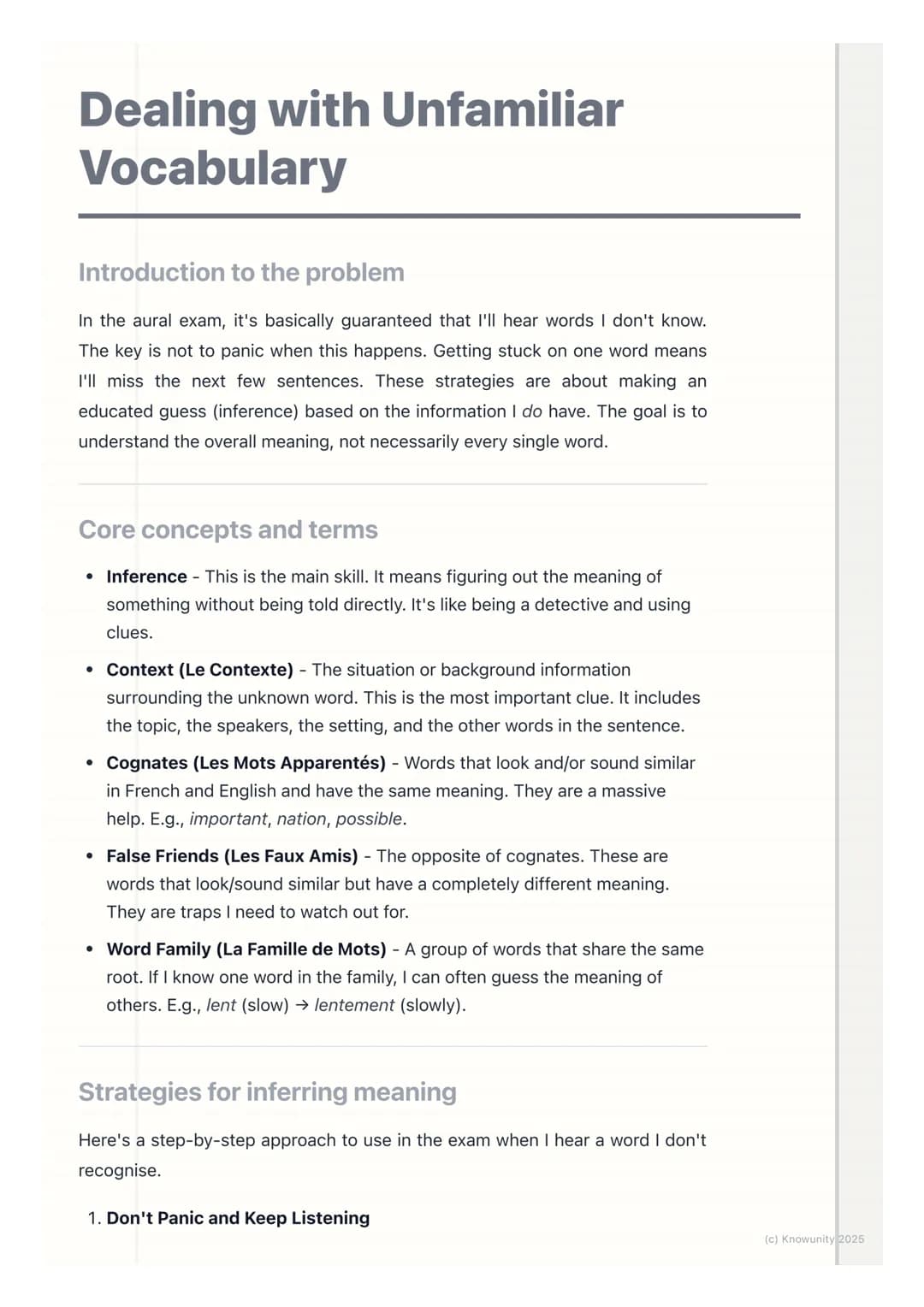
The Detective Mindset
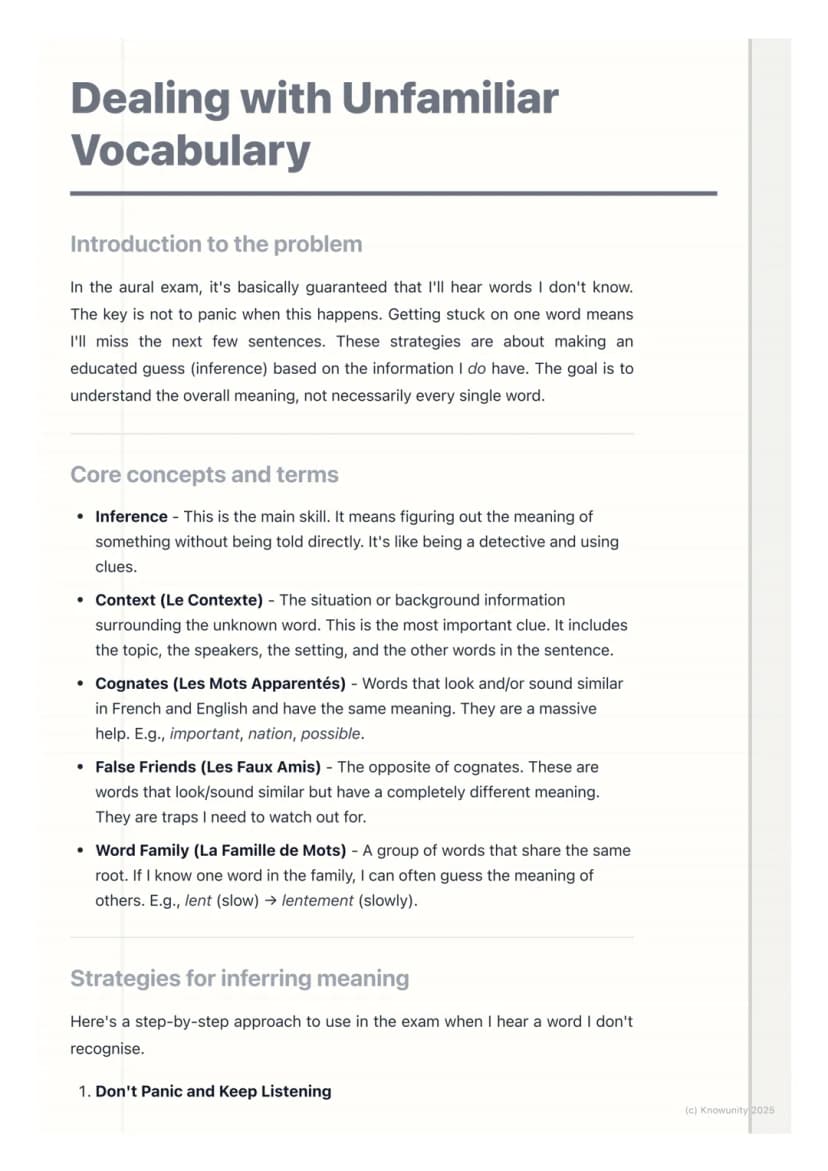
Don't let unknown words derail your entire exam performance. When you hear something unfamiliar, your brain's first instinct might be to freeze - but that's exactly what you can't afford to do.
Inference is your superpower here. Think of it like solving a mystery using the clues around you. The context - basically everything happening around that mystery word - gives you massive hints about what it might mean.
You've got some brilliant tools at your disposal. Cognates are words that sound similar in French and English with the same meaning (like "important" or "nation"). However, watch out for false friends - sneaky words that sound English but mean something completely different.
Top Tip: Focus on understanding the overall conversation, not translating every single word. Your goal is the general message, not a perfect dictionary definition.
2
of 5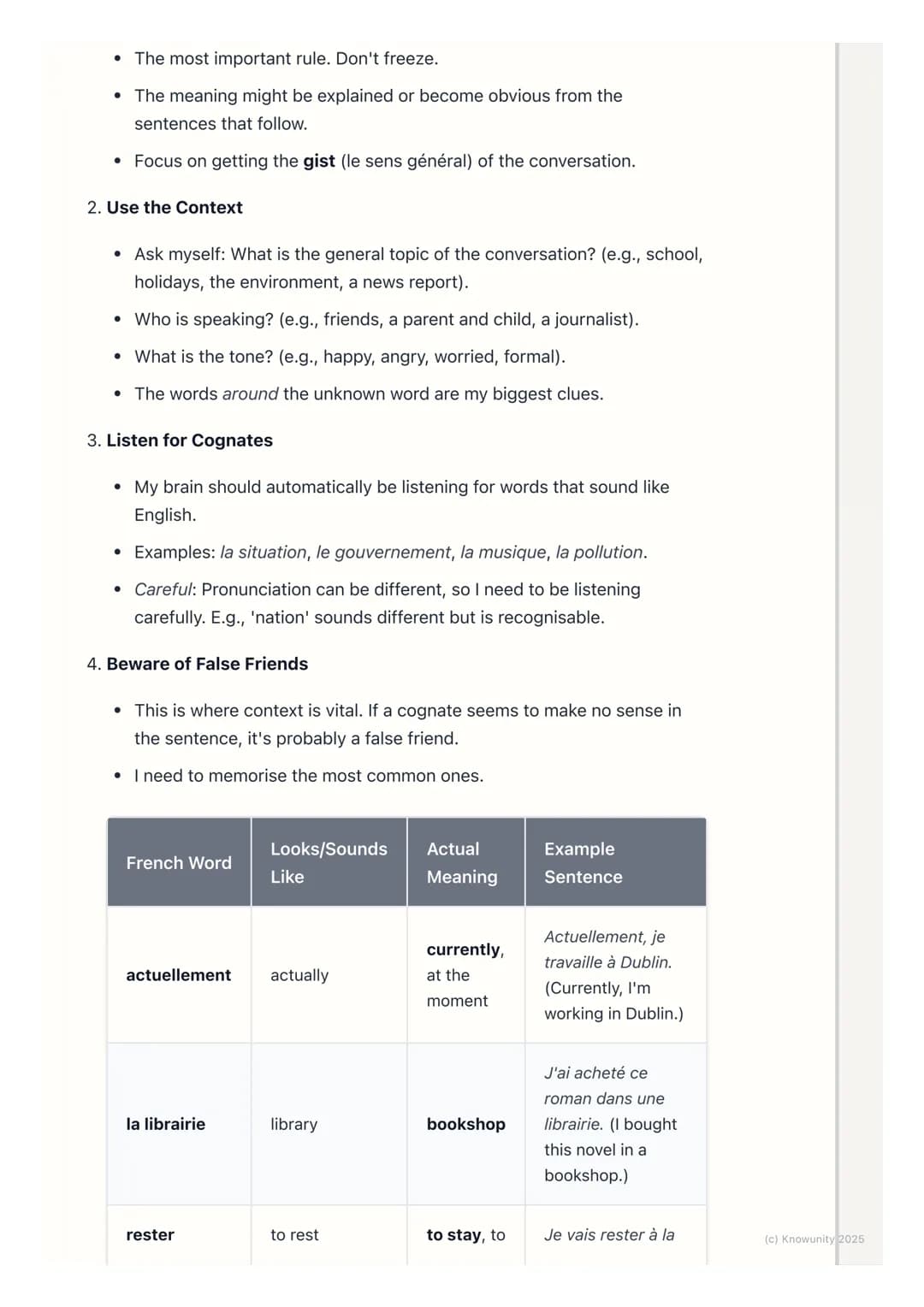
Your Step-by-Step Strategy
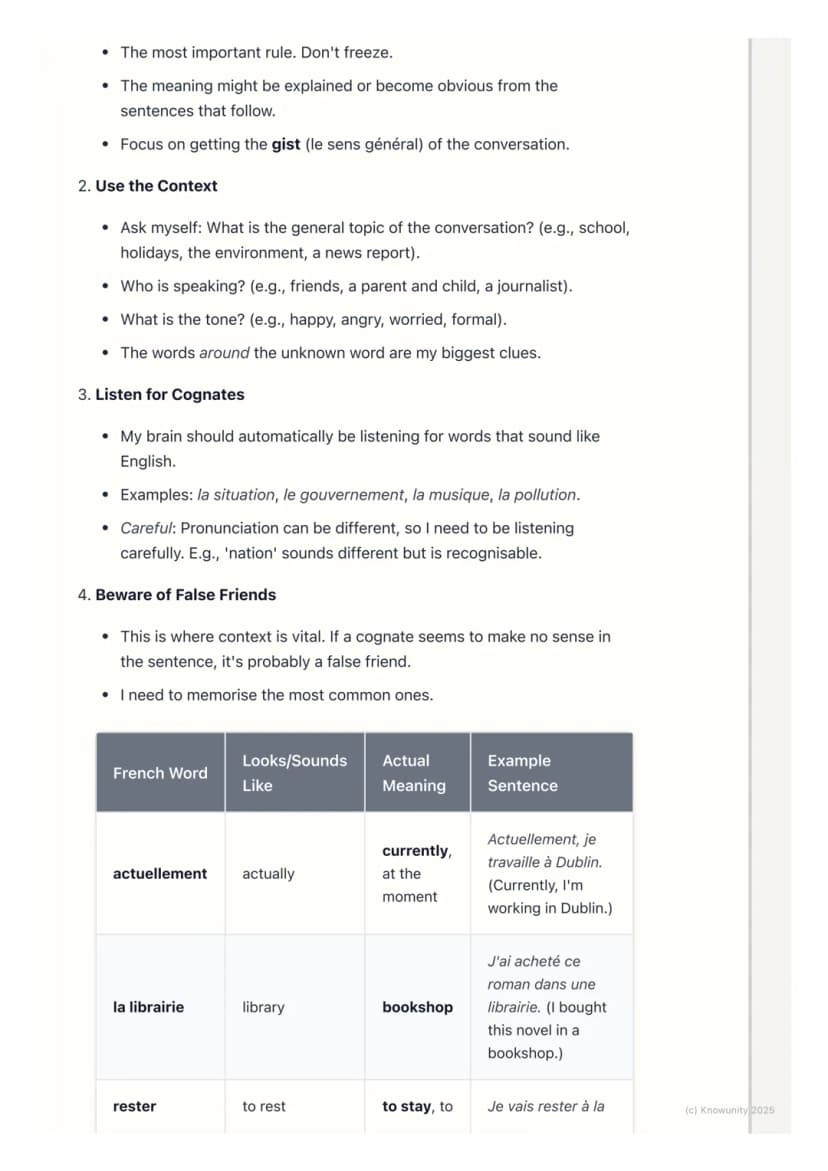
When you hit an unknown word, follow this game plan. First, keep listening - seriously, this is crucial. The meaning often becomes clear from the sentences that follow, so don't let one word stop you in your tracks.
Next, analyse the context like a pro. Ask yourself: what's the topic? Who's talking? What's the mood? A conversation between mates about weekend plans will give you very different clues than a formal news report about politics.
Listen actively for cognates - words like "la situation" or "le gouvernement" are gifts wrapped up for you. Your brain should automatically tune into these English-sounding words.
But stay alert for those tricky false friends. Words like "actuellement" (which means "currently", not "actually") or "la librairie" (bookshop, not library) can completely throw you off if you're not careful.
Remember: If a cognate seems to make no sense in context, it's probably a false friend trying to trick you.
3
of 5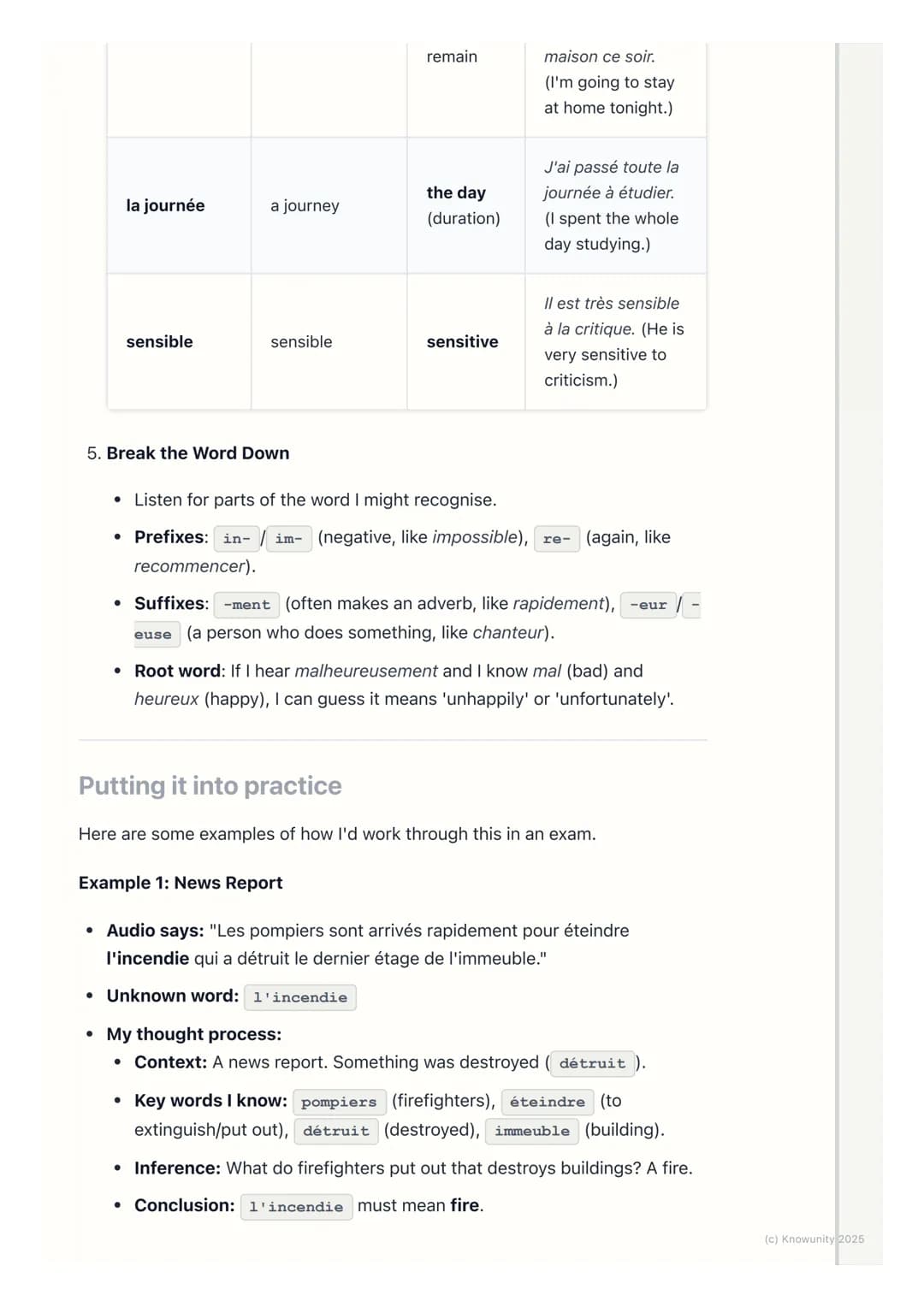
Breaking Down the Mystery
Sometimes you need to become a word detective and break down unfamiliar terms into smaller pieces. Listen for prefixes you recognise - "in-" or "im-" often mean "not" (like "impossible"), while "re-" usually means "again".
Suffixes are equally helpful. Words ending in "-ment" are often adverbs (like "rapidement"), whilst "-eur" or "-euse" typically describe people who do something (like "chanteur" for singer).
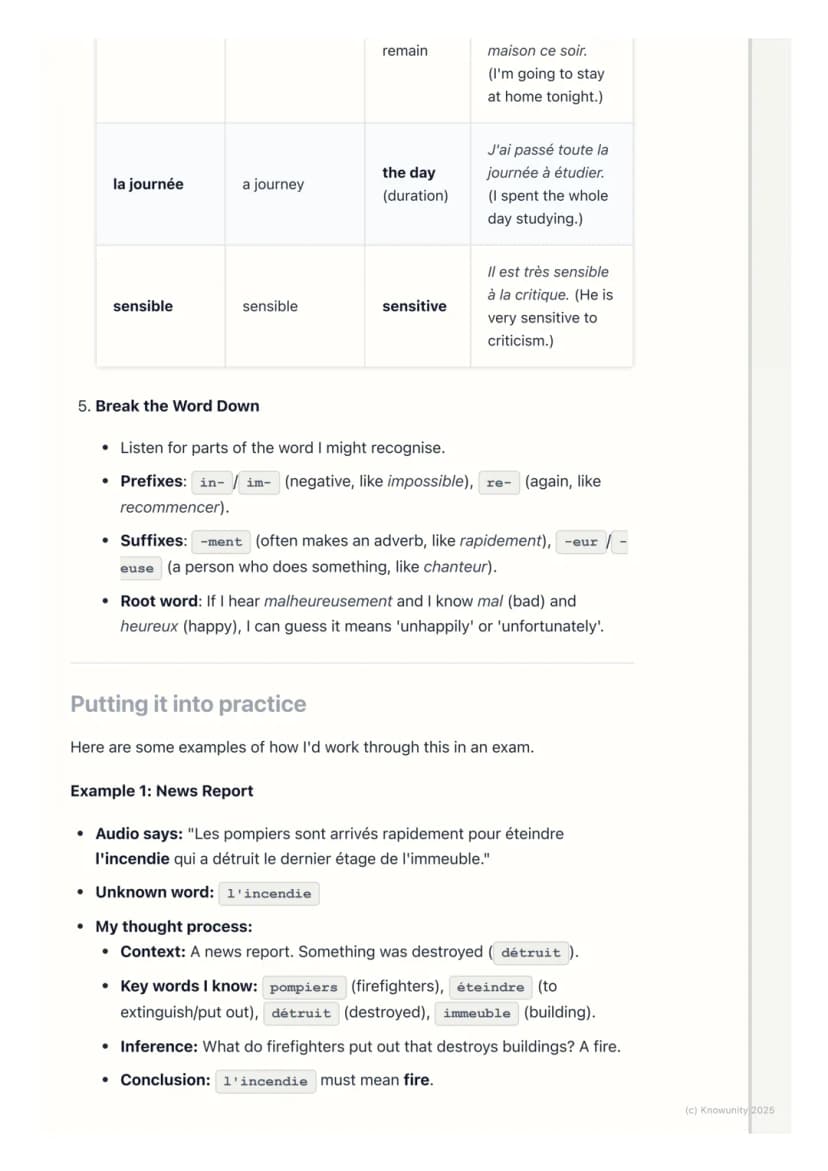
Here's how this works in practice: imagine hearing "malheureusement". If you know "mal" means bad and "heureux" means happy, you can reasonably guess this means "unfortunately" or "sadly".
The key is building these connections quickly during the exam. Don't spend ages analysing - make your best guess and move on.
Pro Strategy: When you hear a long, complex word, listen for any part that sounds familiar. Even recognising one element can unlock the whole meaning.
4
of 5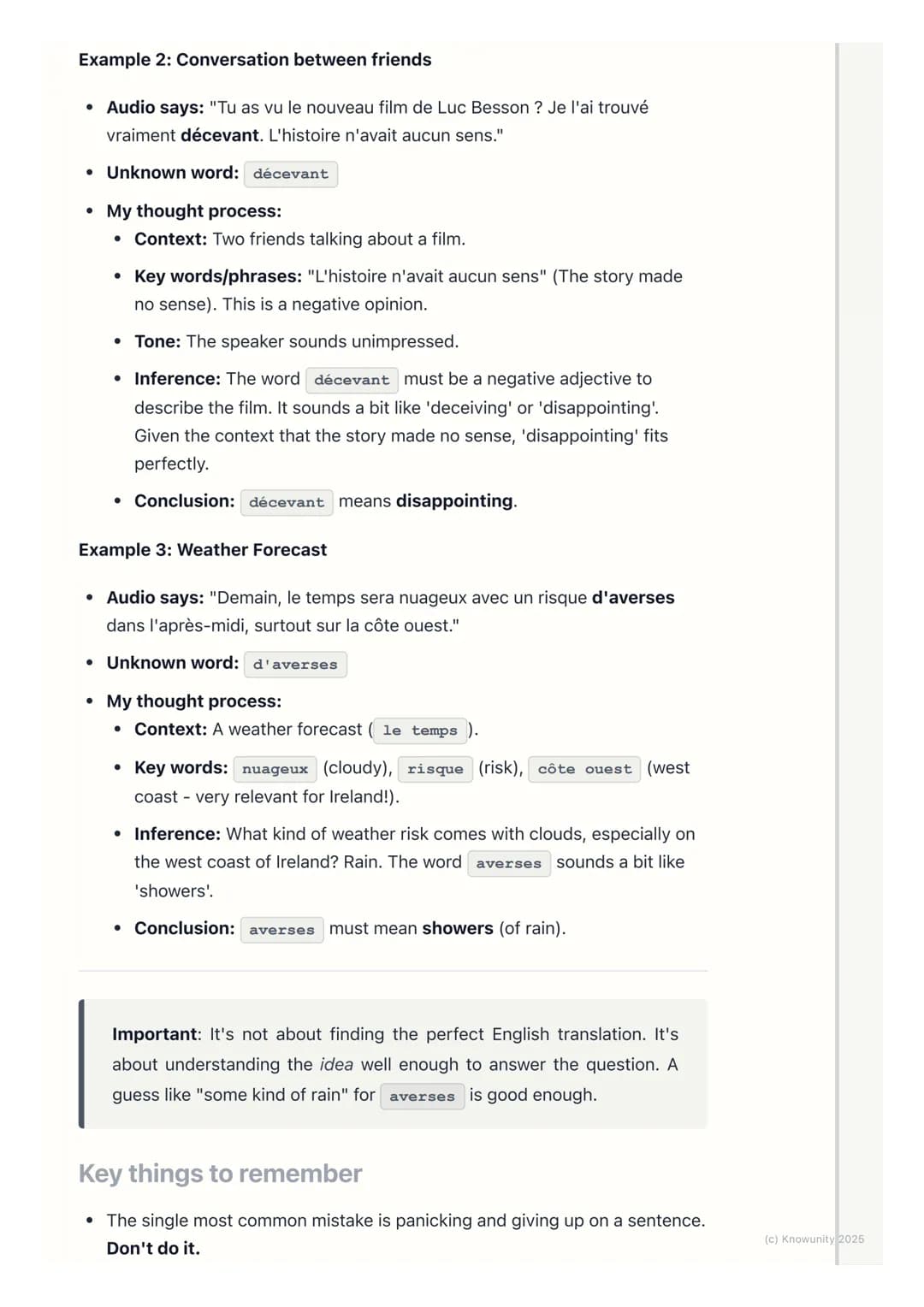
Real Exam Scenarios
Let's walk through some realistic examples you might encounter. Picture this: a news report mentions "Les pompiers sont arrivés pour éteindre l'incendie". You don't know "incendie", but you hear "pompiers" (firefighters) and "éteindre" (to put out). What do firefighters put out? Fire! So "incendie" must mean fire.
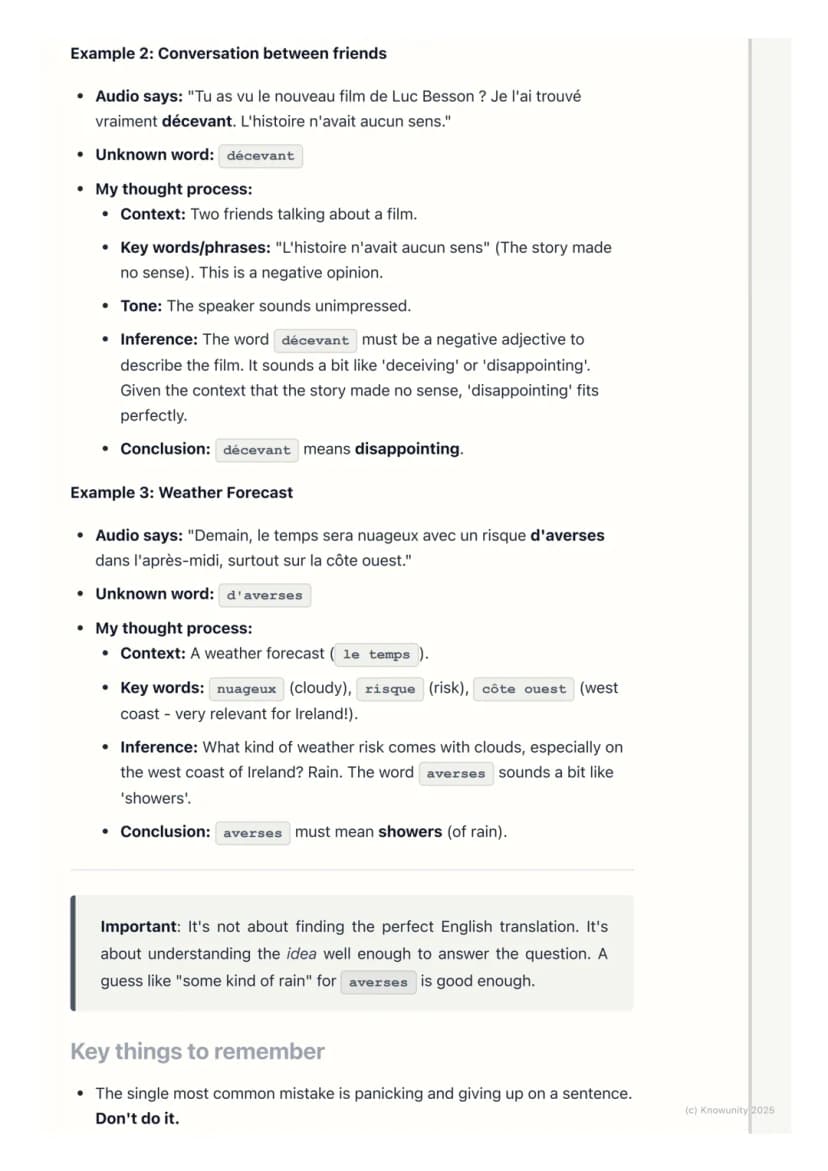
Here's another scenario: your friends are discussing a film, saying it was "vraiment décevant" because "l'histoire n'avait aucun sens" (the story made no sense). The negative tone tells you "décevant" is definitely not complimentary - it means disappointing.
Weather forecasts are common in exams too. If you hear "temps nuageux avec un risque d'averses", you know it's about cloudy weather with some kind of risk. In Ireland, what weather risk comes with clouds? Rain! "Averses" means showers.
Remember: you don't need perfect translations. Understanding "some kind of rain" for "averses" is absolutely fine for exam purposes.
Confidence Booster: These inference skills get stronger with practice. Every guess you make correctly builds your linguistic intuition for the next challenge.
5
of 5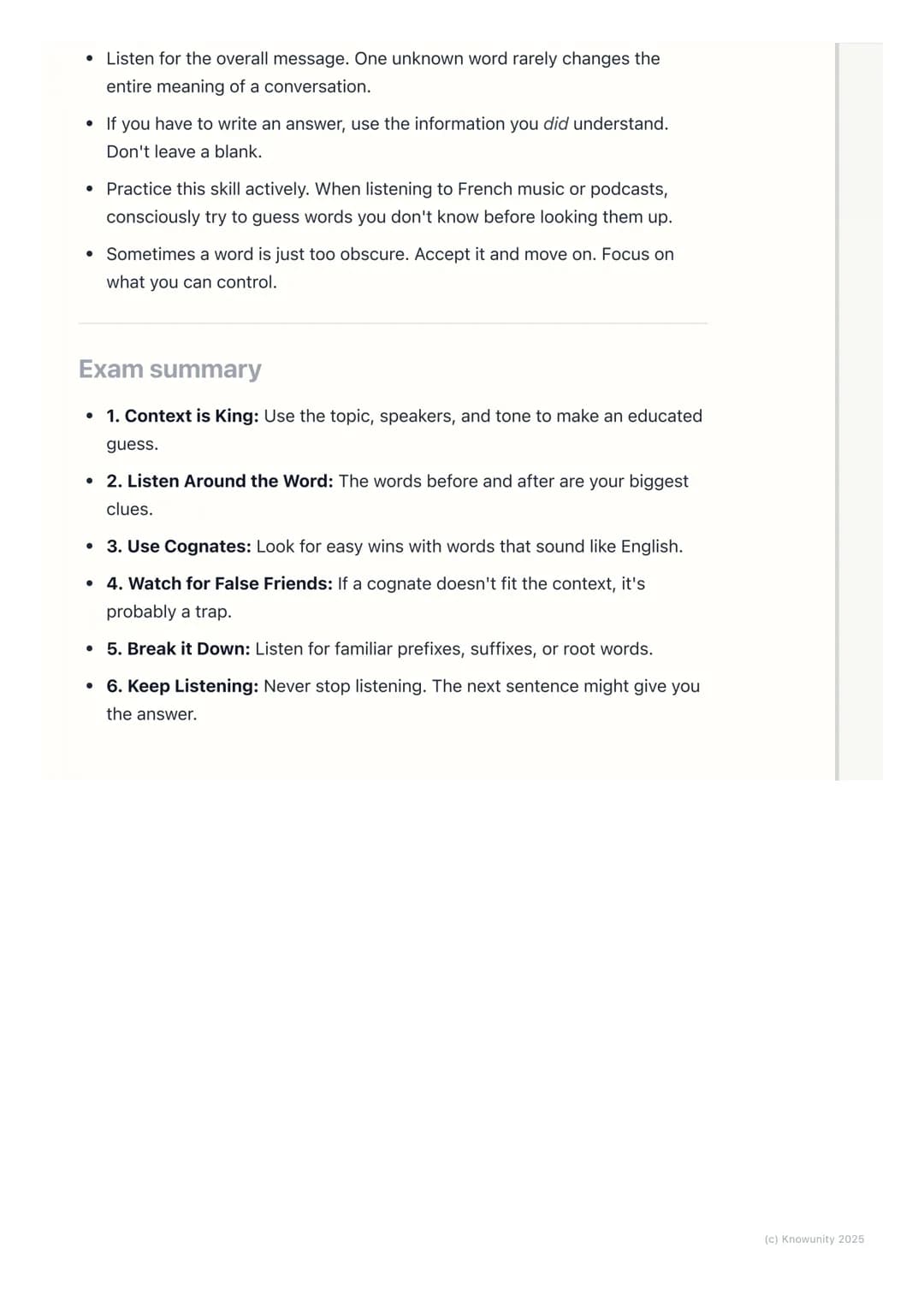
Exam Success Strategies
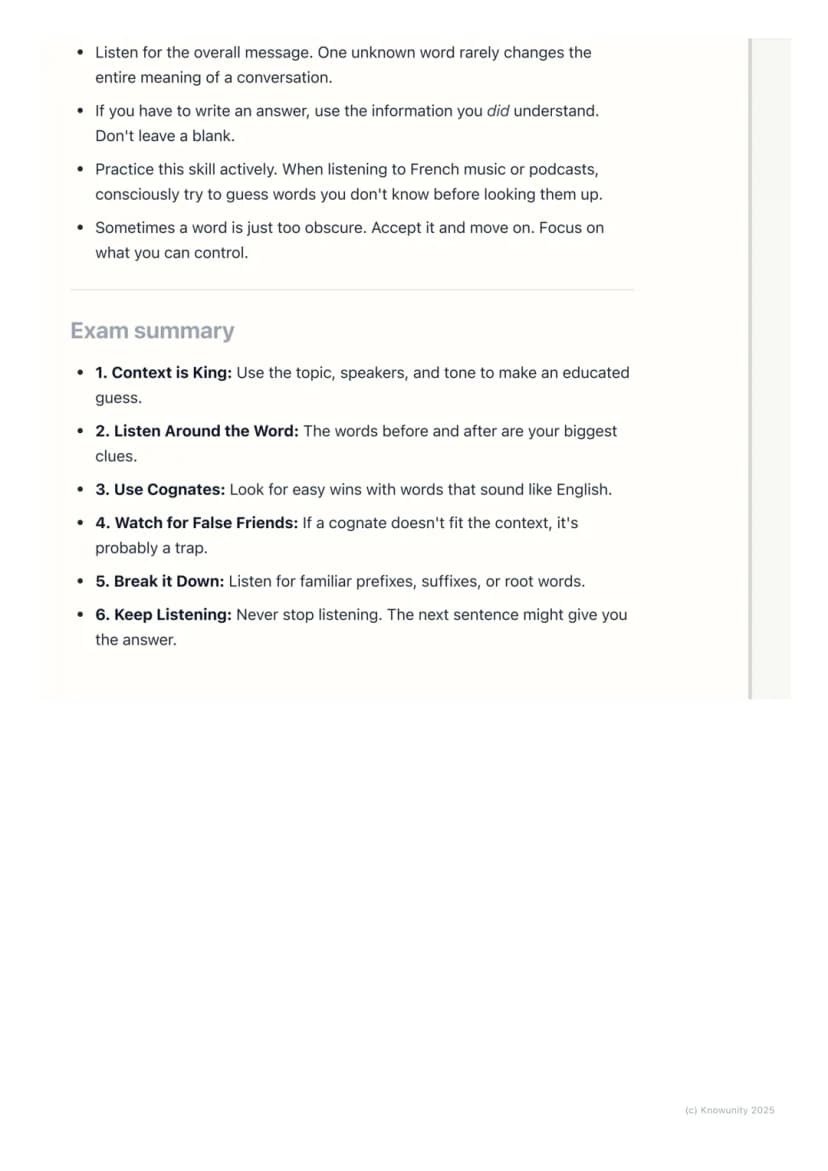
Here's your action plan for exam day. Never panic and give up on a sentence because of one unknown word - that's the fastest way to miss the next few sentences too. Keep your ears open and stay engaged with the conversation.
Focus on the overall message rather than getting stuck on individual vocabulary. One mystery word rarely changes the entire meaning of what someone's saying. If you understand 80% of a conversation, you can usually figure out the remaining 20%.
When writing your answers, use the information you did understand. Don't leave blanks because you missed one word - work with what you've got. Examiners give credit for demonstrating understanding, even if it's not complete.
Practice this skill outside of exam conditions. When you're listening to French music or YouTube videos, consciously try to guess unknown words before looking them up. This builds your confidence and speed.
Final Reality Check: Sometimes a word is just too obscure or technical. Accept it, don't waste mental energy on it, and focus on what you can control. You've got this!
Credeam că nu vei întreba niciodată...
Ce este Companionul AI Knowunity?
Companionul nostru AI este creat special pentru nevoile studenților. Bazându-ne pe milioanele de materiale de pe platformă, putem oferi răspunsuri exacte și relevante pentru studenți. Dar nu este vorba doar despre răspunsuri, companionul este mai ales despre ghidarea studenților prin provocările zilnice de învățare, cu planuri de studiu personalizate, chestionare sau conținuturi în chat și personalizare 100% bazată pe abilitățile și evoluțiile studenților.
De unde pot descărca aplicația Knowunity?
Aplicația este disponibilă în Google Play Store și Apple App Store.
Este Knowunity chiar gratuită?
Da! Bucură-te de access la materiale de studiu, conectează-te cu alți elevi, și primește ajutor instant - toate acestea la un click distanță. În plus, câștigă puncte ca să deblochezi mai multe funcționalități!
Cel mai popular conținut la French
2Cel mai popular conținut
9 Irish
IrishIrish oral questions and answers
Questions and answers for the leaving cert oral
5th Year4264
 English
Key Quotes : Sive
Key Quotes and explanations: Sive
6th Year2842
IrishIrish oral questions
Outline of oral questions
5th Year2055
IrishIníon- le hÁine Durkin
Aine Durkin’s poem, Iníon: Themes & summary
5th Year850
IrishIrish poetry 2027
Iníon + Dínit an Bhróin
5th Year1133
IrishLC HL notes- Iníon (poem)
Includes poem in English and Irish, theme, key words & phrases
5th Year2284
EnglishCultural Context : Shawshank Redemption : Sive : Small Things Like These
Comparative Study : Cultural Context : Shawshank Redemption, Sive and Small Things Like These
6th Year1430
IrishMo Ghrá-sa (Idir Lúibíní)
Notes on mo ghrá-sa
5th Year380
IrishAn Gaeilge Aiste
Irish Language essay
6th Year1320
Nu găsești ce cauți? Explorează alte MATERII.
Recenzii de la utilizatorii noștri. Ei iubesc să folosească Knowunity — și tu o vei face.
4.6/5App Store
4.7/5Google Play
Aplicația este foarte ușor de utilizat și bine concepută. Am găsit tot ce căutam până acum și am reușit să învăț multe din prezentări! Cu siguranță voi folosi aplicația pentru o temă la clasă! Și desigur, ajută mult ca sursă de inspirație.
Ștefan Sutilizator iOS
Această aplicație este super. Sunt atât de multe materiale de studiu și ajutor pentru elevi [...]. Materia mea mai problematică este franceza, de exemplu, și aplicația oferă foarte multe materiale ajutătoare. Mulțumită acestei aplicații, mi-am îmbunătățit franceza. Aș recomanda-o oricui.
Samantha Klichutilizator Android
Wow, sunt cu adevărat impresionat. Am încercat aplicația pentru că am văzut-o promovată de multe ori și am rămas uimit. Aceasta este AJUTORUL de care ai nevoie pentru școală și, mai presus de toate, oferă atât de multe lucruri, precum exerciții și fișe de informații, care mi-au fost FOARTE de ajutor.
Annautilizator iOS
French1 vizualizări·Actualizat Jun 17, 2026·5 paginiMastering New French Words
Ever feel your heart sink when you hear a French word you don't recognise during the Leaving Cert aural exam? You're not alone! The good news is that understanding every single word isn't necessary to ace your listening exam -...
1
of 5
Înscrie-te pentru a vedea CONȚINUTUL. E gratuit!
- Acces la toate documentele
- Îmbunătățește notele tale!
- Alătură-te milioanelor de elevi
The Detective Mindset
Don't let unknown words derail your entire exam performance. When you hear something unfamiliar, your brain's first instinct might be to freeze - but that's exactly what you can't afford to do.
Inference is your superpower here. Think of it like solving a mystery using the clues around you. The context - basically everything happening around that mystery word - gives you massive hints about what it might mean.
You've got some brilliant tools at your disposal. Cognates are words that sound similar in French and English with the same meaning (like "important" or "nation"). However, watch out for false friends - sneaky words that sound English but mean something completely different.
Top Tip: Focus on understanding the overall conversation, not translating every single word. Your goal is the general message, not a perfect dictionary definition.
2
of 5Înscrie-te pentru a vedea CONȚINUTUL. E gratuit!
- Acces la toate documentele
- Îmbunătățește notele tale!
- Alătură-te milioanelor de elevi
Your Step-by-Step Strategy
When you hit an unknown word, follow this game plan. First, keep listening - seriously, this is crucial. The meaning often becomes clear from the sentences that follow, so don't let one word stop you in your tracks.
Next, analyse the context like a pro. Ask yourself: what's the topic? Who's talking? What's the mood? A conversation between mates about weekend plans will give you very different clues than a formal news report about politics.
Listen actively for cognates - words like "la situation" or "le gouvernement" are gifts wrapped up for you. Your brain should automatically tune into these English-sounding words.
But stay alert for those tricky false friends. Words like "actuellement" (which means "currently", not "actually") or "la librairie" (bookshop, not library) can completely throw you off if you're not careful.
Remember: If a cognate seems to make no sense in context, it's probably a false friend trying to trick you.
3
of 5Înscrie-te pentru a vedea CONȚINUTUL. E gratuit!
- Acces la toate documentele
- Îmbunătățește notele tale!
- Alătură-te milioanelor de elevi
Breaking Down the Mystery
Sometimes you need to become a word detective and break down unfamiliar terms into smaller pieces. Listen for prefixes you recognise - "in-" or "im-" often mean "not" (like "impossible"), while "re-" usually means "again".
Suffixes are equally helpful. Words ending in "-ment" are often adverbs (like "rapidement"), whilst "-eur" or "-euse" typically describe people who do something (like "chanteur" for singer).
Here's how this works in practice: imagine hearing "malheureusement". If you know "mal" means bad and "heureux" means happy, you can reasonably guess this means "unfortunately" or "sadly".
The key is building these connections quickly during the exam. Don't spend ages analysing - make your best guess and move on.
Pro Strategy: When you hear a long, complex word, listen for any part that sounds familiar. Even recognising one element can unlock the whole meaning.
4
of 5Înscrie-te pentru a vedea CONȚINUTUL. E gratuit!
- Acces la toate documentele
- Îmbunătățește notele tale!
- Alătură-te milioanelor de elevi
Real Exam Scenarios
Let's walk through some realistic examples you might encounter. Picture this: a news report mentions "Les pompiers sont arrivés pour éteindre l'incendie". You don't know "incendie", but you hear "pompiers" (firefighters) and "éteindre" (to put out). What do firefighters put out? Fire! So "incendie" must mean fire.
Here's another scenario: your friends are discussing a film, saying it was "vraiment décevant" because "l'histoire n'avait aucun sens" (the story made no sense). The negative tone tells you "décevant" is definitely not complimentary - it means disappointing.
Weather forecasts are common in exams too. If you hear "temps nuageux avec un risque d'averses", you know it's about cloudy weather with some kind of risk. In Ireland, what weather risk comes with clouds? Rain! "Averses" means showers.
Remember: you don't need perfect translations. Understanding "some kind of rain" for "averses" is absolutely fine for exam purposes.
Confidence Booster: These inference skills get stronger with practice. Every guess you make correctly builds your linguistic intuition for the next challenge.
5
of 5Înscrie-te pentru a vedea CONȚINUTUL. E gratuit!
- Acces la toate documentele
- Îmbunătățește notele tale!
- Alătură-te milioanelor de elevi
Exam Success Strategies
Here's your action plan for exam day. Never panic and give up on a sentence because of one unknown word - that's the fastest way to miss the next few sentences too. Keep your ears open and stay engaged with the conversation.
Focus on the overall message rather than getting stuck on individual vocabulary. One mystery word rarely changes the entire meaning of what someone's saying. If you understand 80% of a conversation, you can usually figure out the remaining 20%.
When writing your answers, use the information you did understand. Don't leave blanks because you missed one word - work with what you've got. Examiners give credit for demonstrating understanding, even if it's not complete.
Practice this skill outside of exam conditions. When you're listening to French music or YouTube videos, consciously try to guess unknown words before looking them up. This builds your confidence and speed.
Final Reality Check: Sometimes a word is just too obscure or technical. Accept it, don't waste mental energy on it, and focus on what you can control. You've got this!
Credeam că nu vei întreba niciodată...
Ce este Companionul AI Knowunity?
Companionul nostru AI este creat special pentru nevoile studenților. Bazându-ne pe milioanele de materiale de pe platformă, putem oferi răspunsuri exacte și relevante pentru studenți. Dar nu este vorba doar despre răspunsuri, companionul este mai ales despre ghidarea studenților prin provocările zilnice de învățare, cu planuri de studiu personalizate, chestionare sau conținuturi în chat și personalizare 100% bazată pe abilitățile și evoluțiile studenților.
De unde pot descărca aplicația Knowunity?
Aplicația este disponibilă în Google Play Store și Apple App Store.
Este Knowunity chiar gratuită?
Da! Bucură-te de access la materiale de studiu, conectează-te cu alți elevi, și primește ajutor instant - toate acestea la un click distanță. În plus, câștigă puncte ca să deblochezi mai multe funcționalități!
Cel mai popular conținut la French
2Cel mai popular conținut
9IrishIrish oral questions and answers
Questions and answers for the leaving cert oral
5th Year4264
EnglishKey Quotes : Sive
Key Quotes and explanations: Sive
6th Year2842
IrishIrish oral questions
Outline of oral questions
5th Year2055
IrishIníon- le hÁine Durkin
Aine Durkin’s poem, Iníon: Themes & summary
5th Year850
IrishIrish poetry 2027
Iníon + Dínit an Bhróin
5th Year1133
IrishLC HL notes- Iníon (poem)
Includes poem in English and Irish, theme, key words & phrases
5th Year2284
EnglishCultural Context : Shawshank Redemption : Sive : Small Things Like These
Comparative Study : Cultural Context : Shawshank Redemption, Sive and Small Things Like These
6th Year1430
IrishMo Ghrá-sa (Idir Lúibíní)
Notes on mo ghrá-sa
5th Year380
IrishAn Gaeilge Aiste
Irish Language essay
6th Year1320
Nu găsești ce cauți? Explorează alte MATERII.
Recenzii de la utilizatorii noștri. Ei iubesc să folosească Knowunity — și tu o vei face.
4.6/5App Store
4.7/5Google Play
Aplicația este foarte ușor de utilizat și bine concepută. Am găsit tot ce căutam până acum și am reușit să învăț multe din prezentări! Cu siguranță voi folosi aplicația pentru o temă la clasă! Și desigur, ajută mult ca sursă de inspirație.
Ștefan Sutilizator iOS
Această aplicație este super. Sunt atât de multe materiale de studiu și ajutor pentru elevi [...]. Materia mea mai problematică este franceza, de exemplu, și aplicația oferă foarte multe materiale ajutătoare. Mulțumită acestei aplicații, mi-am îmbunătățit franceza. Aș recomanda-o oricui.
Samantha Klichutilizator Android
Wow, sunt cu adevărat impresionat. Am încercat aplicația pentru că am văzut-o promovată de multe ori și am rămas uimit. Aceasta este AJUTORUL de care ai nevoie pentru școală și, mai presus de toate, oferă atât de multe lucruri, precum exerciții și fișe de informații, care mi-au fost FOARTE de ajutor.
Annautilizator iOS