
Ever wondered why bridges aren't made of glass or why... Afișează mai mult
 Engineering
 Irish
Irish English
Înscrie-te pentru a vedea CONȚINUTULE gratuit!
Acces la toate documentele
Îmbunătățește notele tale!
Alătură-te milioanelor de elevi
Knowunity AI
Mai mult
Materii
Triangle Congruence and Similarity Theorems
Triangle Properties and Classification
Linear Equations and Graphs
Geometric Angle Relationships
Trigonometric Functions and Identities
Equation Solving Techniques
Circle Geometry Fundamentals
Division Operations and Methods
Basic Differentiation Rules
Exponent and Logarithm Properties
Afișează toate materiile
Human Organ Systems
Reproductive Cell Cycles
Biological Sciences Subdisciplines
Cellular Energy Metabolism
Autotrophic Energy Processes
Inheritance Patterns and Principles
Biomolecular Structure and Organization
Cell Cycle and Division Mechanics
Cellular Organization and Development
Biological Structural Organization
Afișează toate materiile
Chemical Sciences and Applications
Atomic Structure and Composition
Molecular Electron Structure Representation
Atomic Electron Behavior
Matter Properties and Water
Mole Concept and Calculations
Gas Laws and Behavior
Periodic Table Organization
Chemical Thermodynamics Fundamentals
Chemical Bond Types and Properties
Afișează toate materiile
European Renaissance and Enlightenment
European Cultural Movements 800-1920
American Revolution Era 1763-1797
American Civil War 1861-1865
Global Imperial Systems
Mongol and Chinese Dynasties
U.S. Presidents and World Leaders
Historical Sources and Documentation
World Wars Era and Impact
World Religious Systems
Afișează toate materiile
Classic and Contemporary Novels
Literary Character Analysis
Rhetorical Theory and Practice
Classic Literary Narratives
Reading Analysis and Interpretation
Narrative Structure and Techniques
English Language Components
Influential English-Language Authors
Basic Sentence Structure
Narrative Voice and Perspective
Afișează toate materiile
2
•
Actualizat Apr 30, 2026
•
Ever wondered why bridges aren't made of glass or why... Afișează mai mult
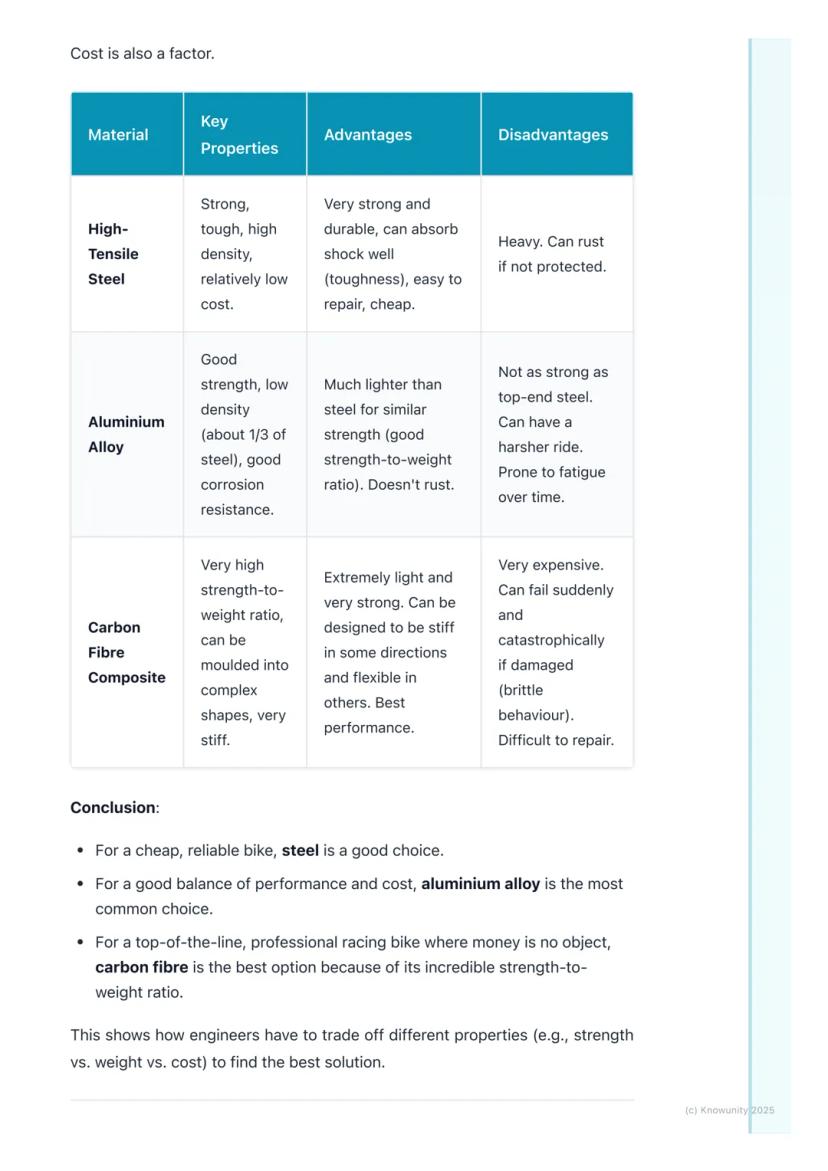
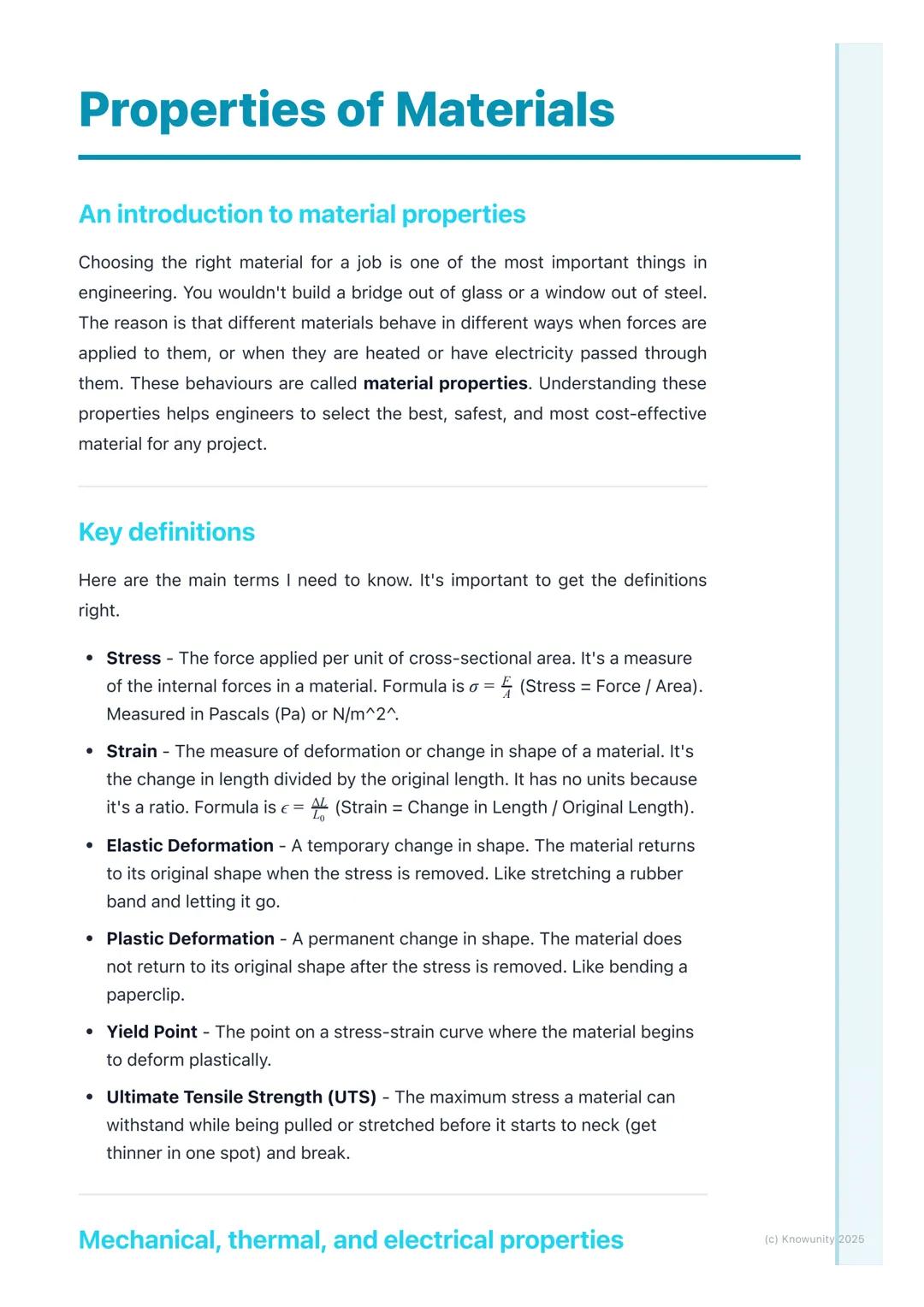
Before diving into specific properties, you need to grasp a few key concepts that form the foundation of materials science. Stress is the force applied per unit area , measured in Pascals. Think of it as how much pressure you're putting on a material.
Strain is how much a material deforms compared to its original size . Unlike stress, strain has no units because it's just a ratio. These two concepts work together to describe how materials respond to forces.
Materials can undergo two types of deformation. Elastic deformation is temporary - like stretching a rubber band that snaps back. Plastic deformation is permanent - like bending a paperclip that stays bent. The yield point marks where elastic becomes plastic, whilst ultimate tensile strength shows the maximum stress before breaking.
Key Insight: Understanding stress and strain is crucial for predicting how any material will behave under real-world conditions.
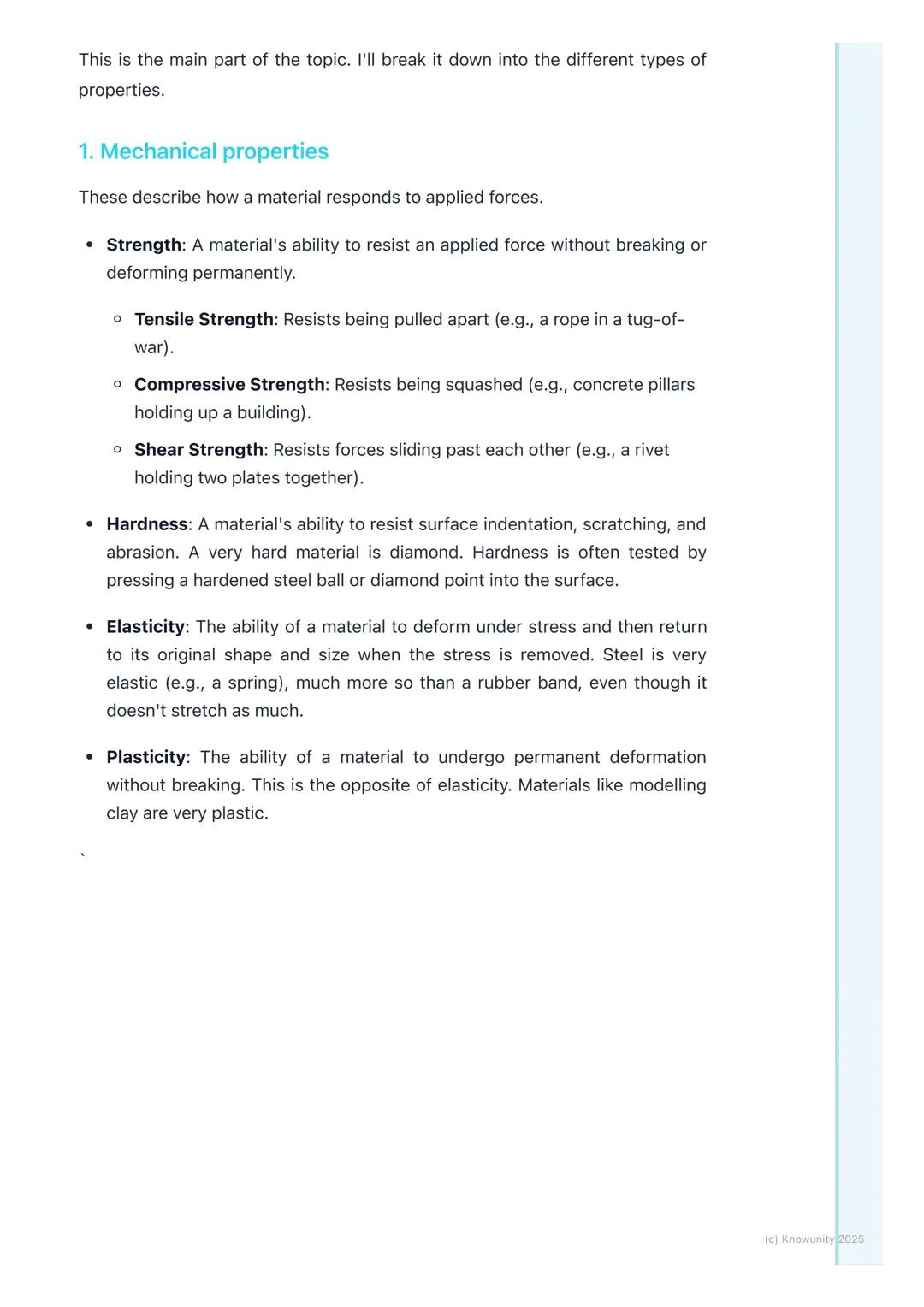
Mechanical properties determine how materials respond to different types of forces, making them essential for engineering applications. Strength describes a material's ability to resist applied forces without breaking or permanently deforming.
There are three main types of strength to remember. Tensile strength resists pulling forces , compressive strength resists crushing forces (concrete pillars), and shear strength resists sliding forces (rivets holding plates together).
Hardness measures resistance to surface damage like scratching or denting - diamond tops this scale. Elasticity allows materials to return to their original shape after deformation, whilst plasticity enables permanent reshaping without breaking.
Don't confuse ductility (ability to be drawn into wires) with malleability (ability to be hammered into sheets). Copper wire demonstrates ductility, whilst aluminium foil shows malleability.
Study Tip: Remember "Ductile = Drawn" and "Malleable = Moulded" to keep these properties straight.
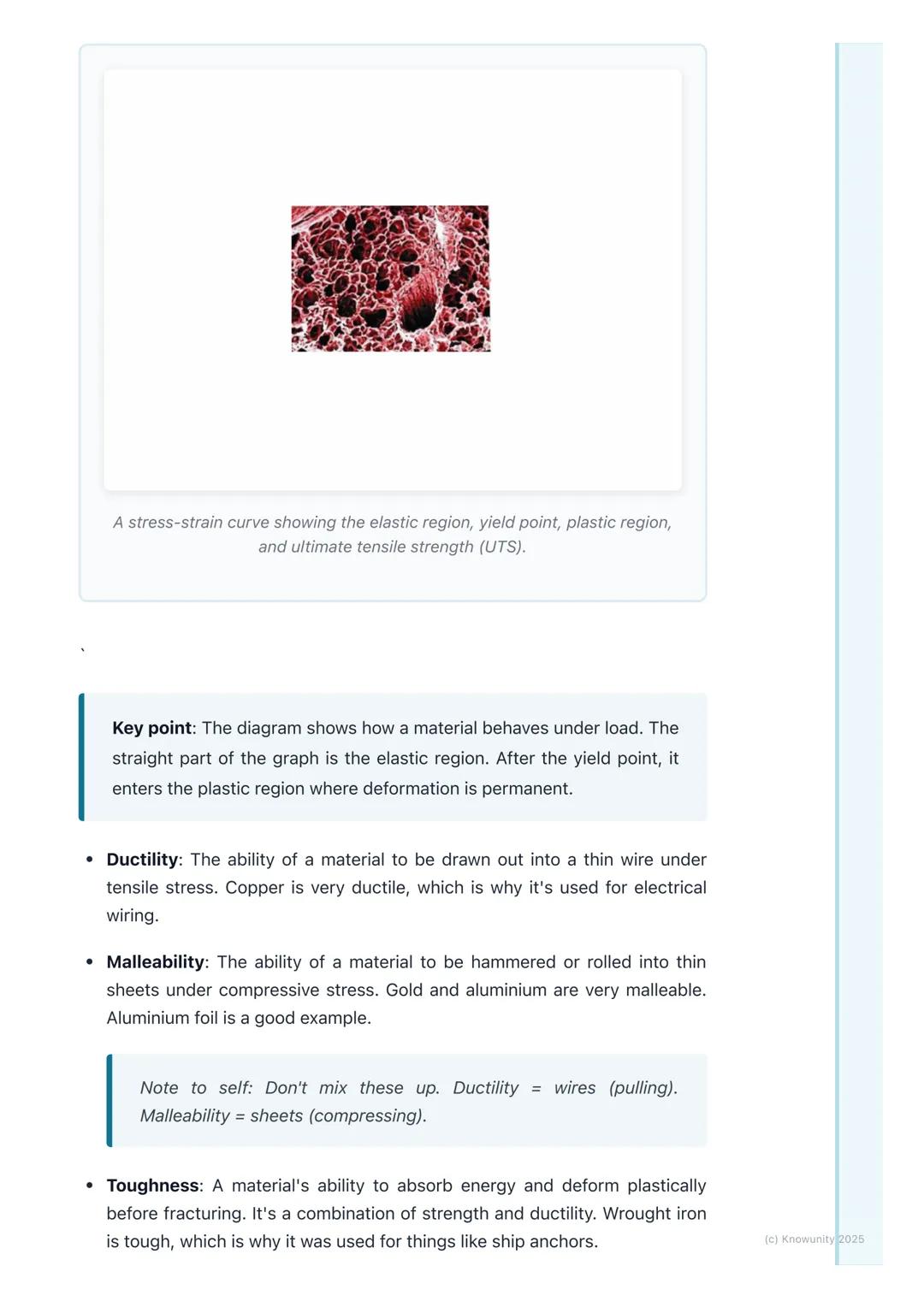
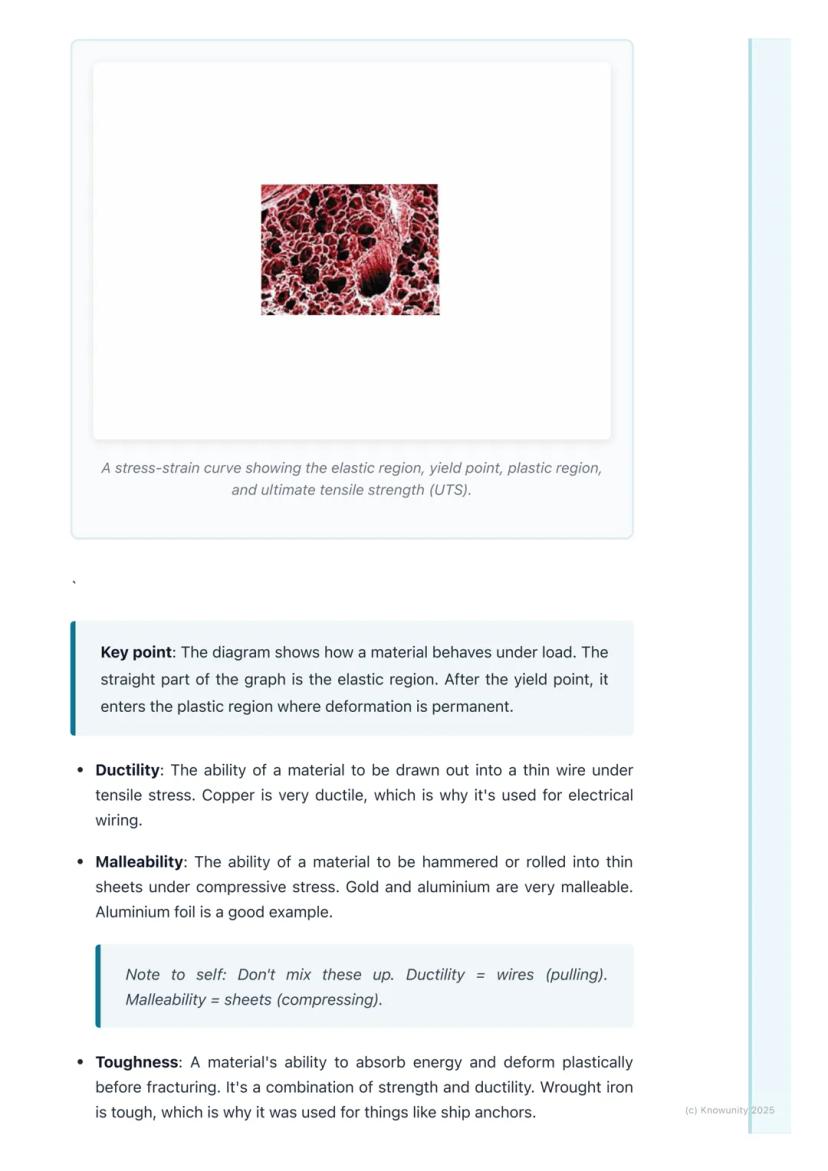
The stress-strain curve is your roadmap for understanding material behaviour under load. The straight portion represents the elastic region where deformation is temporary. After the yield point, you enter the plastic region where changes become permanent.
Toughness combines strength and ductility - it's a material's ability to absorb energy before fracturing. Wrought iron exemplifies toughness, which is why it was perfect for ship anchors. Brittleness sits at the opposite end, describing materials that fracture suddenly with minimal deformation.
Glass and ceramics are classic brittle materials - they simply snap without warning. This brittleness makes them unsuitable for applications requiring impact resistance, despite their impressive compressive strength.
Understanding these properties helps predict failure modes. Tough materials bend and absorb energy before breaking, giving warning signs. Brittle materials fail catastrophically without notice.
Real-World Application: Engineers choose tough materials for safety-critical applications where sudden failure could be dangerous.
Thermal properties describe how materials respond to temperature changes. Thermal conductivity determines how well heat flows through a material - metals like copper excel here, making them perfect for saucepans and radiators.
Materials with low thermal conductivity act as insulators. Wood, plastic, and fibreglass keep heat from transferring, which is why saucepan handles use these materials. Thermal expansion causes materials to change size with temperature - large bridges need expansion joints to prevent buckling in summer heat.
Electrical properties govern how materials interact with electricity. Conductors like copper and silver allow current to flow easily, making them ideal for wiring. Insulators like rubber and plastic resist current flow, providing essential safety in electrical applications.
Semiconductors like silicon sit between conductors and insulators. Their unique properties enable all modern electronics - your phone's processor relies entirely on semiconductor behaviour.
Connect the Dots: The same copper used in electrical wiring also appears in cookware because it conducts both electricity and heat exceptionally well.
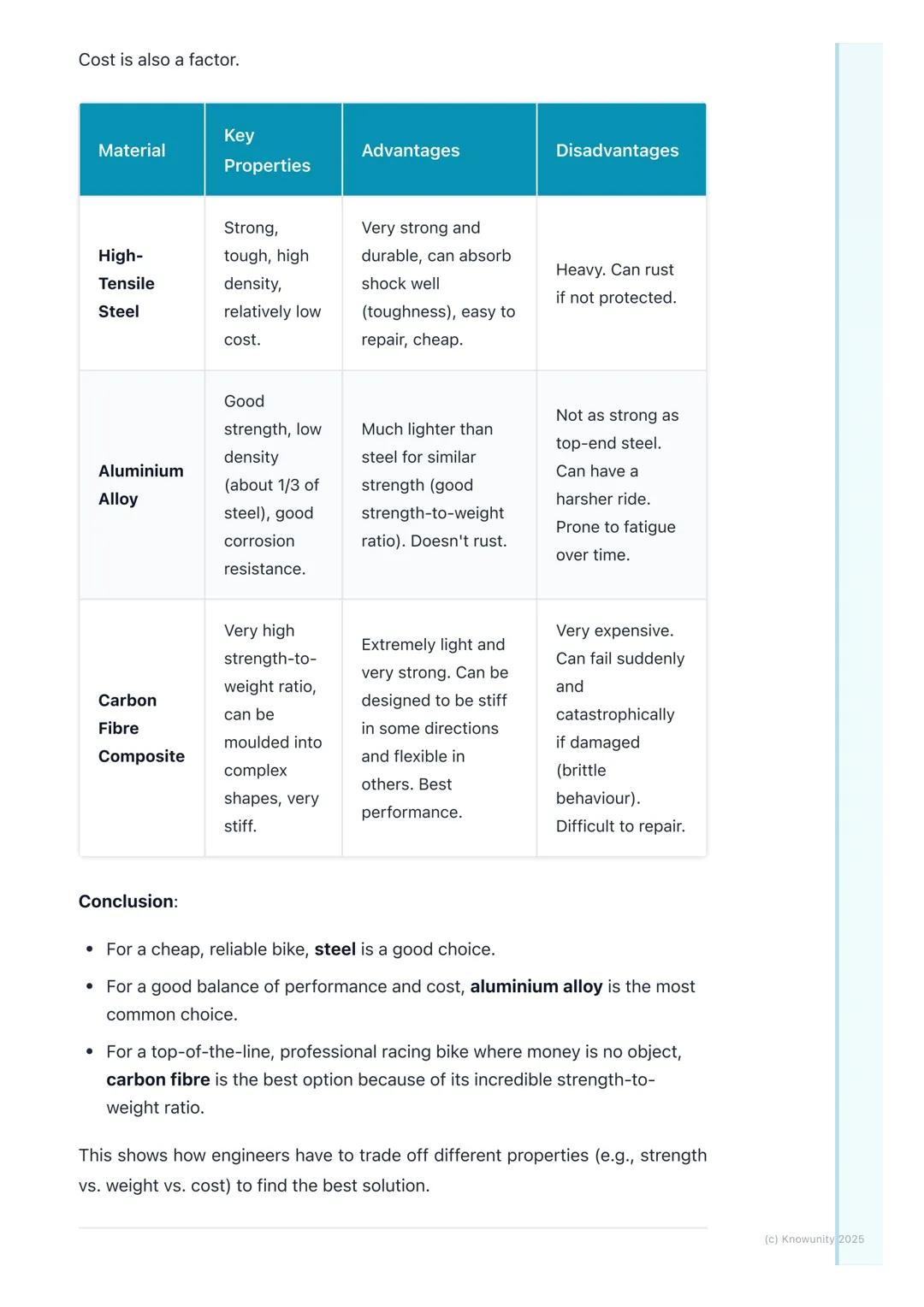
Real engineering involves balancing multiple properties to find the best solution. Consider designing a racing bicycle frame where you need high strength, low weight, and good stiffness whilst managing costs.
High-tensile steel offers excellent strength and toughness at low cost. It's durable, absorbs shock well, and repairs easily. However, steel's high density makes it heavy, and it can rust without protection.
Aluminium alloy provides the best balance for most applications. With about one-third the density of steel but similar strength, it offers an excellent strength-to-weight ratio. It doesn't rust either, though it may provide a harsher ride and can suffer fatigue over time.
Carbon fibre composite represents the premium choice. Its exceptional strength-to-weight ratio and ability to be moulded into complex shapes make it perfect for professional racing. The trade-offs include high cost, brittle failure modes, and difficult repairs.
Engineering Reality: The "best" material depends entirely on your priorities - there's no universal winner.
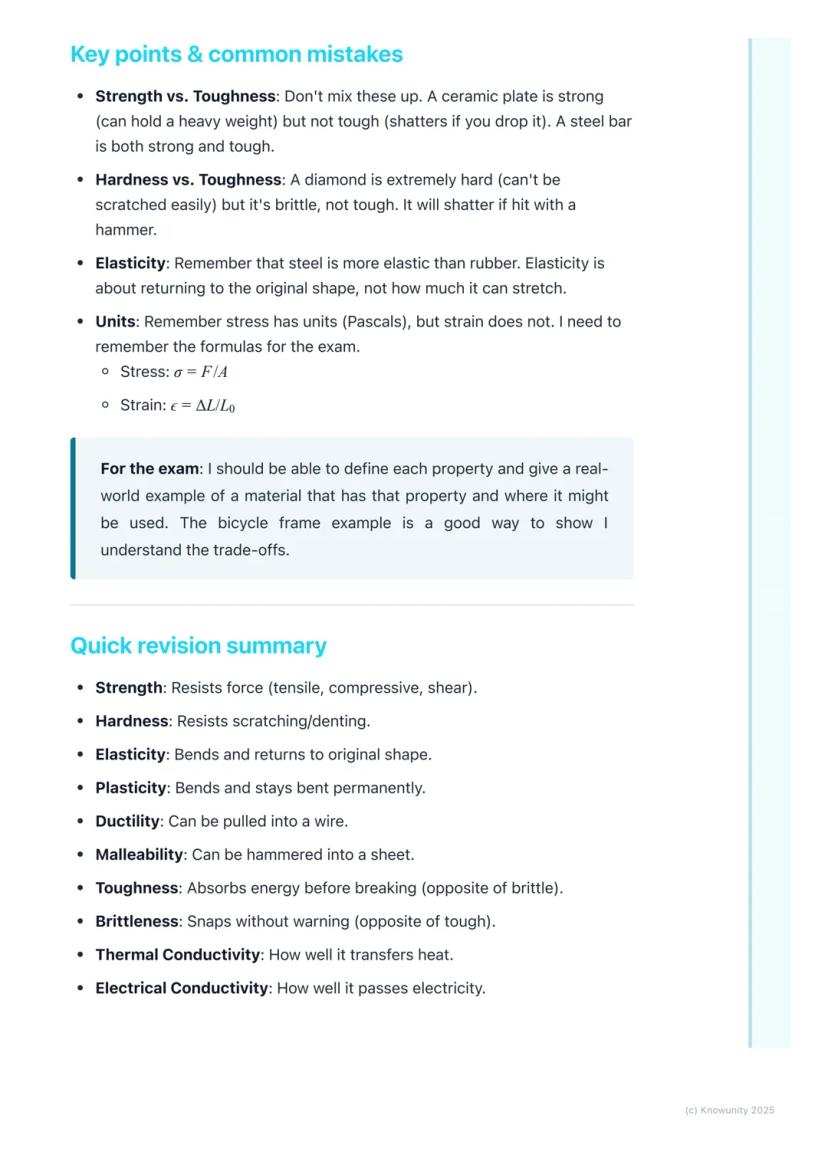
Understanding the differences between similar-sounding properties prevents costly mistakes. Strength versus toughness often confuses students - a ceramic plate can support heavy weight (strong) but shatters when dropped (not tough). Steel bars are both strong and tough.
Hardness versus toughness creates another common mix-up. Diamond is incredibly hard but brittle (shatters easily). Don't assume hard materials are tough. Elasticity also trips up students - steel is more elastic than rubber because elasticity measures the ability to return to original shape, not how much something stretches.
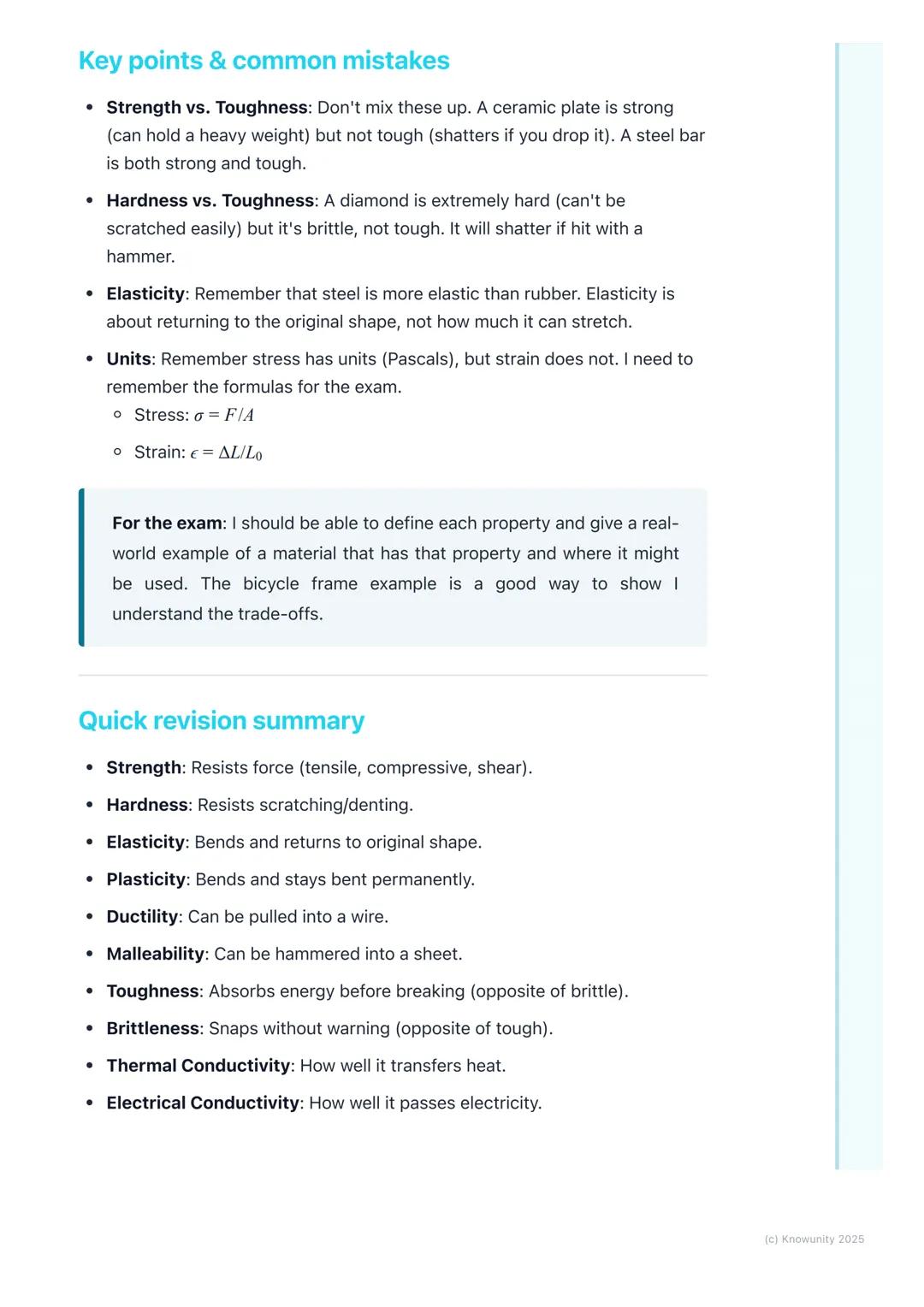
For calculations, remember that stress has units (Pascals) whilst strain is unitless. The formulas σ = F/A and ε = ΔL/L₀ are essential for solving problems.
Master these key properties for quick revision: strength (resists force), hardness (resists scratching), elasticity (returns to shape), plasticity (permanent deformation), ductility , malleability , toughness (energy absorption), brittleness (sudden failure), thermal conductivity (heat transfer), and electrical conductivity (current flow).
Exam Success: Practice identifying real-world examples of each property and explain why specific materials are chosen for particular applications.
Companionul nostru AI este creat special pentru nevoile studenților. Bazându-ne pe milioanele de materiale de pe platformă, putem oferi răspunsuri exacte și relevante pentru studenți. Dar nu este vorba doar despre răspunsuri, companionul este mai ales despre ghidarea studenților prin provocările zilnice de învățare, cu planuri de studiu personalizate, chestionare sau conținuturi în chat și personalizare 100% bazată pe abilitățile și evoluțiile studenților.
Aplicația este disponibilă în Google Play Store și Apple App Store.
Da! Bucură-te de access la materiale de studiu, conectează-te cu alți elevi, și primește ajutor instant - toate acestea la un click distanță. În plus, câștigă puncte ca să deblochezi mai multe funcționalități!
App Store
Google Play
Aplicația este foarte ușor de utilizat și bine concepută. Am găsit tot ce căutam până acum și am reușit să învăț multe din prezentări! Cu siguranță voi folosi aplicația pentru o temă la clasă! Și desigur, ajută mult ca sursă de inspirație.
Ștefan S
utilizator iOS
Această aplicație este super. Sunt atât de multe materiale de studiu și ajutor pentru elevi [...]. Materia mea mai problematică este franceza, de exemplu, și aplicația oferă foarte multe materiale ajutătoare. Mulțumită acestei aplicații, mi-am îmbunătățit franceza. Aș recomanda-o oricui.
Samantha Klich
utilizator Android
Wow, sunt cu adevărat impresionat. Am încercat aplicația pentru că am văzut-o promovată de multe ori și am rămas uimit. Aceasta este AJUTORUL de care ai nevoie pentru școală și, mai presus de toate, oferă atât de multe lucruri, precum exerciții și fișe de informații, care mi-au fost FOARTE de ajutor.
Anna
utilizator iOS
Te ajută să înveți foarte repede și ști foarte bine ce ai dori tu să înveți, vă recomand cu drag să încercați și să învățați mai repede.!
Thomas R
utilizator iOS
Foarte bună aplicația!!!! Mă ajută să înțeleg mult mai bine lecțiile și temele le termin mult mai repede.👍❤️
Paul P
utilizator Android
Te ajută foarte bine la teme acest robot,recomand!
David K
utilizator iOS
Aplicația e grozavă! Tot ce trebuie să fac este să introduc subiectul în bara de căutare și primesc răspunsul foarte rapid. Nu mai trebuie să mă uit la 10 videoclipuri pe YouTube pentru a înțelege ceva, deci îmi economisesc timpul. Super recomandat!
Sudenaz Ocak
utilizator Android
La școală eram chiar slab la matematică, dar datorită aplicației, mă descurc mai bine acum. Sunt atât de recunoscător că ai creat aplicația.
Greenlight Bonnie
utilizator Android
Această aplicație e super interesantă și seamănă ca tiktok-ul doar că tu ai doar teorie și explicații.
Karla S
utilizator Android
Nu mai trebuie să stau cu orele să învăț după caiet când pot să citesc de 2 ori lecțiile care apar aici și iau 10 la test ! Knowunity m-a ajutat să iau nota 9,20 la română ! Voi recomanda ff tare aceasta aplicate , să nu uităm ca are și chat GPT !👍🏻
Denisa B
utilizator iOS
CHESTIONARELE ȘI FLASHCARD-URILE SUNT ATÂT DE UTILE ȘI IUBESC Knowunity AI. E LITERALMENTE CA CHATGPT DOAR CĂ MAI DEȘTEPT!! M-A AJUTAT ȘI CU PROBLEMELE MELE CU MASCARA!! PLUS CU MATERIILE MELE ADEVĂRATE! EVIDENT 😍😁😲🤑💗✨🎀😮
Sarah L
utilizator Android
Este foarte bună te ajută la teme te face să înțelegi lecțiile am înțeles o lecție în 20 de minute i singură nu reușeam să o învăț dar cu Knowunity am învățat-o foarte ușor
Alessia V
utilizator iOS
Aplicația este foarte ușor de utilizat și bine concepută. Am găsit tot ce căutam până acum și am reușit să învăț multe din prezentări! Cu siguranță voi folosi aplicația pentru o temă la clasă! Și desigur, ajută mult ca sursă de inspirație.
Ștefan S
utilizator iOS
Această aplicație este super. Sunt atât de multe materiale de studiu și ajutor pentru elevi [...]. Materia mea mai problematică este franceza, de exemplu, și aplicația oferă foarte multe materiale ajutătoare. Mulțumită acestei aplicații, mi-am îmbunătățit franceza. Aș recomanda-o oricui.
Samantha Klich
utilizator Android
Wow, sunt cu adevărat impresionat. Am încercat aplicația pentru că am văzut-o promovată de multe ori și am rămas uimit. Aceasta este AJUTORUL de care ai nevoie pentru școală și, mai presus de toate, oferă atât de multe lucruri, precum exerciții și fișe de informații, care mi-au fost FOARTE de ajutor.
Anna
utilizator iOS
Te ajută să înveți foarte repede și ști foarte bine ce ai dori tu să înveți, vă recomand cu drag să încercați și să învățați mai repede.!
Thomas R
utilizator iOS
Foarte bună aplicația!!!! Mă ajută să înțeleg mult mai bine lecțiile și temele le termin mult mai repede.👍❤️
Paul P
utilizator Android
Te ajută foarte bine la teme acest robot,recomand!
David K
utilizator iOS
Aplicația e grozavă! Tot ce trebuie să fac este să introduc subiectul în bara de căutare și primesc răspunsul foarte rapid. Nu mai trebuie să mă uit la 10 videoclipuri pe YouTube pentru a înțelege ceva, deci îmi economisesc timpul. Super recomandat!
Sudenaz Ocak
utilizator Android
La școală eram chiar slab la matematică, dar datorită aplicației, mă descurc mai bine acum. Sunt atât de recunoscător că ai creat aplicația.
Greenlight Bonnie
utilizator Android
Această aplicație e super interesantă și seamănă ca tiktok-ul doar că tu ai doar teorie și explicații.
Karla S
utilizator Android
Nu mai trebuie să stau cu orele să învăț după caiet când pot să citesc de 2 ori lecțiile care apar aici și iau 10 la test ! Knowunity m-a ajutat să iau nota 9,20 la română ! Voi recomanda ff tare aceasta aplicate , să nu uităm ca are și chat GPT !👍🏻
Denisa B
utilizator iOS
CHESTIONARELE ȘI FLASHCARD-URILE SUNT ATÂT DE UTILE ȘI IUBESC Knowunity AI. E LITERALMENTE CA CHATGPT DOAR CĂ MAI DEȘTEPT!! M-A AJUTAT ȘI CU PROBLEMELE MELE CU MASCARA!! PLUS CU MATERIILE MELE ADEVĂRATE! EVIDENT 😍😁😲🤑💗✨🎀😮
Sarah L
utilizator Android
Este foarte bună te ajută la teme te face să înțelegi lecțiile am înțeles o lecție în 20 de minute i singură nu reușeam să o învăț dar cu Knowunity am învățat-o foarte ușor
Alessia V
utilizator iOS
Ever wondered why bridges aren't made of glass or why electrical wires use copper instead of plastic? The secret lies in understanding material properties- the specific ways different materials behave when forces, heat, or electricity are applied to them.... Afișează mai mult
Acces la toate documentele
Îmbunătățește notele tale!
Alătură-te milioanelor de elevi
Before diving into specific properties, you need to grasp a few key concepts that form the foundation of materials science. Stress is the force applied per unit area , measured in Pascals. Think of it as how much pressure you're putting on a material.
Strain is how much a material deforms compared to its original size . Unlike stress, strain has no units because it's just a ratio. These two concepts work together to describe how materials respond to forces.
Materials can undergo two types of deformation. Elastic deformation is temporary - like stretching a rubber band that snaps back. Plastic deformation is permanent - like bending a paperclip that stays bent. The yield point marks where elastic becomes plastic, whilst ultimate tensile strength shows the maximum stress before breaking.
Key Insight: Understanding stress and strain is crucial for predicting how any material will behave under real-world conditions.
Acces la toate documentele
Îmbunătățește notele tale!
Alătură-te milioanelor de elevi
Mechanical properties determine how materials respond to different types of forces, making them essential for engineering applications. Strength describes a material's ability to resist applied forces without breaking or permanently deforming.
There are three main types of strength to remember. Tensile strength resists pulling forces , compressive strength resists crushing forces (concrete pillars), and shear strength resists sliding forces (rivets holding plates together).
Hardness measures resistance to surface damage like scratching or denting - diamond tops this scale. Elasticity allows materials to return to their original shape after deformation, whilst plasticity enables permanent reshaping without breaking.
Don't confuse ductility (ability to be drawn into wires) with malleability (ability to be hammered into sheets). Copper wire demonstrates ductility, whilst aluminium foil shows malleability.
Study Tip: Remember "Ductile = Drawn" and "Malleable = Moulded" to keep these properties straight.
Acces la toate documentele
Îmbunătățește notele tale!
Alătură-te milioanelor de elevi
The stress-strain curve is your roadmap for understanding material behaviour under load. The straight portion represents the elastic region where deformation is temporary. After the yield point, you enter the plastic region where changes become permanent.
Toughness combines strength and ductility - it's a material's ability to absorb energy before fracturing. Wrought iron exemplifies toughness, which is why it was perfect for ship anchors. Brittleness sits at the opposite end, describing materials that fracture suddenly with minimal deformation.
Glass and ceramics are classic brittle materials - they simply snap without warning. This brittleness makes them unsuitable for applications requiring impact resistance, despite their impressive compressive strength.
Understanding these properties helps predict failure modes. Tough materials bend and absorb energy before breaking, giving warning signs. Brittle materials fail catastrophically without notice.
Real-World Application: Engineers choose tough materials for safety-critical applications where sudden failure could be dangerous.
Acces la toate documentele
Îmbunătățește notele tale!
Alătură-te milioanelor de elevi
Thermal properties describe how materials respond to temperature changes. Thermal conductivity determines how well heat flows through a material - metals like copper excel here, making them perfect for saucepans and radiators.
Materials with low thermal conductivity act as insulators. Wood, plastic, and fibreglass keep heat from transferring, which is why saucepan handles use these materials. Thermal expansion causes materials to change size with temperature - large bridges need expansion joints to prevent buckling in summer heat.
Electrical properties govern how materials interact with electricity. Conductors like copper and silver allow current to flow easily, making them ideal for wiring. Insulators like rubber and plastic resist current flow, providing essential safety in electrical applications.
Semiconductors like silicon sit between conductors and insulators. Their unique properties enable all modern electronics - your phone's processor relies entirely on semiconductor behaviour.
Connect the Dots: The same copper used in electrical wiring also appears in cookware because it conducts both electricity and heat exceptionally well.
Acces la toate documentele
Îmbunătățește notele tale!
Alătură-te milioanelor de elevi
Real engineering involves balancing multiple properties to find the best solution. Consider designing a racing bicycle frame where you need high strength, low weight, and good stiffness whilst managing costs.
High-tensile steel offers excellent strength and toughness at low cost. It's durable, absorbs shock well, and repairs easily. However, steel's high density makes it heavy, and it can rust without protection.
Aluminium alloy provides the best balance for most applications. With about one-third the density of steel but similar strength, it offers an excellent strength-to-weight ratio. It doesn't rust either, though it may provide a harsher ride and can suffer fatigue over time.
Carbon fibre composite represents the premium choice. Its exceptional strength-to-weight ratio and ability to be moulded into complex shapes make it perfect for professional racing. The trade-offs include high cost, brittle failure modes, and difficult repairs.
Engineering Reality: The "best" material depends entirely on your priorities - there's no universal winner.
Acces la toate documentele
Îmbunătățește notele tale!
Alătură-te milioanelor de elevi
Understanding the differences between similar-sounding properties prevents costly mistakes. Strength versus toughness often confuses students - a ceramic plate can support heavy weight (strong) but shatters when dropped (not tough). Steel bars are both strong and tough.
Hardness versus toughness creates another common mix-up. Diamond is incredibly hard but brittle (shatters easily). Don't assume hard materials are tough. Elasticity also trips up students - steel is more elastic than rubber because elasticity measures the ability to return to original shape, not how much something stretches.
For calculations, remember that stress has units (Pascals) whilst strain is unitless. The formulas σ = F/A and ε = ΔL/L₀ are essential for solving problems.
Master these key properties for quick revision: strength (resists force), hardness (resists scratching), elasticity (returns to shape), plasticity (permanent deformation), ductility , malleability , toughness (energy absorption), brittleness (sudden failure), thermal conductivity (heat transfer), and electrical conductivity (current flow).
Exam Success: Practice identifying real-world examples of each property and explain why specific materials are chosen for particular applications.
Companionul nostru AI este creat special pentru nevoile studenților. Bazându-ne pe milioanele de materiale de pe platformă, putem oferi răspunsuri exacte și relevante pentru studenți. Dar nu este vorba doar despre răspunsuri, companionul este mai ales despre ghidarea studenților prin provocările zilnice de învățare, cu planuri de studiu personalizate, chestionare sau conținuturi în chat și personalizare 100% bazată pe abilitățile și evoluțiile studenților.
Aplicația este disponibilă în Google Play Store și Apple App Store.
Da! Bucură-te de access la materiale de studiu, conectează-te cu alți elevi, și primește ajutor instant - toate acestea la un click distanță. În plus, câștigă puncte ca să deblochezi mai multe funcționalități!
0
Instrumente inteligente NOU
Transformă această notiță în: ✓ 50+ întrebări de exersare ✓ Flashcard-uri interactive ✓ Examen de practică complet ✓ Planuri de eseu
App Store
Google Play
Aplicația este foarte ușor de utilizat și bine concepută. Am găsit tot ce căutam până acum și am reușit să învăț multe din prezentări! Cu siguranță voi folosi aplicația pentru o temă la clasă! Și desigur, ajută mult ca sursă de inspirație.
Ștefan S
utilizator iOS
Această aplicație este super. Sunt atât de multe materiale de studiu și ajutor pentru elevi [...]. Materia mea mai problematică este franceza, de exemplu, și aplicația oferă foarte multe materiale ajutătoare. Mulțumită acestei aplicații, mi-am îmbunătățit franceza. Aș recomanda-o oricui.
Samantha Klich
utilizator Android
Wow, sunt cu adevărat impresionat. Am încercat aplicația pentru că am văzut-o promovată de multe ori și am rămas uimit. Aceasta este AJUTORUL de care ai nevoie pentru școală și, mai presus de toate, oferă atât de multe lucruri, precum exerciții și fișe de informații, care mi-au fost FOARTE de ajutor.
Anna
utilizator iOS
Te ajută să înveți foarte repede și ști foarte bine ce ai dori tu să înveți, vă recomand cu drag să încercați și să învățați mai repede.!
Thomas R
utilizator iOS
Foarte bună aplicația!!!! Mă ajută să înțeleg mult mai bine lecțiile și temele le termin mult mai repede.👍❤️
Paul P
utilizator Android
Te ajută foarte bine la teme acest robot,recomand!
David K
utilizator iOS
Aplicația e grozavă! Tot ce trebuie să fac este să introduc subiectul în bara de căutare și primesc răspunsul foarte rapid. Nu mai trebuie să mă uit la 10 videoclipuri pe YouTube pentru a înțelege ceva, deci îmi economisesc timpul. Super recomandat!
Sudenaz Ocak
utilizator Android
La școală eram chiar slab la matematică, dar datorită aplicației, mă descurc mai bine acum. Sunt atât de recunoscător că ai creat aplicația.
Greenlight Bonnie
utilizator Android
Această aplicație e super interesantă și seamănă ca tiktok-ul doar că tu ai doar teorie și explicații.
Karla S
utilizator Android
Nu mai trebuie să stau cu orele să învăț după caiet când pot să citesc de 2 ori lecțiile care apar aici și iau 10 la test ! Knowunity m-a ajutat să iau nota 9,20 la română ! Voi recomanda ff tare aceasta aplicate , să nu uităm ca are și chat GPT !👍🏻
Denisa B
utilizator iOS
CHESTIONARELE ȘI FLASHCARD-URILE SUNT ATÂT DE UTILE ȘI IUBESC Knowunity AI. E LITERALMENTE CA CHATGPT DOAR CĂ MAI DEȘTEPT!! M-A AJUTAT ȘI CU PROBLEMELE MELE CU MASCARA!! PLUS CU MATERIILE MELE ADEVĂRATE! EVIDENT 😍😁😲🤑💗✨🎀😮
Sarah L
utilizator Android
Este foarte bună te ajută la teme te face să înțelegi lecțiile am înțeles o lecție în 20 de minute i singură nu reușeam să o învăț dar cu Knowunity am învățat-o foarte ușor
Alessia V
utilizator iOS
Aplicația este foarte ușor de utilizat și bine concepută. Am găsit tot ce căutam până acum și am reușit să învăț multe din prezentări! Cu siguranță voi folosi aplicația pentru o temă la clasă! Și desigur, ajută mult ca sursă de inspirație.
Ștefan S
utilizator iOS
Această aplicație este super. Sunt atât de multe materiale de studiu și ajutor pentru elevi [...]. Materia mea mai problematică este franceza, de exemplu, și aplicația oferă foarte multe materiale ajutătoare. Mulțumită acestei aplicații, mi-am îmbunătățit franceza. Aș recomanda-o oricui.
Samantha Klich
utilizator Android
Wow, sunt cu adevărat impresionat. Am încercat aplicația pentru că am văzut-o promovată de multe ori și am rămas uimit. Aceasta este AJUTORUL de care ai nevoie pentru școală și, mai presus de toate, oferă atât de multe lucruri, precum exerciții și fișe de informații, care mi-au fost FOARTE de ajutor.
Anna
utilizator iOS
Te ajută să înveți foarte repede și ști foarte bine ce ai dori tu să înveți, vă recomand cu drag să încercați și să învățați mai repede.!
Thomas R
utilizator iOS
Foarte bună aplicația!!!! Mă ajută să înțeleg mult mai bine lecțiile și temele le termin mult mai repede.👍❤️
Paul P
utilizator Android
Te ajută foarte bine la teme acest robot,recomand!
David K
utilizator iOS
Aplicația e grozavă! Tot ce trebuie să fac este să introduc subiectul în bara de căutare și primesc răspunsul foarte rapid. Nu mai trebuie să mă uit la 10 videoclipuri pe YouTube pentru a înțelege ceva, deci îmi economisesc timpul. Super recomandat!
Sudenaz Ocak
utilizator Android
La școală eram chiar slab la matematică, dar datorită aplicației, mă descurc mai bine acum. Sunt atât de recunoscător că ai creat aplicația.
Greenlight Bonnie
utilizator Android
Această aplicație e super interesantă și seamănă ca tiktok-ul doar că tu ai doar teorie și explicații.
Karla S
utilizator Android
Nu mai trebuie să stau cu orele să învăț după caiet când pot să citesc de 2 ori lecțiile care apar aici și iau 10 la test ! Knowunity m-a ajutat să iau nota 9,20 la română ! Voi recomanda ff tare aceasta aplicate , să nu uităm ca are și chat GPT !👍🏻
Denisa B
utilizator iOS
CHESTIONARELE ȘI FLASHCARD-URILE SUNT ATÂT DE UTILE ȘI IUBESC Knowunity AI. E LITERALMENTE CA CHATGPT DOAR CĂ MAI DEȘTEPT!! M-A AJUTAT ȘI CU PROBLEMELE MELE CU MASCARA!! PLUS CU MATERIILE MELE ADEVĂRATE! EVIDENT 😍😁😲🤑💗✨🎀😮
Sarah L
utilizator Android
Este foarte bună te ajută la teme te face să înțelegi lecțiile am înțeles o lecție în 20 de minute i singură nu reușeam să o învăț dar cu Knowunity am învățat-o foarte ușor
Alessia V
utilizator iOS